By Timothy P. Williams, Senior Director of Formation and Leadership Development
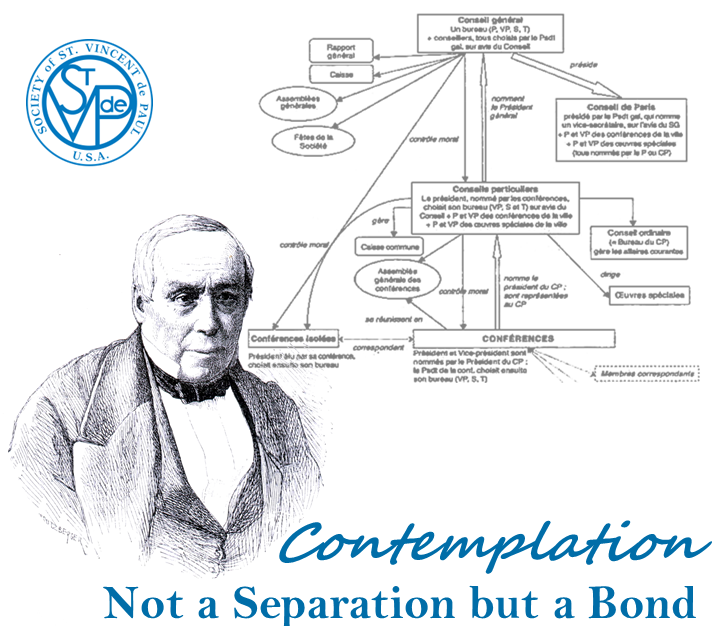
Among the four Permanent Principles of Catholic Social Doctrine is subsidiarity, by which we preserve the dignity of each person, and of each organization by reserving to them the decisions which affect them most directly, and which they can best fulfill. [cf. CSDC, IV] As a faithful Catholic organization, then, it is only logical that “The Society embraces the Principle of Subsidiarity as its basic standard of operation.” [Rule, Part I, 3.9]
This principle is most often invoked to explain the relationship of Conferences to Councils, and Councils to higher level Councils, all the way to the Council General. The first significant addition to the Rule pertained to the addition of Councils, which, it said, existed primarily to provide “unity of direction in important matters, and great freedom for action of each Conference in the details of its works.” [1841 Rule, Ch. II] The current Rule continues to explain the role of Councils in very similar terms.
As then-President-General Bailly explained in 1841, “a Council … is rather a link than a power… to explain or solve the difficulties which arise naturally in a young Society. But all this has been imposed on no one, all is freely accepted, followed, and may be abandoned.” [Bailly, Circ. Ltr. 1841]
Although it can be tempting to view all this as justification to ignore everything our higher Councils recommend to us, a more complete understanding of subsidiarity must include its mutual nature. The word itself derives from the Latin subsidium, meaning “support.” The term was used by Roman armies to refer to forces held in reserve, or reinforcements. The purpose of reinforcements is of course not to consume or command the regular forces, but to strengthen and help them.
While establishing new Conferences in his home city of Lyon in 1836, Frédéric expressed this relationship in a letter to Emmanuel Bailly, explaining that just the first Conference had once benefitted from Bailly’s “advice and example,” it would become the highest priority to enable the new members to have the same benefit by establishing these new Conferences “in union with the society of Paris. Our work here is nascent, but it is living. It is feeble, but it can become strong by preserving its bonds with the mother work.” [135, to Bailly, 1836]
Subsidiarity, then, is not a hierarchy but a union; not a separation but a bond; a mark of neither dependence nor independence, but of “a true and unique worldwide Community of Vincentian friends.” [Rule, Part I, 3.3] As Bailly explained, between Councils and Conferences “there is neither authority nor obedience; there may be deference and advice; there is certainly, above all, charity; there are the same end, the same good works; there is a union of hearts in Jesus Christ our Lord.” [Bailly, Circ. Ltr., 1841]
Contemplate
Does my Conference seek advice and example from its Council? Does my Council offer support and freedom to its Conferences?
Recommended Reading
It is always good to re-read The Rule
Contemplación: No una separación, sino un vínculo
Traducción de Sandra Joya
Entre los cuatro Principios Permanentes de la Doctrina Social Católica se encuentra la subsidiariedad, mediante la cual preservamos la dignidad de cada persona y de cada organización, reservándoles las decisiones que les afectan más directamente y que mejor pueden cumplir. [cf. CSDC, IV] Como organización católica fiel, es lógico que «La Compañía adopte el Principio de Subsidiariedad como su norma básica de funcionamiento». [Regla, Parte I, 3.9]
Este principio se invoca con mayor frecuencia para explicar la relación de las Conferencias con los Consejos, y de estos con los Consejos de nivel superior, hasta llegar al Consejo General. La primera adición significativa a la Regla se refiere a la incorporación de los Consejos, que, según se afirma, existían principalmente para proporcionar «unidad de dirección en asuntos importantes y gran libertad de acción a cada Conferencia en los detalles de sus trabajos». [Regla de 1841, Cap. II] La Regla actual continúa explicando la función de los Consejos en términos muy similares.
Como explicó el entonces Presidente General Bailly en 1841, «un Consejo… es más un vínculo que un poder… para explicar o resolver las dificultades que surgen naturalmente en una Sociedad joven. Pero todo esto no se ha impuesto a nadie; todo se acepta, se sigue y puede abandonarse libremente». [Bailly, Carta Circular 1841]
Aunque puede resultar tentador considerar todo esto como una justificación para ignorar todo lo que nuestros Consejos superiores nos recomiendan, una comprensión más completa de la subsidiariedad debe incluir su naturaleza mutua. La palabra en sí deriva del latín subsidium, que significa «apoyo». El término era utilizado por los ejércitos romanos para referirse a las fuerzas mantenidas en reserva o refuerzos. El propósito de los refuerzos, por supuesto, no es consumir ni comandar las fuerzas regulares, sino fortalecerlas y ayudarlas.
Al fundar nuevas Conferencias en su ciudad natal, Lyon, en 1836, Federico expresó esta relación en una carta a Emmanuel Bailly, explicando que, si bien la primera Conferencia se había beneficiado una vez de los consejos y el ejemplo de Bailly, sería la máxima prioridad permitir que los nuevos miembros obtuvieran el mismo beneficio estableciendo estas nuevas Conferencias «en unión con la sociedad de París. Nuestra obra aquí es incipiente, pero viva. Es débil, pero puede fortalecerse preservando sus vínculos con la obra madre». [135, a Bailly, 1836]
La subsidiariedad, entonces, no es una jerarquía, sino una unión; no es una separación, sino un vínculo; una marca ni de dependencia ni de independencia, sino de «una verdadera y única Comunidad mundial de amigos vicencianos». [Regla, Parte I, 3.3] Como explicó Bailly, entre los Consejos y las Conferencias «no hay autoridad ni obediencia; puede haber deferencia y consejo; sin duda, hay, sobre todo, caridad; hay el mismo fin, las mismas buenas obras; hay unión de corazones en Jesucristo nuestro Señor». [Bailly, Carta Circular, 1841]
Contemplar
¿Mi Conferencia busca el consejo y el ejemplo de su Consejo? ¿Mi Consejo ofrece apoyo y libertad a sus Conferencias?


The bond between Conference and higher Councils is a beautiful way to describe the mutuality of relationship! This is a wonderful correlation of the unity required for subsidiarity to thrive. “One Society” provides the foundational unity upon which subsidiarity is built. Without unity first, there is risk of losing identity as the Society of St Vincent de Paul – in the same way that a river without banks is just water. Thank you, Tim!