• Search the Site

Contemplation: Giving the Carpenter His Due

Contemplation: Giving the Carpenter His Due

Contemplation: Giving the Carpenter His Due 720 491 Tim Williams

Leer en Español

By Timothy P. Williams, Senior Director of Formation and Leadership Development 

Our Rule calls us to humility, but what does that mean for us in practice, both as individuals and as a Society? Humility, of course, is not the same a s secrecy – we are not a secret Society. Nor is humility simply patting ourselves on the back in private. Humility, above all else, is the knowledge that none of this is about us. We’re not the “stars of the movie”. It is “knowing that all that God gives us is for others and that we can achieve nothing of eternal value without His grace.” [Rule, Part I, 2.5.1]

St. Vincent went so far as to say that humility required “self-contempt, considering ourselves the most wretched of all,” and went on to say that we should be “quite pleased to have others preferred to us, either on the missions, or elsewhere, in any ministry whatsoever; or that they succeed better than we do; and we accept that cheerfully for love of Our Lord.” [CCD XII:57]

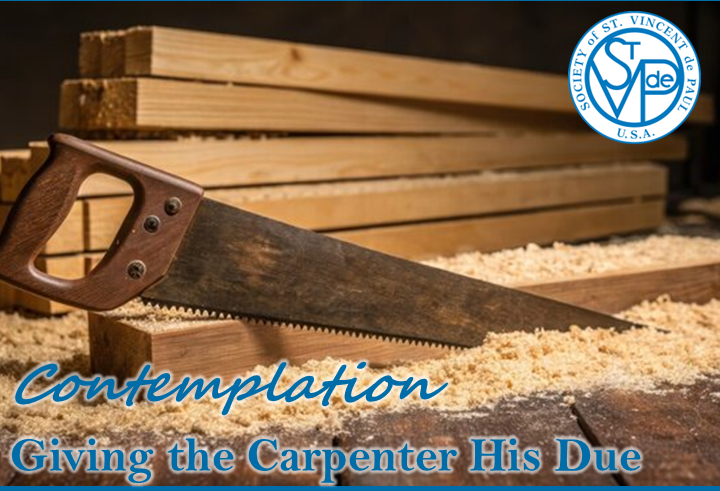
It seems strange, at first, to imagine that we should hold ourselves and our Society in such low esteem. It seems almost to contradict our belief that this is a special calling from God. Yet it is precisely the belief that we are called that demands our humility. We did not choose God, He chose us. Nothing we accomplish is our work, we are only His instruments. We can no more brag about our works than a saw can brag about the straightness of its cut. Like the saw, our success is due completely to the Carpenter.

The original Rule explained that we love our Society “not because of its excellence, or from pride, but as dutiful children love a poor and deformed mother more than all other womenalthough we may be fonder of our little association, we will always consider it as less excellent than others; we will regard it, as in fact it is, but as a work formed nobody knows by whom, nor how – born yesterday, and which may die tomorrow.” [Rule, 1835]

How can we possibly approach the poor as true servants if we cannot see ourselves as less than other organizations, or if we approach our works with an eye toward how others might perceive them? “You will say to me perhaps,” St Vincent said, “What will this court think of us and what will they say about us in Paris? Monsieur, let people think and say whatever they wish.” [CCD II:316]

Vincent often pointed out that Christ’s entire life was an act of humility, and that by his example of sharing in our lowly humanity, he shows us that the way to holiness does not lie in seeking worldly success or praise. By seeing Christ in the neighbor, then, let us also see His example of humility, and when the neighbor, humbled by the circumstances which have caused him to seek help, seems to say by his manner “I am not worthy that you should enter under my roof…” let us answer with humility in return, offering words – God’s words – of love, comfort, and healing.

Contemplate

Do I sometimes allow myself to view our annual reports as a scorecard, or a resumé?

Recommended Reading

Vincentian Meditations II

Contemplación: Dándole al Carpintero lo que le corresponde

Traducción de Sandra Joya

Nuestra Regla nos llama a la humildad, pero ¿qué significa esto en la práctica, tanto como individuos como como Sociedad? Humildad, por supuesto, no es lo mismo que secretismo; no somos una Sociedad secreta. La humildad tampoco es simplemente felicitarnos en privado. La humildad, sobre todo, es saber que nada de esto tiene que ver con nosotros. No somos los protagonistas de la película. Es saber que todo lo que Dios nos da es para los demás y que nada de valor eterno podemos lograr sin su gracia. [Regla, Parte I, 2.5.1]
San Vicente llegó a decir que la humildad requería «autodesprecio, considerándonos los más miserables de todos», y añadió que deberíamos estar «muy contentos de que otros sean preferidos a nosotros, ya sea en las misiones o en cualquier otro lugar, en cualquier ministerio; o que tengan más éxito que nosotros; y lo aceptamos con alegría por amor a Nuestro Señor».  [CCD XII:57]
A primera vista, parece extraño imaginar que debamos tenernos a nosotras mismas y a nuestra Sociedad en tan baja estima. Casi parece contradecir nuestra creencia de que este es un llamado especial de Dios. Sin embargo, es precisamente la creencia de que somos llamadas la que exige nuestra humildad. No elegimos a Dios, Él nos eligió a nosotras. Nada de lo que logramos es obra nuestra; solo somos sus instrumentos. No podemos jactarnos de nuestras obras, como una sierra no puede jactarse de la rectitud de su corte. Al igual que la sierra, nuestro éxito se debe completamente al Carpintero.
La Regla original explicaba que amamos a nuestra Sociedad «no por su excelencia ni por orgullo, sino como los hijos obedientes aman a una madre pobre y deforme más que a todas las demás mujeres… aunque podamos apreciar más nuestra pequeña asociación, siempre la consideraremos menos excelente que otras; la consideraremos, como de hecho es, pero como una obra formada quién sabe por quién ni cómo, nacida ayer y que puede morir mañana».  [Regla, 1835]
¿Cómo podemos acercarnos a los pobres como verdaderos servidores si no podemos vernos inferiores a otras organizaciones, o si abordamos nuestras obras con la mirada puesta en cómo los demás podrían percibirlas? «Quizás me digas», decía san Vicente, «¿Qué pensará de nosotros esta corte y qué dirán de nosotros en París? Señor, que cada uno piense y diga lo que quiera». [CCD II:316]
San Vicente señalaba a menudo que toda la vida de Cristo fue un acto de humildad, y que con su ejemplo de compartir nuestra humilde humanidad, nos muestra que el camino a la santidad no reside en buscar el éxito ni la alabanza mundana. Al ver a Cristo en el prójimo, veamos también su ejemplo de humildad, y cuando el prójimo, humillado por las circunstancias que lo han llevado a buscar ayuda, parezca decir con su actitud: «No soy digno de que entres bajo mi techo…», respondamos con humildad, ofreciendo palabras —las palabras de Dios— de amor, consuelo y sanación.

Contemplar

¿A veces me permito considerar nuestros informes anuales como un cuadro de mando o un currículum?

2 Comments
  • The year end report is much more than a score card..You don’t put a light under a basket.. Our benefactors have the right to know what we are doing with their donations and also the amount of need…It is also a health chart of the conference. Number of Vincentians active. Are we responding to the easy calls? Food and thrift store items.. There Report needs to cover all activities of the conference…. Does the conference join in a prayer of Thanksgiving for what is received or offer a Bible and literature 10 most asks questions about the. Catholic Faith…. Are we Christians? Yes it is a score card hopefully the Pastor is proud to share with the Parish on St Vincents DePaul’s feast day..

    • Thank you for sharing your thoughts, and YES, annual reports are essential to accountability. Honoring the intent of our benefactors, St Vincent said, is a matter of justice. So, of course, we should always keep careful and transparent records. What we need to avoid, though, is ever allowing ourselves to view the numbers as records of accomplishment. As Frederic once put it, these reports “are not statistical documents where success is defined in prideful numbers.”

      No amount of money or bread can equal the love of God, which we seek to share first and foremost through the personal relationships we form with the neighbor. If we allow ourselves to lose sight of this, to become enamored with “prideful numbers”, and to ask others outside the Society to judge us in that way, then ours will no longer be works of charity. After all, Amazon can deliver bread more efficiently than we can, but “Charity does not consist so much in the distributing of bread as in the manner it is distributed.”

      In humble gratitude for having been called by God to this work, we must never forget that any good that comes from it is due to Him, not to our feeble efforts.

      “We’re mistaken,” St Vincent taught, “if we base the outcome of our little works on worldly esteem; that’s attaching ourselves to the shadow and leaving the body behind.”

Sign Up for Our Newsletter

Privacy Preferences

When you visit our website, it may store information through your browser from specific services, usually in the form of cookies. Here you can change your Privacy preferences. It is worth noting that blocking some types of cookies may impact your experience on our website and the services we are able to offer.

Click to enable/disable Google Analytics tracking code.
Click to enable/disable Google Fonts.
Click to enable/disable Google Maps.
Click to enable/disable video embeds.
Our website uses cookies, mainly from 3rd party services. Define your Privacy Preferences and/or agree to our use of cookies.
Skip to content