
By Timothy P. Williams, Senior Director of Formation and Leadership Development
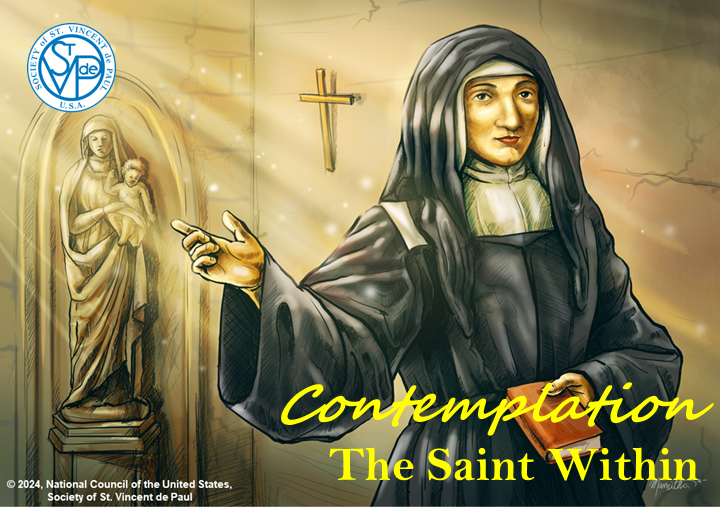
St. Louise de Marillac is often presented as a woman who is very anxious and unsure, is easily upset and indecisive, and who needs constant guidance from St. Vincent de Paul. Yet Louise was a natural leader, a gift that Vincent recognized very early in their relationship. She was well-educated in theology, had a deep and mystical spirituality, wrote beautifully about the faith, and acted as a spiritual guide for many, especially the Daughters of Charity. Under Canon Law, it was Vincent who formally founded the Daughters, but we know from their correspondence that the company was Louise, the co-founder’s original vision. So why do we keep hearing that misleading characterization?
The answer, as with so many misjudgments we make about people we encounter, lies in the context. Louise and Vincent exchanged many letters during their 35-year relationship. They were truly friends, with deep mutual respect. Their correspondence often discussed the “business” of their many works of charity, but the letters that touch us most deeply, and seem to reveal more of both personalities, are the ones not between two leaders of religious communities, but between Louise and her Spiritual Director.
In a relationship with a Spiritual Director, we reveal our deepest anxieties, our uncertainties, and our weaknesses. We seek the guidance of that director, sometimes referred to as a “confessor” in order to grow. The letters are both personal and true, giving us wonderful insights into these saints whom we love. Imagine, though, if a stranger seeking to learn more about you were to read all that you have revealed in the confessional, or in intimate conversations with very close friends and family members.
In a similar way, we encounter neighbors who are, at the time they call us, often in a desperate bind, sometimes facing consequences of their own decisions, and struggling with both financial and emotional burdens. If that were all we knew about them, if our encounter ended with a phone call, or a mailed-in application, how much of their full stories would we miss? How quickly might we leap to judgment, unintentionally betraying the trust they’ve shown by confiding to us their personal crisis?
It is for this reason that we visit the neighbor, person-to-person, forming “relationships based on trust and friendship”. We try to “understand them as we would a brother or sister”, like the family members who confide in us, cry on our shoulders, and whom we love and appreciate. [Rule, Part I, 1.9] Like Louise, they are much more than the sum of their weaknesses. They trust us with what Frédéric called the “secret of [their] lonely heart and troubled mind.” [Baunard, 279]
There are other saints who ensured that their personal writings were not preserved after their death. Saint Louise, by revealing to us both her weakness and her holiness, reminds us to seek the holiness within all of our neighbors – and ourselves.
Contemplate
How can I better see past the crisis on the surface to find the saint within?
Recommended Reading
Get to know Louise through some of her Spiritual Writings.
Contemplación: La Santa Interior
Traducción de Sandra Joya
Santa Luisa de Marillac suele ser presentada como una mujer muy ansiosa e insegura, que se alteraba fácilmente y era indecisa, y que necesitaba la guía constante de San Vicente de Paúl. Sin embargo, Luisa era una líder nata, un don que Vicente reconoció desde el principio de su relación. Tenía una sólida formación teológica, una profunda espiritualidad mística, escribía con gran belleza sobre la fe y fue guía espiritual para muchos, especialmente para las Hijas de la Caridad. Según el Derecho Canónico, fue Vicente quien fundó formalmente las Hijas, pero sabemos por su correspondencia que la empresa fue la visión original de Luisa, la cofundadora. Entonces, ¿por qué seguimos escuchando esa descripción engañosa?
La respuesta, como ocurre con tantos juicios erróneos que hacemos sobre las personas que conocemos, reside en el contexto. Luisa y Vicente intercambiaron mucha correspondencia durante sus 35 años de relación. Eran verdaderos amigos, con un profundo respeto mutuo. Su correspondencia a menudo trataba sobre el “asunto” de sus numerosas obras de caridad, pero las cartas que nos conmueven más profundamente y parecen revelar más de ambas personalidades son las que se intercambian no entre dos líderes de comunidades religiosas, sino entre Luisa y su Director Espiritual.
En la relación con un Director Espiritual, revelamos nuestras más profundas ansiedades, incertidumbres y debilidades. Buscamos la guía de ese director, a veces llamado “confesor”, para crecer. Las cartas son personales y sinceras, y nos brindan una maravillosa perspectiva de estos santos a quienes amamos. Imaginen, sin embargo, si un desconocido que busca saber más sobre ustedes leyera todo lo que han revelado en el confesionario o en conversaciones íntimas con amigos y familiares muy cercanos.
De manera similar, nos encontramos con vecinos que, al llamarnos, a menudo se encuentran en una situación desesperada, a veces enfrentando las consecuencias de sus propias decisiones y lidiando con cargas financieras y emocionales. Si eso fuera todo lo que supiéramos de ellos, si nuestro encuentro terminara en una llamada telefónica o una solicitud por correo, ¿cuánto de sus historias completas nos perderíamos? ¿Con qué rapidez podríamos juzgarlos precipitadamente, traicionando sin querer la confianza que nos han demostrado al confiarnos su crisis personal?
Por eso visitamos al prójimo, de persona a persona, forjando relaciones basadas en la confianza y la amistad. Intentamos comprenderlos como a un hermano o una hermana, como a los familiares que confían en nosotros, lloran en nuestros hombros y a quienes amamos y apreciamos. [Regla, Parte I, 1.9] Como Luisa, son mucho más que la suma de sus debilidades. Nos confían lo que Federico llamó el «secreto de [su] corazón solitario y su mente atribulada». [Baunard, 279]
Hay otros santos que se aseguraron de que sus escritos personales no se conservaran después de su muerte. Santa Luisa, al revelarnos tanto su debilidad como su santidad, nos recuerda que debemos buscar la santidad en nuestro prójimo y en nosotros mismos.
Contemplar
¿Cómo puedo ver mejor más allá de la crisis superficial para encontrar la santidad interior?


Very insightful! I appreciate knowing that about St. Louise. St. Teresa of Calcutta is another Saint who left us with reflections on her “weaknesses”.
When we have/take the time to hear our friends’ stories, we get a deeper understanding and appreciation of them and their experiences.
God bless you for all you do to share Christ’s love in our ministry.