By Timothy P. Williams, Senior Director of Formation and Leadership Development
When our personal efforts pay off with the results we’d hoped for, we naturally feel a sense of exhilaration, and even pride in our accomplishment. We pat ourselves on the back a little bit, hang a certificate on the wall, or put a trophy on a shelf. We tend to do the same thing collectively, too, when the group we are part of tallies up the results of our work. As part of the group, we feel as if we all share the credit. But does this sort of pride advance our mission in the Society of St. Vincent de Paul?
Blessed Frédéric, reporting on the early works of the Conferences in Lyon, noted that the results were “modest, but fortunate”, quickly adding that “We can build our hope only on the foundation of God’s blessing, on the support of our patron saint, and on our alliance with each other.” [1361, Report, 1837] In other words, no good results are possible without God’s blessing, Vincent’s intercession, and our commitment to work together. We are responsible for what we put into it – to God alone goes the credit of any achievement that results.
Vincent often reminded his followers that their very organization was entirely the work of God. “It wasn’t [Louise]; she didn’t think of it!. As for me, alas! it never occurred to me.” [CCD IX:358] The Daughters of Charity, the Congregation of the Mission, and we, the Society of St Vincent de Paul, are not the authors of our works. We are only humbly answering God’s call to do His work, and if we are committed to doing His will, we can have faith that the results will also be His will, and therefore entirely to His credit, not our own.
Advising his younger cousin Ernest Falconnet’s, Frédéric explained that “one must not make a goal of [glory], but instead accept it as a blessing” for “the good man does not spread word of his good deed to gain recognition”. [32, to Falconnet, 1831] Humility demands of us that we never lose sight of God’s grace, which alone is responsible for any good we may achieve. This applies both individually and collectively.
Vincent once recalled that his mentor, St. Francis de Sales, renowned for his writing and his preaching, recognized that even his great personal gifts were not to his own credit. He recalled Francis saying, “I noticed…that something went out from me, not through any inspiration of mine and with no forethought, in a way of which I am totally ignorant, but uttered by me through divine impulse.” [CCD XIIIa:82]
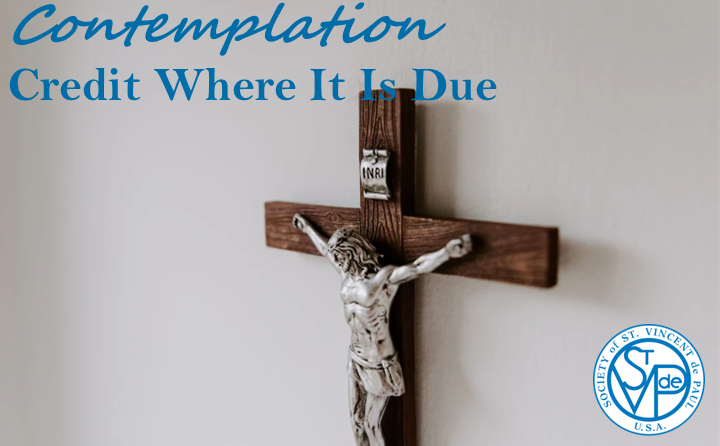
Like Francis de Sales, “Vincentians seek to draw closer to Christ. They hope that someday it will be no longer they who love, but Christ who loves through them.” [Rule, Part I, 2.1] The closer we come to this ideal, the less we will need to remind ourselves that it is He, not us, who alone is responsible for all the good we may do. We claim no glory for ourselves, but if it is Christ who loves through us, then the only reminder of glory we need on our walls is the crucifix through which our eternal reward is earned.
Contemplate
Am I content to participate with quiet gratitude in God’s work?
Recommended Reading
Contemplación: Reconocimiento merecido
Traducción de Sandra Joya
Cuando nuestros esfuerzos personales dan los frutos que esperábamos, naturalmente sentimos una gran alegría, e incluso orgullo por nuestro logro. Nos felicitamos a nosotros mismos, colgamos un certificado en la pared o colocamos un trofeo en una estantería. Solemos hacer lo mismo colectivamente, cuando el grupo al que pertenecemos evalúa los resultados de nuestro trabajo. Como parte del grupo, sentimos que todos compartimos el mérito. Pero, ¿este tipo de orgullo contribuye a nuestra misión en la Sociedad de San Vicente de Paúl?
El Beato Federico, al informar sobre las primeras obras de las Conferencias en Lyon, señaló que los resultados eran «modestos, pero afortunados», añadiendo rápidamente que «Solo podemos fundamentar nuestra esperanza en la bendición de Dios, en el apoyo de nuestro santo patrón y en nuestra unión entre nosotros». [1361, Informe, 1837] En otras palabras, no es posible obtener buenos resultados sin la bendición de Dios, la intercesión de San Vicente y nuestro compromiso de trabajar juntos. Somos responsables de lo que aportamos; solo a Dios corresponde el mérito de cualquier logro que se obtenga.
San Vicente recordaba a menudo a sus seguidores que su organización era enteramente obra de Dios. «No fue [Luisa]; ¡ella no pensó en ello! En cuanto a mí, ¡ay!, nunca se me ocurrió». [CCD IX:358] Las Hijas de la Caridad, la Congregación de la Misión y nosotros, la Sociedad de San Vicente de Paúl, no somos los autores de nuestras obras. Solo respondemos humildemente al llamado de Dios para hacer su obra, y si estamos comprometidos a cumplir su voluntad, podemos tener fe en que los resultados también serán su voluntad y, por lo tanto, el mérito será enteramente suyo, no nuestro.
Al aconsejar a su primo menor, Ernest Falconnet, Federico le explicó que «no se debe buscar la gloria como un fin, sino aceptarla como una bendición», porque «el hombre bueno no divulga sus buenas acciones para obtener reconocimiento». [32, a Falconnet, 1831] La humildad nos exige que nunca perdamos de vista la gracia de Dios, que es la única responsable de cualquier bien que podamos lograr. Esto se aplica tanto individual como colectivamente. Vincent recordó una vez que su mentor, San Francisco de Sales, reconocido por sus escritos y su predicación, reconocía que incluso sus grandes dones personales no eran mérito propio. Recordó que Francisco decía: «Me di cuenta de que algo emanaba de mí, no por inspiración mía ni con premeditación, de una manera que desconozco por completo, sino que lo expresaba por impulso divino». [CCD XIIIa:82]
Al igual que Francisco de Sales, «los vicentinos buscan acercarse a Cristo. Esperan que algún día ya no sean ellos quienes amen, sino Cristo quien ame a través de ellos». [Regla, Parte I, 2.1] Cuanto más nos acerquemos a este ideal, menos necesitaremos recordarnos que es Él, y no nosotros, el único responsable de todo el bien que podamos hacer. No buscamos la gloria para nosotros mismos, pero si es Cristo quien ama a través de nosotros, entonces el único recordatorio de gloria que necesitamos en nuestras paredes es el crucifijo, a través del cual se obtiene nuestra recompensa eterna.
Contemplar
¿Me conformo con participar con humilde gratitud en la obra de Dios?