By Timothy P. Williams, Senior Director of Formation and Leadership Development
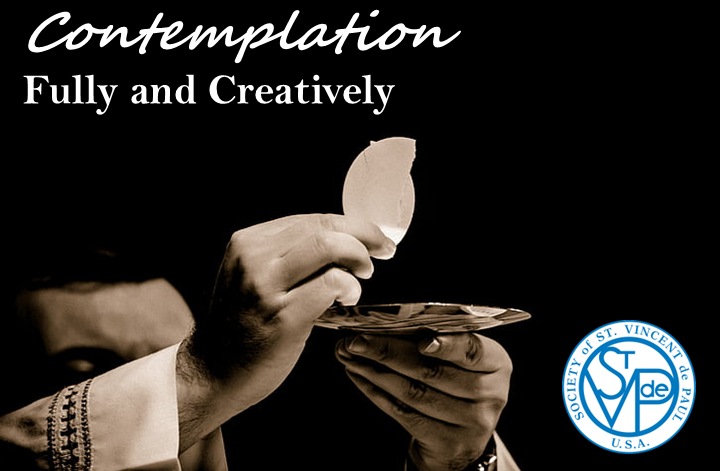
“Love,” St. Vincent taught, “is inventive even to infinity.” Vincent’s example in this observation was the ultimate example of both love and creativity, the institution of the Eucharist by Jesus, who recognized that “His absence could cause some forgetfulness or cooling off in our hearts”, and so He ensured His continued presence among us. [CCD XI:139] Throughout time, we are regularly invited to partake of Him, to join with Him physically and spiritually; to be in communion.
This communion unites us with Christ’s entire body, the body of the church, comprised of all the faithful. Communion unites us with Jesus and with each other. Blessed Frédéric reflected on this effect of the sacrament, saying to one friend that “when I have not been able to be with you…I have found you at the altar. I believe firmly that when I am receiving, I am in close touch with my friends, all united to the same Savior.” [Baunard, 381] When we receive Communion, we are never alone – we are in communion.
Yet, our friends and family here on earth do not comprise the full body of the church. As St. Louise explained, “Holy Communion with the Body of Jesus Christ causes us truly to participate in the joy of the Communion of Saints in Paradise.” [SWLM, A.15] As Frédéric recognized, that “mysterious connection that the Church calls the communion of saints” reminds us ”that our beloved dead do not forget us any more than we forget them, that they think of us, love us, pray for us, that perhaps they walk with us as invisible guardians.” [1353, to La Perrière, 1836]
After the death of his mother, he said that when receiving Communion, “it seems to me that she follows Him into my poor heart… Then I firmly believe in the actual presence of my mother by my side.” [Baunard, 158] Indeed, the Catechism teaches that “The communion of saints must be understood as the communion of the sacraments…. the name ‘communion’ can be applied to all of them, for they unite us to God…. But this name is better suited to the Eucharist than to any other….” [CCC, 950] In turn, the Eucharist compels us to share ourselves generously with the neighbor, just as Frédéric did, visiting the homes of the poor after Mass. “He thus returned to Our Lord,” his biographer wrote, “in the person of His suffering poor, the visit which he had just received from Him in the Holy Eucharist.” [Baunard, 209]
Our Rule, explaining our journey together towards holiness, especially notes our “devotion to the Eucharist”. [Rule, Part I, 2.2] How could it be otherwise? We are the body of Christ, and in receiving the body of Christ in the sacrament, we are united in in faith, united in love, united in the sacraments, united with the Father, Son, and Holy Spirit, and finally, we are united with the ones Christ came especially to serve and to bless, so that we, too, may devote ourselves to them fully and creatively.
Contemplate
How often does my Conference receive the Eucharist together?
Recommended Reading
Contemplación: Plena y Creativa
Traducción de Sandra Joya
“El amor”, enseñaba San Vicente, “es inventivo hasta el infinito”. El ejemplo de Vicente en esta observación fue el máximo exponente de amor y creatividad: la institución de la Eucaristía por Jesús, quien reconoció que “su ausencia podía causar olvido o enfriamiento en nuestros corazones”, y por ello aseguró su presencia continua entre nosotros. [CCD XI:139] A lo largo de la historia, se nos invita regularmente a participar de Él, a unirnos a Él física y espiritualmente; a estar en comunión.
Esta comunión nos une a todo el cuerpo de Cristo, el cuerpo de la Iglesia, compuesto por todos los fieles. La comunión nos une a Jesús y entre nosotros. El beato Federico reflexionó sobre este efecto del sacramento, diciéndole a un amigo: “Cuando no he podido estar contigo… te he encontrado en el altar. Creo firmemente que cuando recibo, estoy en estrecho contacto con mis amigos, todos unidos al mismo Salvador”. [Baunard, 381] Cuando recibimos la Comunión, nunca estamos solos; estamos en comunión.
Sin embargo, nuestros amigos y familiares aquí en la tierra no constituyen el cuerpo completo de la Iglesia. Como explicó Santa Luisa: «La Sagrada Comunión con el Cuerpo de Jesucristo nos hace participar verdaderamente de la alegría de la Comunión de los Santos en el Paraíso». [SWLM, A.15] Como reconoció Federico, esa «misteriosa conexión que la Iglesia llama la comunión de los santos» nos recuerda «que nuestros difuntos queridos no nos olvidan más de lo que nosotros los olvidamos, que piensan en nosotros, nos aman, rezan por nosotros, que quizás caminan con nosotros como guardianes invisibles». [1353, a La Perrière, 1836]
Tras la muerte de su madre, dijo que al recibir la Comunión, «me parece que ella lo sigue en mi pobre corazón… Entonces creo firmemente en la presencia real de mi madre a mi lado». [Baunard, 158] De hecho, el Catecismo enseña que «La comunión de los santos debe entenderse como la comunión de los sacramentos… El nombre ‘comunión’ puede aplicarse a todos ellos, pues nos unen a Dios… Pero este nombre se adapta mejor a la Eucaristía que a cualquier otro…». [CIC, 950] A su vez, la Eucaristía nos impulsa a compartirnos generosamente con el prójimo, como lo hizo Federico al visitar los hogares de los pobres después de la Misa. «Devolvió así a Nuestro Señor —escribió su biógrafo—, en la persona de sus pobres sufrientes, la visita que acababa de recibir de Él en la Sagrada Eucaristía». [Baunard, 209]
Nuestra Regla, al explicar nuestro camino juntos hacia la santidad, destaca especialmente nuestra «devoción a la Eucaristía». [Regla, Parte I, 2.2] ¿Cómo podría ser de otra manera? Somos el cuerpo de Cristo, y al recibir el cuerpo de Cristo en el sacramento, nos unimos en la fe, en el amor, en los sacramentos, con el Padre, el Hijo y el Espíritu Santo, y, finalmente, con aquellos a quienes Cristo vino especialmente a servir y bendecir, para que también nosotros podamos dedicarnos a ellos plena y creativamente.
Contemplar
¿Con qué frecuencia mi Conferencia recibe la Eucaristía juntos?