
By Timothy P. Williams, Senior Director of Formation and Leadership Development
The parable of the good Samaritan is a favorite among Vincentians, depicting, as it does, the personal encounter between the wounded victim lying by the side of the road and the traveler who stops to personally help. The Samaritan is exactly the model we seek to follow in our vocation, obedient to the words of our Savior, who calls us to “go and do likewise.”
Blessed Frédéric himself analogized our calling to the calling of the Samaritan, likening the victim to “the humanity of our days…attacked by the kidnappers and robbers of thought, by wicked men who have robbed it of what it possessed: the treasure of faith and love.” [90, to Curnier, 1835] The neighbor, he saw, would not always exhibit such obvious needs as the bloodied victim lying in a ditch. How does one look, after all, when robbed of the treasure of faith?
More importantly, how do we approach this victim? For Frédéric, our approach to healing the wounds had to be accompanied by “words of consolation and peace”. [Ibid] Only our gentleness and love can help him move past the fear that separates him from his neighbors and from hope. Sometimes, those gentle words are all that is really needed.
Members of the Society of St. Vincent de Paul in Paris regularly participate in what they call “maraudes”, which are visits to the homeless, whose tents and blankets line the banks of the Seine, and seem to occupy every other doorway once the businesses close for the night. Although the Vincentians bring with them soup, blankets and other comforts to offer, the people often decline. What they do not decline, though, is the opportunity to talk to somebody.
In his exegesis of the parable of the good Samaritan in the encyclical Fratelli Tutti, Pope Francis suggests that “only two kinds of people: those who care for someone who is hurting and those who pass by; those who bend down to help and those who look the other way and hurry off.” [FT, 70] For the homeless in Paris, or any large city, there is no shortage of those who look the other way, or don’t take our eyes off of our phones as we hurry past. But in the evening hours, dedicated Vincentians walk the streets, finding the most marginalized not by accident, but instead by striving to “seek out and find those in need and the forgotten, the victims of exclusion or adversity.” [Rule, Part I, 1.5]
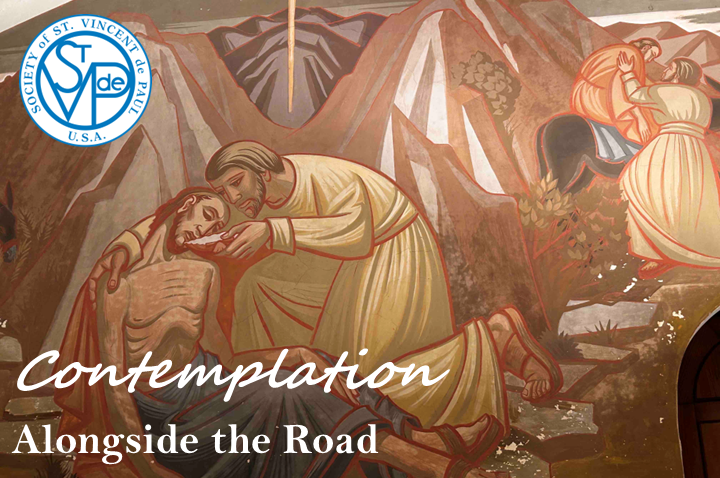
On the wall of the crypt in which Frédéric Ozanam is entombed is a mural of the parable of the good Samaritan. In it, the Samaritan is Ozanam. While the poor may always be with us, the face and the circumstances of poverty are constantly changing. The robbers’ victim in Christ’s parable lay along the side of the road to Jericho. May the depiction of Frédéric as the Samaritan remind us that the road beside which the poor lie is the one we walk together; it is our Vincentian Pathway.
Contemplate
Do I look to the margins, or do I hurry past?
Recommended Reading
Contemplación: Junto al Camino
Traducción de Sandra Joya
La parábola del buen samaritano es una de las favoritas entre los vicencianos, pues describe el encuentro personal entre la víctima herida que yace al borde del camino y el viajero que se detiene para ayudarla. El samaritano es precisamente el modelo que buscamos seguir en nuestra vocación, obedientes a las palabras de nuestro Salvador, quien nos llama a «ir y hacer lo mismo».
El propio Beato Federico comparó nuestra vocación con la del samaritano, comparando a la víctima con «la humanidad de nuestros días… atacada por los secuestradores y ladrones del pensamiento, por hombres malvados que la han despojado de lo que poseía: el tesoro de la fe y el amor». [90, a Curnier, 1835] Vio que el prójimo no siempre exhibiría necesidades tan evidentes como la víctima ensangrentada que yace en una zanja. ¿Cómo se ve uno, después de todo, cuando se le roba el tesoro de la fe?
Y lo que es más importante, ¿cómo nos acercamos a esta víctima? Para Frédéric, nuestra forma de sanar las heridas debía ir acompañada de palabras de consuelo y paz. [Ibíd.] Solo nuestra dulzura y amor pueden ayudar a superar el miedo que lo separa de su prójimo y de la esperanza. A veces, esas palabras de cariño son todo lo que realmente se necesita.
Los miembros de la Sociedad de San Vicente de Paúl en París participan regularmente en lo que llaman “maraudes”, que son visitas a las personas sin hogar, cuyas tiendas y mantas bordean las orillas del Sena y parecen ocupar casi cualquier puerta una vez que los negocios cierran por la noche. Aunque los vicentinos llevan sopa, mantas y otros consuelos, la gente a menudo rechaza la invitación. Sin embargo, lo que no rechazan es la oportunidad de hablar con alguien.
En su exégesis de la parábola del buen samaritano en la encíclica Fratelli Tutti, el papa Francisco sugiere que “solo hay dos tipos de personas: quienes cuidan a alguien que sufre y quienes pasan de largo; quienes se inclinan para ayudar y quienes miran hacia otro lado y se apresuran a irse”. [FT, 70] Para las personas sin hogar en París, o en cualquier gran ciudad, no faltan quienes miran hacia otro lado o no aparten la vista del teléfono mientras pasamos a toda prisa. Pero al anochecer, los Vicentinos dedicados a recorrer las calles, encontrando a los más marginados no por casualidad, sino esforzándose por «buscar y encontrar a los necesitados y a los olvidados, a las víctimas de la exclusión o la adversidad». [Regla, Parte I, 1.5]
En el muro de la cripta donde se encuentra Federico Ozanam se encuentra un mural de la parábola del buen samaritano. En él, el samaritano es Ozanam. Si bien los pobres siempre nos acompañan, el rostro y las circunstancias de la pobreza cambian constantemente. La víctima de los ladrones en la parábola de Cristo yacía junto al camino a Jericó. Que la representación de Federico como el samaritano nos recuerde que el camino junto al cual yacen los pobres es el que recorremos juntos; es nuestro Camino Vicentino.
Contemplar
¿Miro hacia los márgenes o me apresuro a pasar de largo?