
• Search the Site

Posts By :

admin

Contemplation: Erasing the Old Divisions

Contemplation: Erasing the Old Divisions 1080 1080 admin

By Timothy Williams, Senior Director of Formation and Leadership Development 

Describing the Conference of History, the group in which the Society’s founders first bonded, Frédéric Ozanam explained that all subjects were debated, except that “the tumultuous realm of politics is foreign to our discussions.” [54, to Falconnet, 1833] The Society, in our first Rule, adopted this as a founding principle, saying that we should “banish political discussions forever from our meetings” just as St. Vincent had, and “should abstain from being inflamed by political leanings which array parties in opposition,” concluding that “Our Society is all charity: politics are wholly foreign to it.” [Rule,1835]

Frédéric, who once ran for political office, always recognized religion had greater power than politics; how much more could be accomplished through devotion to God than to the questions that divide us. Indeed, his vision for the Society was of “a community of faith and works erasing little by little the old divisions of political parties” comprised of members with “the unanimous resolve to make it a moral country and to become better themselves in order to make others happier.” [290, to Amelie, 1841]

Frédéric never shied away from debate, but as he put it himself, “I am less qualified than almost any other, to deal with those questions which are agitating men’s minds! I mean questions of labour, wages, commerce, administration…” [Baunard, 259] His personal advocacy focused instead on what our present-day Rule calls our “distinctive approach” to see issues “from the perspective of those we visit.” [Rule, Part I, 7.4] As friends of the poor, our advocacy concerns itself with enlightening our fellow citizens on the conditions of our friends, encouraging them to help individually, and as communities.

Our human nature leads us to see our own times as uniquely polarized, but the passions of politics have led to angry disputes and even civil wars in all ages. Frédéric saw that “the faith suffers from that alliance with the political interests and passions.” [211, to Lacordaire, 1839] He believed that “abandoning political doctrines to their own consequences and people to their passions, God wants to teach us to take our trust back from people and their doctrines…” [200, to Bailly, 1839] Catholic Social Doctrine lays out the goals, not the means. It acknowledges natural political disagreements that exist among people of good will but calls us to seek common ground in order to do the good that can be done. The Society seeks not to win the argument, but to represent the common ground – the civilization of love.

We are concerned with worldly matters, of course, or we wouldn’t feed the hungry, or shelter the homeless, but just as the hope in which we serve is much greater and more powerful than merely the hope of paying bills, let us also resolve with Blessed Frédéric that “Amid the philosophical and political schools that sow division in the mind and turmoil in the heart, may the Society we belong to become a great school unconcerned with the irritating issues of this world, where those who once fought come together to know and love one another, where we learn but one thing, something understandable, acceptable, and amenable to all, something admirably simple and yet infinite, eternal as the God it comes from. And by this we do mean charity!” [1378, Gen’l Assembly, 1839]

Contemplate

Do I always seek common ground with fellow Vincentians in our friendship, service, and spirituality?

Recommended Reading

Antoine Frédéric Ozanam


Contemplación : Borrando Las Veijas Divisiones

Traducción de Sandra Joya

Al describir la conferencia de Historia, el grupo en el que se reunieron por primera vez los fundadores de la Sociedad, Federico Ozanam explicó que se debatían todos los temas, excepto que, ” el tumultuoso reino de la política es ajeno a nuestras discusiones” (54, a Falconnet, 1833) La Sociedad en nuestra primera Regla, adoptó esto cómo principio fundador, diciendo, que debíamos ” desterrar para siempre las discusiones politicas de nuestras reuniones” tal como lo hizo San Vicente, y ” deberíamos abstenernos de ser inflamados por inclinaciones políticas que colocando a los partidos en oposición ” concluyendo que ” Nuestra Sociedad es toda Caridad: la politica le es completamente ajena ” (Regla, 1835)

Federico, que una vez se presentó a un cargo politico, siempre reconoció que la religión tenía mayor poder que la politica ¿ Cuánto más se podría lograr a través de la devoción a Dios que a las cuestiones que nos dividen? De hecho, su visión para la compañía era la de “una comunidad de fe y de obras que borrara poco a poco las antiguas divisiones de los partidos politicos” compuesta por miembros con ” la resolución unánime de hacer de ella un país moral y de mejorar ellos mismos para hacer más felices a los demás “, (290, una Amelia, 1841)

Federico nunca rehuyó el debate, pero como él mismo lo expresó ” estoy menos calificado que casi cualquier otro para tratar esas cuestiones que agitan las mentes de los hombres. Me refiero a cuestiones de trabajo,salarios,comercio,administración…” (Baunard, 259) Su defensa personal se centró, en cambio en lo que nuestra Regla actual llama Nuestro ” enfoque distintivo” de ver los problemas ” desde la perspectiva de aquellos a quienes visitamos”, (Regla Parte 1: 7.4) como amigos de los Pobres, nuestra defensa se ocupa de ilustrar a nuestros conciudadanos, sobre las condiciones de nuestros amigos, alentandonos a ayudar individualmente y como comunidades.

Nuestra naturaleza humana, nos lleva a ver nuestros propios tiempos como singularmente polarizados,pero las pasiones politicas han llevado a disputas furiosas e incluso a guerras civiles en todas las épocas. Federico vio que ” la fe sufre por esa alianza con los intereses y pasiones politicas ” ( 211, a Lacordaire, 1839) creía que ” al abandonar las doctrinas politicas a sus propias consecuencias y a las personas a sus pasiones, Dios quiere enseñarnos a retirar nuestra confianza de las personas y sus doctrinas….”(200, a Bailly, 1839) La Doctrina Social Católica establece los objetivos, no los medios. Reconoce los desacuerdos politicos naturales que existen entre las personas de buena voluntad, pero no busca ganar la discusión, sino representar el terreno común : la civilización del amor.

Por supuesto, nos preocupan los asuntos mundanos, o no alimentariamos a los hambrientos, ni daríamos cobijo a los sin techo, pero así como la esperanza en la que servimos es mucho mayor y más poderosa que la nueva esperanza de pagar las cuentas, resolvamos también con el Beato Federico que ” En medio de las escuelas filosóficas y politicas que siembran división en la mente y confusión en el corazón , que la Sociedad a la que pertenecemos se ubica en una gran escuela despreocupada de los problemas irritantes de este mundo, donde los que una vez lucharon se reunieron para conocerse y amarse mutuamente, donde aprenderemos una sola cosa, algo comprensible, aceptable y agradable para todos, algo admirablemente sencillo, y, sin embargo, infinito, eterno como el Dios del que proviene ¡ Y con esto queremos decir caridad! (1378, Asamblea General, 1839)

Contemplar 

¿Siempre busca puntos en común con otros Vicentinos en nuestra Amistad, Servicio y Espiritualidad?

2-13-25 Weekly Questions & Answers

2-13-25 Weekly Questions & Answers 1200 628 admin

February 13, 2025

Q: Are members allowed to use any of the Society’s resources (food, clothing, etc.) for their own personal use?

A: In every set of nationally approved bylaws, the following paragraph exists:
Compensation: “No part of the property belonging to this entity, nor its net earnings or income shall ever inure to the benefit of any member or individual, or any person having a personal or private interest in the activities of the entity. There shall be no fee or honorarium for Conference service beyond reimbursement of expenses.” One example of the above is that members cannot receive a financial benefit from their involvement in the works of the Society. Some people think this refers to money only, but it does not. It refers to any resources that belong to the Society. Whether it is food, clothing, furniture, medications, or money, the members of the Society are not to take any for their personal use. The fact is that the members are not to benefit from the availability of any resources purchased or received as donations for the needy. For example, a member or volunteer may not take merchandise donated to a store for their own personal use. Another example, a member cannot go to the Conference food pantry and simply take food for their own use or use Conference gift vouchers to get things for their personal use. This also refers to using the Society’s name or accounts in order to acquire something that will benefit an individual member. For example, a member cannot go to a food bank and under the name of St. Vincent de Paul purchase food for their own use.

Q: Can you provide your advice and guidance regarding a Conference’s desire to open a credit card account? The Conferences share the same taxpayer ID as the Council.

A: This falls under the realm of a Council decision. With the Conference using the Council’s EIN, the Council is in a “doing business as…” relationship with the Conference. Technically, the Council is the legal entity; so, use of the credit card places an ultimate obligation on the Council.


13 de Febrero

P: ¿Se les permite a los miembros usar cualquiera de los recursos de la Sociedad (alimentos, ropa, etc.) para su uso personal?

R: En cada conjunto de Estatutos aprobados a nivel nacional, existe el siguiente párrafo:
Compensación: “Ninguna parte de la propiedad que pertenezca a esta entidad, ni sus ganancias o ingresos netos redundarán en beneficio de ningún miembro o individuo, ni de ninguna persona que tenga un interés personal o privado en las actividades de la entidad. No habrá ninguna cuota ni honorarios por los servicios prestados por la Conferencia, más allá del reembolso de los gastos.” Un ejemplo de lo anterior es que los miembros no pueden recibir un beneficio financiero por su participación en los trabajos de la Sociedad. Algunas personas piensan que esto se refiere solo al dinero, pero no es así. Se refiere a cualquier recurso que pertenezca a la Sociedad. Ya sea comida, ropa, muebles, medicinas o dinero, los miembros de la Sociedad no deben tomar nada para su uso personal. El hecho es que los miembros no deben beneficiarse de la disponibilidad de ningún recurso comprado o recibido como donaciones para los necesitados. Por ejemplo, un miembro o voluntario no puede llevar mercancía donada de una tienda para su uso personal. Otro ejemplo, un miembro no puede ir a la despensa de alimentos de la Conferencia y simplemente tomar comida para su propio uso o usar los vales de regalo de la Conferencia para obtener cosas para su uso personal. Esto también se refiere al uso del nombre o las cuentas de la Sociedad con el fin de adquirir algo que beneficiará a un miembro individual. Por ejemplo, un miembro no puede ir a un banco de alimentos y bajo el nombre de San Vicente de Paúl comprar alimentos para su propio uso.

P: ¿Puede proporcionar su consejo y orientación con respecto al deseo de una Conferencia de abrir una cuenta de tarjeta de crédito? Las Conferencias comparten el mismo número de identificación fiscal que el Consejo.

R: Esto entra en el ámbito de una decisión del Consejo. Con la Conferencia utilizando el EIN del Consejo, el Consejo se encuentra en una situación de “hacer negocios como…” con relación con la Conferencia. Técnicamente, el Consejo es la entidad jurídica; por lo tanto, el uso de la tarjeta de crédito impone finalmente una obligación al Consejo

Feature: Voice for the Poor

Feature: Voice for the Poor 2560 1755 admin

Be a Voice for the Poor

By Steve Uram, National Director of Poverty Programs

When you think about “calls to action” you may think about SVdP’s national advocacy committee, Voice for the Poor.

For over 23 years, the Voice For the Poor Committee has been the advocacy arm of the Society of St. Vincent de Paul, identifying issues that are critical to those living in poverty and need, and bringing attention to the issue to reduce or eliminate poverty.

“Before joining Voice for the Poor, I would be discouraged and powerless when we see the needs increasing – with lack of food for children, lack of housing for families, and the homelessness crisis,” said Dorothy (Dot) O’Connor, Voice for the Poor, West Region.  “But now that I’m engaged with Voice for the Poor and learning to trust in God, I’ve seen firsthand that we really can make a difference, and I’m engaging in ways that I wouldn’t have had the courage to engage in…I believe that the people who make decisions at the local, state, and federal levels will remember our stories, and feel confident the work of Voice of the Poor will bring change.”

For nearly 20 years, Vincentians across the country have utilized our E-Advocacy platform to write letters to their federal legislators. Our platform allows Vincentians to communicate easily with their elected officials on policies that affect, and hopefully transform, the situations of our neighbors in need. The platform can also be leveraged for Councils and Archdiocesan Councils to conduct advocacy campaigns at the state level. Recently, Illinois, Georgia, Michigan and Kentucky have conducted state advocacy campaigns. You can take part in our current campaign asking Congress to prioritize families in poverty when crafting the federal budget. Take action at https://ssvpusa.org/take-action.

The SVdP USA National Council also works in concert with other national Catholic organizations such as the U.S. Conference of Catholic Bishops, Catholic Charities, Catholic Rural Life, and other faith-based organizations to send letters to Congress and the president to support issues such as funding for SNAP, housing, child tax credits, and FEMA funding. Your advocacy is as important as the rent or utility assistance you provide to your neighbor.

“Collaboration takes a lot of work, but it’s often worth the effort. We can do more with others than we can do alone,” said Bobby Kinkela, Voice for the Poor, National Committee Chair.

Adding our collective Vincentian voice to others amplifies our ability to advocate for our neighbors. Their expertise and new ideas are great to share with other Vincentians.

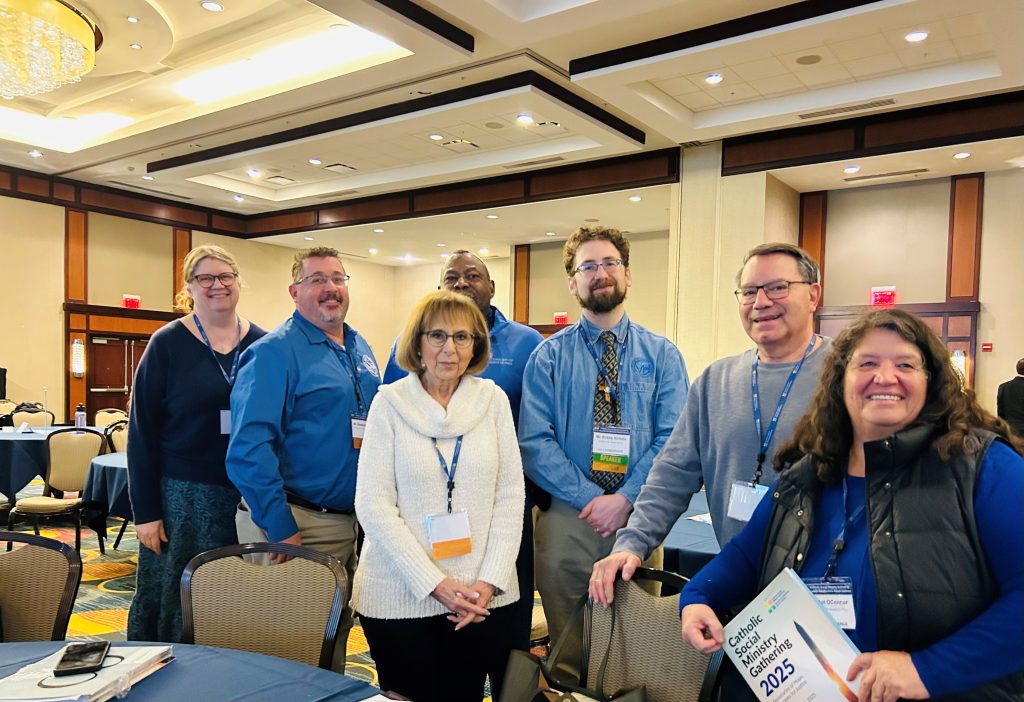
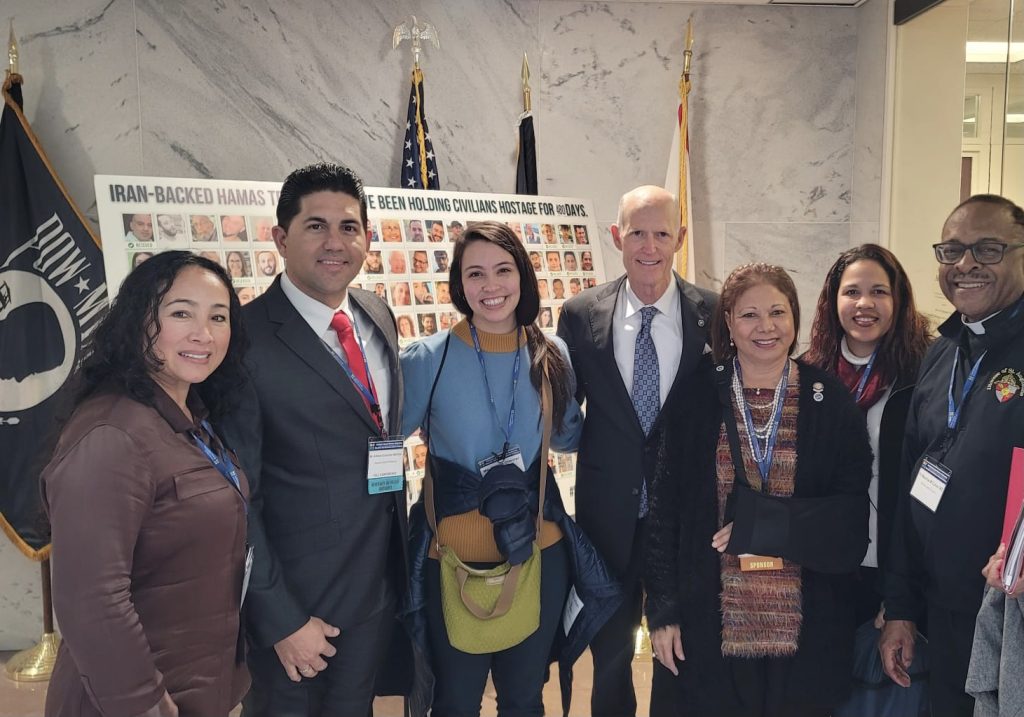
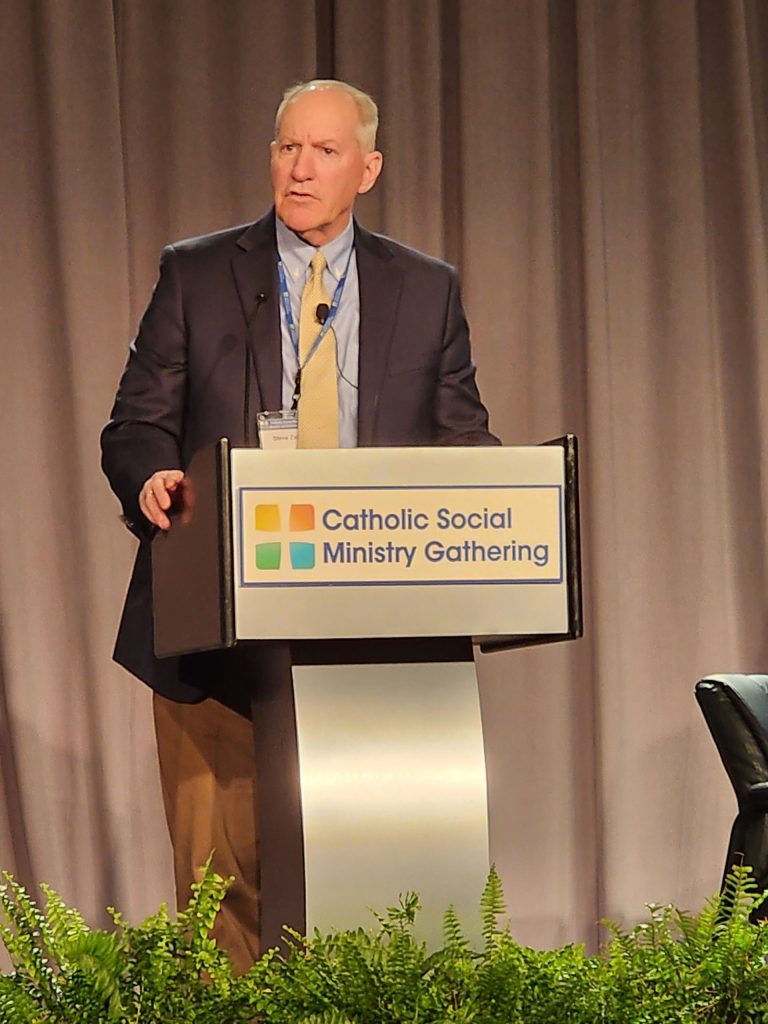
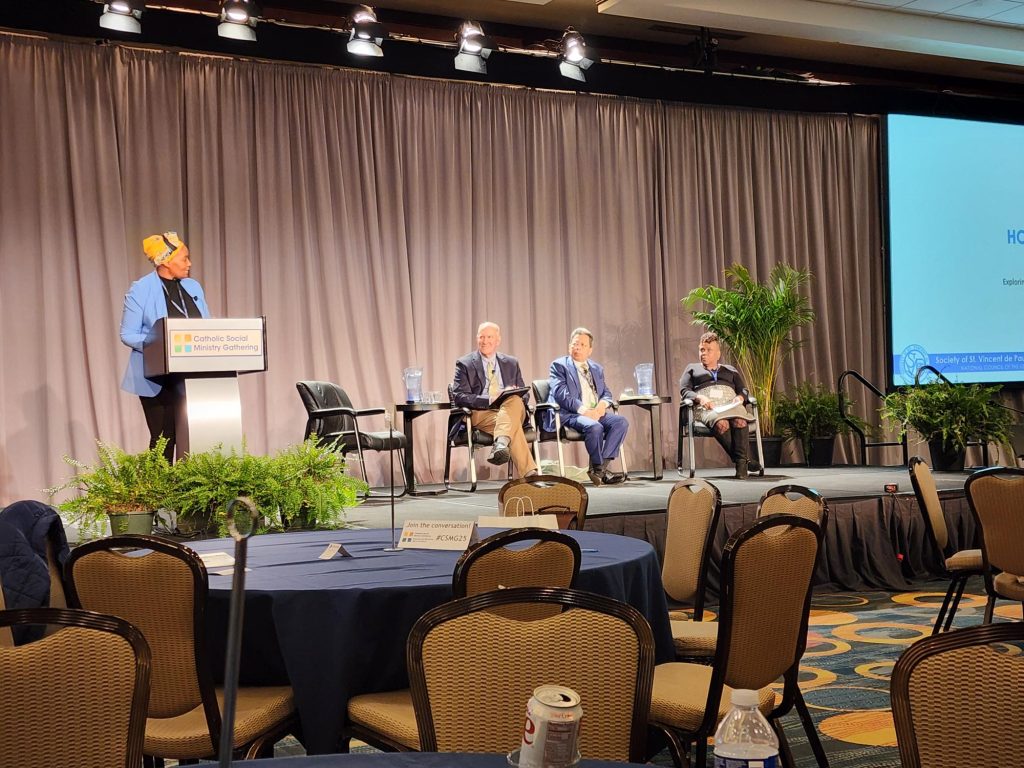
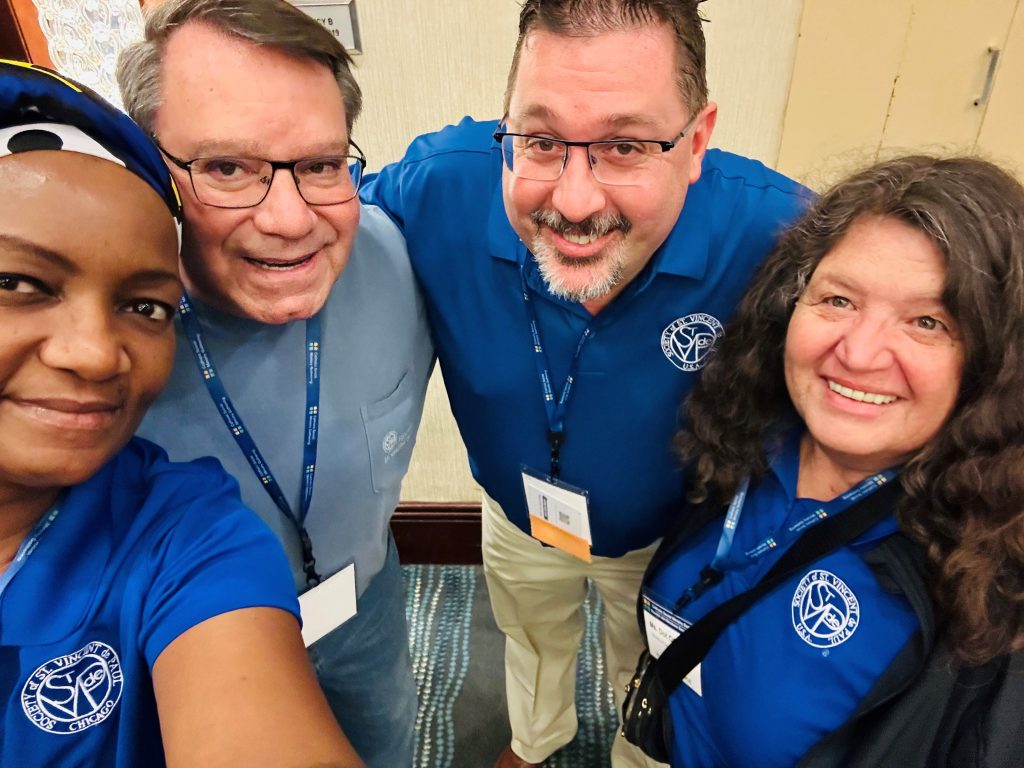
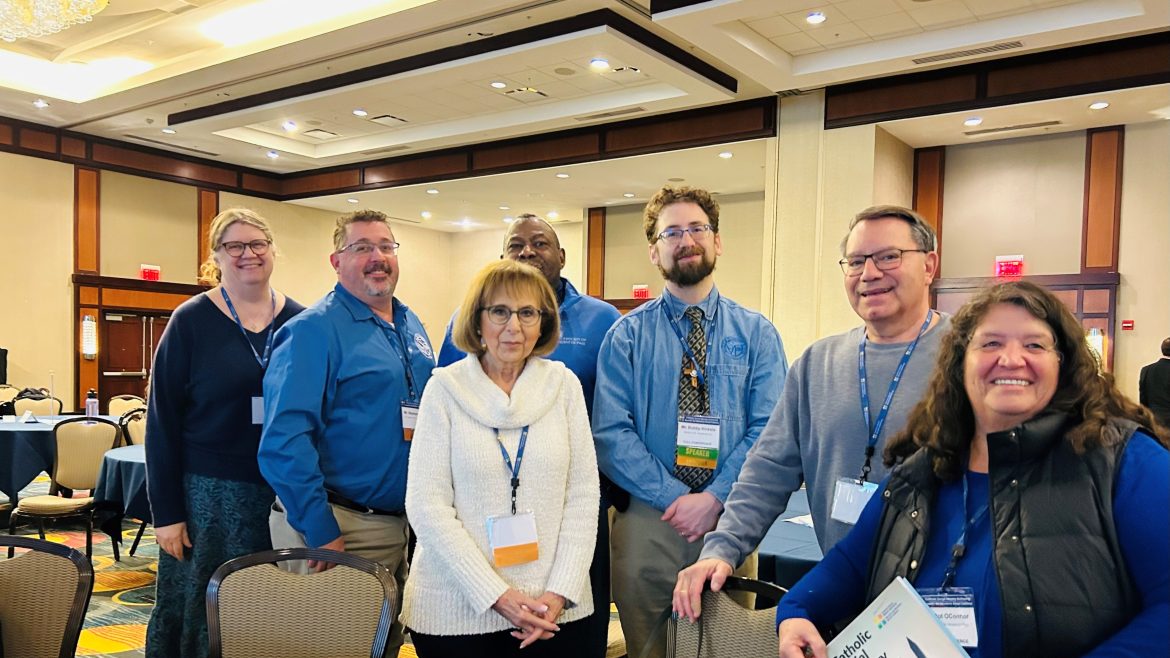
The Voice for the Poor committee, along with several National Council staff and Board members, attended the Catholic Social Ministry Gathering (CSMG) in Washington D.C. Jan 25-29, 2025.

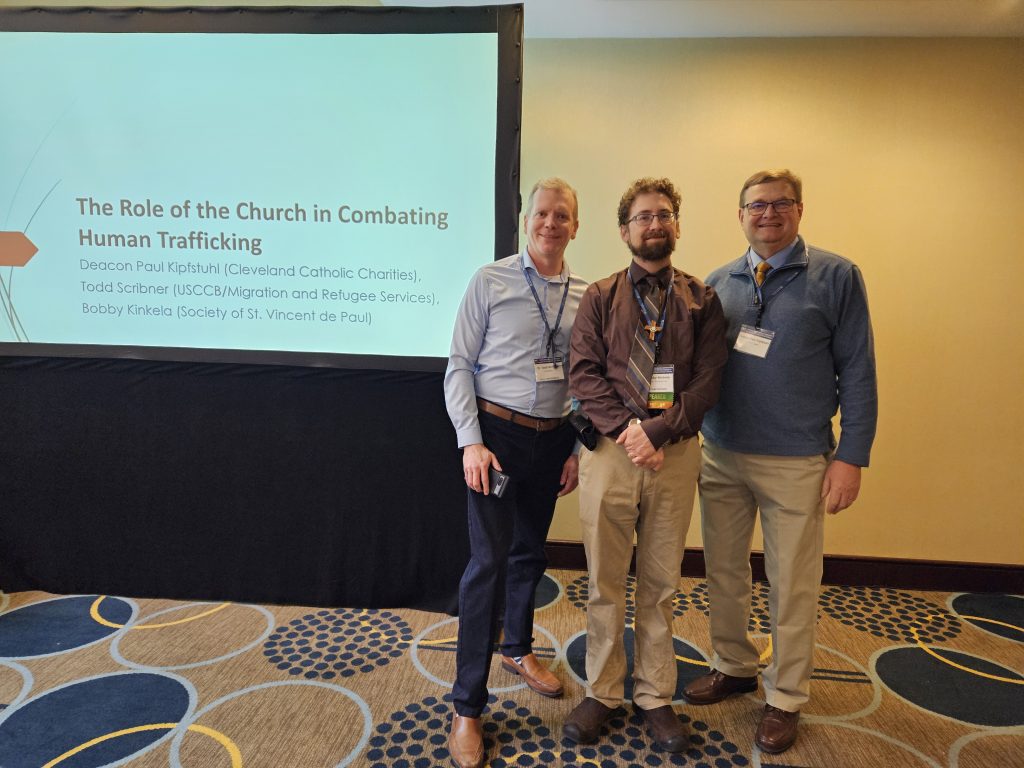
At CSMG, SVdP National President John Berry gave a keynote address to the audience, saying the time was right to take a bold approach to highlighting the causes of homelessness and the steps that can be taken to reduce the number of people who are unhoused. Several Voice for the Poor members also led breakout sessions on human trafficking and homelessness prevention and sat on expert panel discussions throughout the 4-day gathering. 

 Hear what Voice for the Poor members said about their experience at CSMG:

Dorothy (Dot) O’Connor, Voice for the Poor, West Region, said this: “My faith has increased exponentially. In my experience in the last 9 months, I have had the opportunity to be a part of a team that lives the Vincentians’ hallmark of the sanctification of its members. As a first-time attendee, I was in awe of the CSMG conference. I was inspired by my colleagues, who were there to advocate for people in need. And I also had the honor of advocating in the Capitol, which was exhilarating. I saw the compassion and kindness of the people there, and I was inspired. It was an emotional event, and I don’t think I will forget what I saw. With more than 500 people in attendance, each speaker was a powerful, positive force of good. I experienced a level of spiritual connection with the people around me that I’ve never encountered before. I met interesting people all doing work to help those we serve, learned new things, and I feel grateful to have been a part of it.”

Michael J Sylvester, Voice for the Poor, North Central Region said this: “I had a very good experience at CSMG.   The liturgies were really uplifting and reminded me of the universality of our Church that can accommodate the many cultural influences we have from the music of the Taize’ community to music rooted in the African-American experience.  They nourished my spirituality, and growing in holiness is the primary objective of our Vincentian vocation.  The presentations were thoughtful and filled with useful information.  I hope they will help me to better see Christ in others as I try, sometimes unsuccessfully, to be Christ to others.  I particularly enjoyed the presentation by Bishop Joseph J. Tyson of the Diocese of Yakima, who delivered an inspiring message of hope.  Finally, it was great to be able to exercise our advocacy skills with staff from the offices of my U.S. Senators and U.S. Representative.  As an added benefit, I was able to connect with participants from a parish within my diocese whose members are primarily Hispanic who want to organize a St. Vincent de Paul Conference.  Our diocesan Council is reaching out to further explore their interest.”

Matthew St. John Harris, Voice for the Poor, Mountain Region, said this: “I had a great experience.  The two people with whom I went to the Halls of Congress were a monsignor and a gentleman from Catholic Charities.  The monsignor had multiple generational ties to the state of Colorado though he was a pastor in the DMV so it was great to learn his take on things as a fellow Coloradan.  The gentleman from Catholic Charities was originally from Puerto Rico and had worked with the previous Representative of the Commonwealth.  As a result of pairing with him I was able to visit the Commonwealth’s House of Representative office. We attempted to visit both Senate and all House of Representative offices for Colorado to drop off CSMG packets which was rather rewarding.  Meeting staff gives one an opportunity to express what he or she believes. I hope to do this again.”

Bobby Kinkela, Voice for the Poor, National Committee Chair said this: “As part of the planning committee for Catholic Social Ministry Gathering, it was great to see the Holy Spirit bring it all together and have affects I did not intend.  I knew it was important to tell Voice for the Poor Vincentians to attend and the benefits, what I didn’t know is a regional vice president would tell everyone about it at their regional meeting during national assembly and get a group of college aged Vincentians to attend!  I knew that it was important to network with other Catholics, I didn’t know that I would find a large number who already have DC offices and are willing to help network with us as we build our own DC office!  I knew we were opening a DC office, but I didn’t know the DC office announcement would coincide with CSMG!  I knew we were doing lots of breakout sessions with Vincentians; I didn’t know how those networks would help us later or the effect it would have on people!  I knew John Berry would be at CSMG; I didn’t know he would speak and give an electric charged call to change our world with courage and hope!  The Holy Spirit is certainly alive and well and active at the Catholic Social Ministry Gathering and it was an honor to be part of it all.”

If you would like to get involved in the Voice for the Poor committee and learn how to advocate for the voiceless in your community, or leverage our E-advocacy website for state or local issues, please reach out to Steve Uram with the National Council.

SVdP Poverty Programs consist of the Homelessness Prevention Committee, the Poverty Action Committee, the Voice for the Poor and the following shared interest groups: Reentry, Workforce Development, Housing, and Getting Ahead.

Contemplation: Neighbors, Each to Each

Contemplation: Neighbors, Each to Each 1080 1080 admin

By Timothy Williams, Senior Director of Formation and Leadership Development 

“Do you serve illegal immigrants?” asks the voice on the phone. The question seems confusing, not because we don’t know the answer, but because the question doesn’t make sense. They might just as well ask us if we serve short people, Protestants, or athletes. The short answer, of course, is yes, but the short answer is not a complete one.

When a Protestant organization had entrusted the early Society with a large donation, the members began to discuss using it first to benefit Catholics in need, and “dissenters” only if there was any left over. Blessed Frédéric, appalled at the conversation, declared that “if it is not clearly understood that we help the poor without religious distinction, I shall go forthwith and return to the Protestants the donation which they have given. I shall say to them: ‘Take it back, we are unworthy of your confidence.’” It was not necessary, his biographer adds, to put this to a vote. [Baunard, 299]

There are many categories into which we may place people, and some in which we place ourselves, but within and without those categories each of us is made in the image of our loving Creator, unique and unrepeatable.[CSDC, 131]  Each of us, Pope Benedict XVI taught, “is the result of a thought of God. Each of us is willed, each of us is loved, each of us is necessary.”

Not all of us, but each of us. This miraculous distinction is at the heart of our faith and our call to service, for nowhere in the Bible are we commanded, Catholic philosopher Peter Kreeft points out, to love humanity. We are commanded to love our neighbor. Even God does not love humanity – He loves You. He died for you. It is easy to love any group, even all of humanity, in the abstract. But, as Kreeft explains, “’Humanity’ never shows up at your door at the most inconvenient time. ‘Humanity’ is not quarrelsome, alcoholic, or fanatical. ‘Humanity’ never has the wrong political, religious, and sexual opinions…. But to die for your neighbor … unthinkable. Except for love.”

Jesus taught us to love in exactly this way, one person at a time. “For I was hungry, and you gave me food…” We serve each person before us who is in need, in any way “that alleviates suffering or deprivation and promotes human dignity”. [Rule, Part I, 1.3] We do this not because they are tall, or polite, or women, but because they are hungry, or cold, or alone; we do this not because they are Catholic, but because we are Catholic, and because in them – in each of them – we see the suffering Christ.

Our Church teaches that nations have a right to regulate borders and control immigration. Vatican City itself exercises this right. But that has nothing to do with the poor one before me today, for as St. Vincent de Paul taught, we “can’t see someone suffering without suffering along with him, or see someone cry without crying as well. This is an act of love.” [CCD XII:221] Vincentians serve for love alone.

Contemplate

Can I see and hear through the fog and noise around us to see only Christ in the person before me?

Recommended Reading

Amélie Ozanam: A Heart with Much Love to Give


Contemplación : Vecinos, cada uno con cada uno

Traducción de Sandra Joya

Sirven ustedes a los imigrantes ilegales? pregunta la voz en el teléfono.  La pregunta parece confusa, no porque no sepamos la respuesta, sino porque la pregunta no tiene sentido. Podrían  preguntarnos también si servimos a personas de baja estatura, a protestantes o deportistas. La respuesta corta, por supuesto, es sí,  pero la respuesta corta no es completa.

Cuando una organización protestante confió a la Sociedad primitiva una gran donación, los miembros comenzaron a discutir si se utilizaría  primero para beneficiar a los católicos  necesitados y a los “disidentes” sólo si quedaba algo. El Beato Federico, horrorizado por la conversación, declaró  que. “si no se entiende claramente que ayudamos a los pobres sin distinción religiosa, iré  inmediatamente a devolver a los protestantes la donación  que han dado. Les diré  “Retirenla, no somos dignos de su confianza” No fue necesario añade su biógrafo, poner esto a votación. (Baunard, 299)

Hay muchas categorías  en las que podemos colocar a las personas y algunas en las que nos colocamos a nosotros mismos, pero dentro y fuera de esas categorías  cada uno de nosotros está  hecho a imagen de Nuestro Creador amoroso, único  e irrepetible  (CSDC, 131).  Cada uno de nosotros enseñó  el papa Venedicto XVI “es el resultado de un pensamiento de Dios. Cada uno de nosotros es querido, cada uno de nosotros es amado, cada uno de nosotros es necesario”. No todos nosotros, pero cada uno de nosotros.

Esta distinción  milagrosa está  en el corazón de nuestra fe y nuestro llamado al servicio, porque en ninguna parte de la Biblia se nos ordena, señala el filósofo  católico  Peter Kreeft, amar a la humanidad. Se nos ordena amar a nuestro prójimo. Incluso Dios no ama a la humanidad, te ama a Ti . Él  murió  por Ti . Es fácil  amar a cualquier grupo, incluso a toda la humanidad, en abstracto. Pero, como explica Kreeft “la humanidad” no es pendenciera, alcoholica o fanática.  La “humanidad” nunca tiene opiniones politicas, religiosas, o sexuales equivocadas…..Pero morir por el prójimo…..es impensable. Excepto por amor.

Jesús nos enseñó a amar exactamente de ésta  manera,una persona a la vez “Porque tuve hambre y me disteis de comer” Servimos a cada persona que tenemos delante que está  en necesidad de cualquier manera ” que alivie el sufrimientoo la privación y promueva la dignidad humana” (Regla, Parte 1: 1-3)

No lo hacemos porque sea altos,o educados o mujeres, sino porque tienen hambre, o frío  o están  solos;  lo hacemos no porque sean católicos,sino porque somos católicos y porque en ellos-en cada uno de ellos vemos al Cristo sufriente.

Nuestea Iglesia enseña que las naciones tienen derecho a regular las fronteras y controlar la inmigración. La propia Ciudad del Vaticano ejerce éste  derecho. Pero eso no tiene nada que ver con el pobre que tengo hoy delante,porque como enseñaba San Vicente de Paúl  ” no podemos ver a alquien que sufre sin sufrir con él, ni ver a alguien que llora sin llorar también. Esto es un acto de amor” (SVP 11B: 560) Los Vicentinos servimos sólo  por amor.

Contemplar 

¿Puedo ver y oir a través  de la niebla y el ruido que nos rodea para ver sólo  a Cristo en la persona que tengo delante?

2-6-25 Weekly Questions & Answers

2-6-25 Weekly Questions & Answers 1200 628 admin

February 6, 2025

Q:  The solidarity contribution assessment for stores is based on their total revenue (normally total sales), and not on their profits (sales minus expenses). Correct?

A:  Yes, on the Stores Report there is a line item titled “Total Revenue” (not “Total All Store Income”) that is used to determine the solidarity assessment for a store. Expenses do not come into play in solidarity calculations.

Q: Here in our city, there is a movement among nonprofits to have conversations about endowments with donors. This is being spearheaded by our local community foundation. Could you please give us your opinion on endowments in light of the issue of hoarding?

A: Endowments are permitted as long as the endowments are funded by donations specifically for that purpose. You should not use funds identified for service to those in need in order to build an endowment. Most Conferences have no need for any Endowment or an endowment campaign, unless it is raising and holding funds in reserve for capital needs. Money collected today is to be spent on today’s needs. Without a specific plan for long term funds, it is considered hoarding and against the Rule. Councils are more likely to have long term needs suitable for endowment funds.


6 de Febrero

P: La contribución solidaria de las tiendas se calcula de sus ingresos totales (normalmente ventas totales) y no de sus beneficios (ventas menos gastos). ¿Es esto correcto?

R: Sí, en el informe de tiendas hay una partida titulada “Ingresos totales” (no “Total de todos los ingresos de la tienda”) que se utiliza para determinar el monto de solidaridad de una tienda. Los gastos no entran en juego en los cálculos de solidaridad.

P: Aquí en nuestra ciudad, hay un movimiento entre las organizaciones sin fines de lucro para tener conversaciones sobre dotaciones y los donantes. Esto está siendo encabezado por nuestra fundación comunitaria local. ¿Podría darnos su opinión sobre las dotaciones a la luz del problema del acaparamiento?

R: Los legados/dotaciones están permitidos siempre y cuando las dotaciones estén financiadas por donaciones específicamente para ese propósito. No debe utilizar los fondos identificados para el servicio a los necesitados con el fin de construir un legado/ dotación. La mayoría de las Conferencias no tienen necesidad de ninguna Legado o una campaña de dotación, a menos que se trate de recaudar y mantener fondos en reserva para las necesidades de capital. El dinero recaudado hoy se gastará en las necesidades de hoy. Sin un plan específico para los fondos a largo plazo, se considera acaparamiento y va en contra de la Regla. Es más probable que los Consejos tengan necesidades a largo plazo adecuadas para los fondos de Legado.

Contemplation: At the Margin

Contemplation: At the Margin 1080 1080 admin

By Timothy Williams, Senior Director of Formation and Leadership Development 

When I was a kid, I used to pull my dad’s old academic books from the shelves and flip through them. He was a college professor at the time, and although I wasn’t really interested in medieval history, I was always fascinated by the little notes he had made in the margins, most of them written in faded pencil many years before. Sometimes they were words, sometimes just lines or arrows. Why did he put those notes there?

That memory comes to mind when I read in our Rule about our “common mission to help the poor and marginalized.” [Rule, Part I, 3.3] To be marginalized is to be excluded, to be kept on the edges of society, and we distinguish it from poverty because it may be caused not only by poverty, but by old age, infirmity, illness, or any “living conditions [that] interfere with … proper growth.” [CSDM, 182] Isolation and despair can be both a cause and a result of marginalization.

It is to the marginalized that we are called by solidarity, one of the four permanent principles of Catholic Social Doctrine. Solidarity is a virtue; it is not merely “a feeling of vague compassion or shallow distress at the misfortunes of so many people” but “a firm and persevering determination to commit oneself to the … good of all and of each individual.” [Sollicitudo Rei Socialis, 38] This specific call to seek the good of each individual is echoed in our definition of the Vincentian Virtue of zeal as “a passion for the full flourishing and eternal happiness of every person.” [Rule, Part I, 2.5.1]

Our material assistance can alleviate some of the causes of marginalization, but it is our loving presence and our friendship that brings the hope that alleviates despair and the love that welcomes all into community.

We have a choice, then, as to how we will view marginalized people. We can choose to see them as outside the mainstream, outside the body of the text; we can see them as “others.” Or we can see them as God’s margin notes, left for us in the flesh and blood image of His Son; we can see them as His highlights, not placed in the margin to be ignored, but to remind us of the most important things.

It would be easy to overlook faded pencil marks in the middle of a printed paragraph, but in the margin, it cannot be simply ignored. So maybe, like my dad’s old pencil-written notes, they can remind us most effectively of our call to solidarity because, whether at the margins or in the text, we’re all on the same page.

Contemplate

Do I truly seek out those at the margins?

Recommended Reading

Turn Everything to Love


Contemplación : En El Margen

Traducción de Sandra Joya

Cuando era niño, solía  sacar de los estantes los viejos libros académicos de mi padre y hojearlos. En ese monento, él  era profesor universitario y, aunque a mi no me interesaba mucho la historia medieval siempre me fascinaban las pequeñas notas que había  hecho en los márgenes, la mayoría  de ellas escritas con lápiz descolorido muchos años antes. A veces eran palabras, a veces sólo  lineas o flechas. ¿Por qué  puso esas notas allí?.

Ese recuerdo me viene a la mente cuando leo nuestra Regla sobre “nuestra misión común de ayudar a los pobres y marginados” [Regla Parte 1:3.3] Ser marginado es ser excluido, ser mantenido al margen de la sociedad, y lo distinguimos de la pobreza porque puede ser causada, no solo por la pobreza, sino por la vejez, la enfermedad, la dolencia o cualquier condición  de la vida (que) interfieran con …el crecimiento adecuado. [CSDM, 182] El aislamiento y la desesperación pueden ser tanto una causa como un resultado de la marginación.

Es hacia los marginados  hacia quienes estamos llamados por la solidaridad uno de los cuatro principios permanentes de la Doctrina Social Católica. La solidaridad es una Virtud, no es meramente ” un sentimiento de vaga compasión o de superficial consternación por las desgracias de tantas personas” sino ” una firme y perseverante determinación de comprometerse por el bien de todos y de cada individuo” [Sollicitudo Rei Socialis,38] Este llamado especifico a buscar el bien de cada individuo se refleja en nuestra definición de la “Virtud Vicentina” del “celo” como una pasión  por el florecimiento  pleno y la felicidad eterna de cada persona [Regla Parte 1: 2.5.1]

Nuestra ayuda material puede aliviar algunas de las causas de la marginación,  pero es nuestra presencia amorosa y nuestra amistad lo que trae la esperanza que alivia la desesperación y el amor que acoge a todos en la Comunidad.

Tenemos, entonces,una opción  en cuanto a como veremos a las personas marginadas. Podemos eliger verlas fuera de la corriente principal, fuera del cuerpo del texto; verlos como “otros” o podemos verlos como notas al margen de Dios, dejadas para nosotros en la imagen de carne y hueso de su Hijo; podemos verlos como sus puntos destacados, no colocados en el margen para ser ignorados, sino para recordarnos las cosas más  importantes.

Seria fácil  pasar por alto unas marcas de lápiz descoloridos en medio de un párrafo  impreso, pero en el margen, no se puede simplemente ignorar. Entonces, tal vez, como las viejas notas escritas por mi padre, puedan recordarnos de manera más  efectiva nuestro llamado a la solidaridad porque, ya sea en los márgenes  o en el texto, todos estamos en la misma página.

Contemplar 

¿Realmente busco a quienes están en los márgenes?

Feature: International Twinning

Feature: International Twinning 351 264 admin

Thanks to International Twinning, 26 indigenous children have quality education and nutritious food

Through International Twinning, Vincentians in the United States are sharing the love of Jesus Christ with those in need, building shelters for families, caring for the sick and elderly, clothing the naked, and feeding the hungry. The Society of St. Vincent de Paul’s International Twinning program promotes financial resource sharing, mutual spiritual support, and cross-cultural friendships by connecting U.S. Conferences with Vincentian Conferences in Central America, South America, and the Caribbean that lack the means to conduct local works of charity.

One such example is the St. Vincent de Paul Conference of St. Mary Cathedral of Colorado Springs, CO, who twins with the San Vicente de Paul Conference Medalla Milagrosa, Monterrey, Nuevo Leon, Mexico.

The St. Mary Cathedral Conference sends financial support for the Rarámuri Integrity Institute, a boarding school serving the indigenous Rarámuri children of the Sierra Tarahumara. The Sierra Tarahumara mountain region has the poorest municipality in Mexico, so basic necessities such as food, blankets, clothing, and medicine are desperately needed, in addition to education.

The boarding school is attended by 26 indigenous children, some with educational gaps and others who do not speak Spanish. Work is done to support the children by providing the students with basic education and offering a variety of nutritious foods. 

“We are very happy to see our contributions are helping [these] children get an education, nourishment, a roof over their head and clothing they would not have on their own,” said Lionel Rivera with St. Mary Cathedral Conference. “We feel we have a great partnership with the St. Vincent de Paul Society Miraculous Medal Conference of Monterrey.”

In addition to helping the children at the Institute, members of the Medalla Milagrosa Conference deliver dinners to homeless individuals, and collect and distribute winter clothing and shoes to those in need.

The Vincentian members of the San Vincente de Paul Conference Medalla Milagrosa also communicated this: “We thank God for this opportunity to collaborate in the construction of His kingdom and each one of you for the collaboration that you send us and thus extend networks of love and solidarity with those most in need.”

If you are inspired to begin a twinning program at your SVdP Conference, and you’d like to know what the greatest needs are of our brothers and sisters in the Americas, contact Valeria Vlasich at the National Council for more information.

“The entire [St. Mary Cathedral] Conference has been impacted in a very positive way,” said Lionel Rivera. “We are all very grateful to have the opportunity to provide an education to the children in rural Mexico. It’s a blessing to be able to strengthen our hope in making a difference, not only here but in other countries too.”


1-30-25 Weekly Questions & Answers

1-30-25 Weekly Questions & Answers 1200 628 admin

January 30

Q: For a Conference that is closing, can the money left in the account be put in the general Council fund for Conferences, or does it need to go specifically to the Conferences that are absorbing the service area of the Conference that is closing?

A:  The intent for the use of funds from a Conference that has closed is to use the money collected to help the poor in that particular area where the Conference once existed. The District Council needs to make every effort to serve families in that area using the resources of the closed Conference. If other Conferences are serving the area, then the Council should specifically reimburse that Conference or Conferences individually, and per client case, based on their assistance to families in that area. They should not be given the money upfront. Every effort should be made to use the resources of a closed Conference collected for families in the community in which it was originally donated.

Q:  We added a room to our pantry and our president who is a carpenter by trade with the help of other members was paid to build it. The total price of the project was lower than the cost of a hired contractor. Is this ok under the bylaws of SVdP?

A:  It is okay for Conferences to pay the president or any other member to do a particular thing for a short-term job as long as all members know and agree with the terms. This could become a problem if it is happening consistently, and the Conference must be aware of any conflicts of interest. It can also be a problem if the president or other officers are paid on a consistent basis for doing regular jobs, they would lose their eligibility to hold office.


30 de enero

P: En el caso de que una Conferencia que esté a punto de ser cerrada, ¿se puede poner el dinero que queda en la cuenta en el fondo general del Consejo para las Conferencias, o tiene que ir específicamente a las Conferencias que están absorbiendo el área de servicio de la Conferencia que se está cerrando?

R: La intención del uso de los fondos de una Conferencia que ha cerrado es utilizar el dinero recaudado para servir a las personas que viven en la pobreza en esa área en particular en donde una vez existió la Conferencia. El Consejo de Distrito debe hacer todo lo posible para servir a las familias de esa área, utilizando los recursos de la Conferencia cerrada. Si otras Conferencias están sirviendo en el área, entonces el Consejo debería reembolsar específicamente a esa Conferencia o Conferencias individualmente, por caso de servicio a las personas en necesidad, en función de su asistencia en esa área. No se les debe dar el dinero por adelantado. Se debe hacer todo lo posible el utilizar los recursos originalmente donados y recolectalos de una Conferencia cerrada para las familias de esa comunidad.

P: Añadimos una habitación a nuestra despensa, nuestro Presidente, que es carpintero de oficio, con la ayuda de otros miembros, se les pagó para que se construyera. El precio total del proyecto fue menor que el costo de un contratista contratado. ¿Está bien hacer esto según los Estatutos de SVdP?

R: Está bien que las Conferencias paguen al Presidente o a cualquier otro miembro para que haga algo en particular por un trabajo a corto plazo, siempre y cuando todos los miembros conozcan y estén de acuerdo con los términos. Esto podría convertirse en un problema si ocurre de manera constante, y la Conferencia debe estar al tanto de cualquier conflicto de intereses. También puede ser un problema si al Presidente u otros funcionarios se les paga de manera constante por realizar trabajos regulares, perderían su elegibilidad para ocupar el cargo.

Ozanam PR Corp/SVdP Eyedentity Program Celebrates 40 Years

Ozanam PR Corp/SVdP Eyedentity Program Celebrates 40 Years 2321 1807 admin

Written by Jack Ahern, MagnaliteCatholic.com

In 1985, the SVdP Phoenix Council decided to inform the public that St. Vincent de Paul exists. To help with this, they formed the SVdP Eyedentity Program. Ozanam PR Corp. was created to run it. Under the leadership of Phoenix Council board member, Jack Ahern, it began to operate. Jack ran it out of his company warehouse.

When word got out about the program, it quickly spread from Phoenix to throughout the United States. In 1996, the SVdP National Council contracted with Ozanam PR Corp. to be an official company promoting and producing SVdP logo merchandise.

From a dozen products in 1985, Ozanam PR Corp now produces and warehouses over 100 SVdP items.  This includes apparel, awards, statues, medals, rosaries, lapel pins, prayer boxes, lanyards, name badges and much, much more. Having almost $100,000 worth of products in their warehouse, they can generally ship orders within a couple of days.

With four generations of Vincentians, the Ahern family has a pretty good idea of what items are needed to help us Vincentians with our vocation.  The dedicated staff of Ozanam PR Corp is honored to have served their fellow Vincentians for 40 years.  We hope to continue our service for many years to come. Please visit us at www.MagnaliteCatholic.com for a complete catalog of our products.

Contemplation: Servants All The Way Down

Contemplation: Servants All The Way Down 1080 1080 admin

By Timothy Williams, Senior Director of Formation and Leadership Development 

Subsidiarity, one of the four permanent principles of Catholic Social Doctrine, is a core principle of the Society of St Vincent de Paul. [Rule, Part I, 3.9] Subsidiarity serves the poor by allowing the flexibility that fosters creativity to Conferences and serves good governance by avoiding what Frédéric called “bureaucracies which impede our march by multiplying our machinery.” [310, to Amélie, 1841] It could also be said that servant leadership is the central exercise in subsidiarity, leaving, as it does, the decisions not to the presidents of Conferences and Councils, but to the members.

Emmanuel Bailly, first Conference President and first President of the Council of Direction (now known as the International Council General) offered one of the earliest explanations of how subsidiarity guides and strengthens our organization, explaining that a Council “is rather a link than a power” and that “all this has been imposed on no one, all is freely accepted, followed, and may be abandoned.” [Bailly, Circ. Ltr., 1841] Frédéric also emphasized the importance of local decision-making, explaining to a new Conference that “knowledge of our organization [in Paris] and manner of acting is not of great use to you. Your city probably has different needs than the capital and provides different resources.” [82, to Curnier, 1834] Councils, in other words, do not supervise or direct Conferences. Instead, “Councils exist to serve all the Conferences they coordinate.” [Rule, Part I, 3.6]

Leaders in the Society seek to imitate Jesus, who calls us “to wash one another’s feet. I have given you a model to follow, so that as I have done for you, you should also do.” Servant leaders in the Society are not called to be bosses or commanders and are not expected to be “large and in charge.” They are instead called to be “small and for all,” not directing, but fulfilling the will of their Conferences and Councils, expressed through consensus of the members. Leaders, St. Vincent taught, should be “firm and unchanging with regard to the end but gentle and humble as to the means.” [CCD II: 332]

Within our Conferences, subsidiarity calls us to respect each Home Visit team’s “special insight into the best way to give help” to the neighbors they personally visit. [Manual, p.24] Our default is to leave that decision to those closest to it. In turn, all Members are called not to be served, but to serve, placing the needs of the neighbor before their own, recognizing that whatever we do for the least among us, we do for our Savior, who assured us that He was Himself among us as one who serves.

Our Cultural Beliefs declare that we are One Society, our Mission Statement says we are a network of friends, and our first President reminds us that “from the Conferences to the Center, there is neither authority nor obedience” but rather, there is “charity; there are the same end, the same good works; there is a union of hearts in Jesus Christ our Lord.” [Bailly, Circ. Ltr. 1841] Subsidiarity and servant leadership, then, are pure expressions of Christian love.

Contemplate

As a Member and leader, do I seek always to humbly regard others as more important than myself?

Recommended Reading

‘Tis a Gift to Be Simple


Contemplación : Los Sirvientes todo el camino hacia abajo

Traducción de Sandra Joya

La susidiaridad,uno de los cuatro principios permanentes de la Doctrina Social Católica, es también  un principio central de la Sociedad de San Vicente de Paúl,  ( Regla,Parte 1,3.9) La susidiaridad sirve a los pobres permitiendo la flexibilidad que fomenta  la creatividad de las Conferencias y sirve al buen gobierno evitando lo que Federico llamaba ” burocracias que impiden nuestra marcha multiplicando nuestra maquinaria” (310,a Amelie,1841) También  se podría  decir que el liderazgo de servicio es el ejercicio central de la subsidiaridad dejando como lo hace, las decisiones no a los presidentes de Conferencias y Consejos, sino a los miembros.

Emmanuel Bailly, primer presidente de Conferencia y primer Presidente del Consejo de Dirección (hoy conocido como el Consejo General Internacional) ofreció  una de las primeras explicaciones de cómo  la subsidiaridad guía  y fortalece nuestra organización, explicando que un Consejo” es más  un vínculo  que un poder” y que ” todo esto no ha sido impuesto a nadie, todo se acepta, se sigue y se puede abandonar libremente. ( Bailly, Cir.Carta,1841) Federico también  enfatizó la importancia de la toma de decisiones local, explicando a una nueva Conferencia que ” el conocimiento de nuestra organización ( en París) y la manera de actuar no es de gran utilidad para ustedes. Su ciudad probablemente tiene necesidades diferentes a las de la capital y proporciona recursos diferentes” (82, a Curnier,1834) Los Consejos, en otras palabras,no supervisan ni dirigen las Conferencias. En cambio, ‘ los Consejos existen para servir a todas las Conferencias que coordinan” (Regla, Parte 1. 3.6)

Los líderes de la Sociedad buscan, imitar a Jesús , quién nos llama a ” lavarnos los pies unos a otros. Les he dado un modelo a seguir, para que como yo he hecho con ustedes, ustedes también  lo hagan”, los líderes  servidores de la Sociedad no están  llamados a ser jefes o comandantes y no se espera que sean ” grandes y estén  a cargo”  En cambio están llamados a ser ” pequeños,  y para todos” no a dirigir, sino a cumplir la voluntad de sus Conferencias y Consejos expresada a través  del consenso de los miembros. Los líderes , enseñaba San Vicente, deben ser ‘ firmes e inmutables en cuanto al fin,pero mansos y humildes en cuanto a los medios. ( CCD II 332)

En nuestras Conferencias, la subsidiaridad nos llama a respetar la ” especial percepción  de cada equipo de visitas domiciliarias sobre la mejor manera de prestar ayuda” a los vecinos que visitan personalmente ( Manual, p. 24) Nuestra actitud predeterminada es dejar esa decisión  a los más  cercanos. A su vez, todos los miembros están  llamados no a ser servidos sino a servir, poniendo las necesidades del prójimo  antes que las suyas, reconociendo que todo lo que hacemos por el más  pequeño entre nosotros,lo hacemos por nuestro Salvador, quien  nos aseguró que El mismo estaba entre nosotros como uno que sirve.

Nuestras creencias Culturales declaran que somos una Sociedad. Nuestra declaracion de misión  dice que somos una red de amigos y nuestro primer Presidente nos recuerda que ” desde las Conferencias hasta el centro,no hay autoridad ni obediencia” sino, más  bien hay caridad, hay un mismo fin, las mismas buenas obras ” hay una unión  de corazones en Jesucristo nuestro Señor ” ( Bailly, Circ. Ltr 1841) La subsidiaridad y el liderazgo de servicio son, entonces, expresiones puras del amor cristiano.

Contemplar 

Como miembro y líder  ¿ busco siempre considerar humildemente a los demás  como más  importantes que yo?

Sign Up for Our Newsletter

Privacy Preferences

When you visit our website, it may store information through your browser from specific services, usually in the form of cookies. Here you can change your Privacy preferences. It is worth noting that blocking some types of cookies may impact your experience on our website and the services we are able to offer.

Click to enable/disable Google Analytics tracking code.
Click to enable/disable Google Fonts.
Click to enable/disable Google Maps.
Click to enable/disable video embeds.
Our website uses cookies, mainly from 3rd party services. Define your Privacy Preferences and/or agree to our use of cookies.
Skip to content