• Search the Site

Upcoming Events

Feature: Young Vincentian Excellence Awards

Feature: Young Vincentian Excellence Awards 2160 1440 admin

Young People in the Spotlight for the 2025 Young Vincentian Excellence Awards

By Linda Roghair, National Vice President of Youth, Young Adults & Emerging Leaders 


A Society-wide search for young people doing amazing work in their community is happening now.

Vincentians from across the U.S. are invited to nominate emerging young Vincentian servant leaders from their Conferences, Councils, and Special Works for two Young Vincentian Excellence Awards which will be presented at the National Assembly in Louisville, KY in August.

We are asking Vincentians to nominate a young person who serves the Society in their community, embodies servant leadership, and has a passion towards the Vincentian Charism. Nominations are open now until May 15, 2025.

Submission Requirements

  • Nominees must be involved in the Society of St. Vincent de Paul USAin some capacity (ie. Youth Conference, Youth University Conference, Adult Conference, Special Works, etc.).
  • Age groups: Youth 16-18 (High School) or Youth University (18-University age), and Young Adults (18-40)
  • Include photos, volunteer logs, etc. if possible
  • Nomination Form must be submitted via email to: YYAEL@svdpusa.org by May 15, 2025. Please include your Conference President, Council President, NCM & Regional Vice President when submitting a nomination.

Award recipients will be gifted a paid trip to participate in the 2025 National Assembly in Louisville, KY (August 28 – 30). Award recipients must commit to attending the National Assembly in order to receive the award.

Last year’s award winner Sarah of the Madison Wisconsin St. Vincent de Paul Youth Service Council had this to say:

“For me being a Vincentian means actively growing in my faith through allowing the grace of incarnational charity to fuel impactful service and beautiful friendships. Winning the Young Vincentian Excellence Award allowed me the opportunity to attend the National Assembly and connect with the Society on a larger scale. I am especially grateful for becoming a member of the YYAEL Team since this amazing group of passionate young people keep me connected to the Society while I am at a college with no current SVdP presence.”
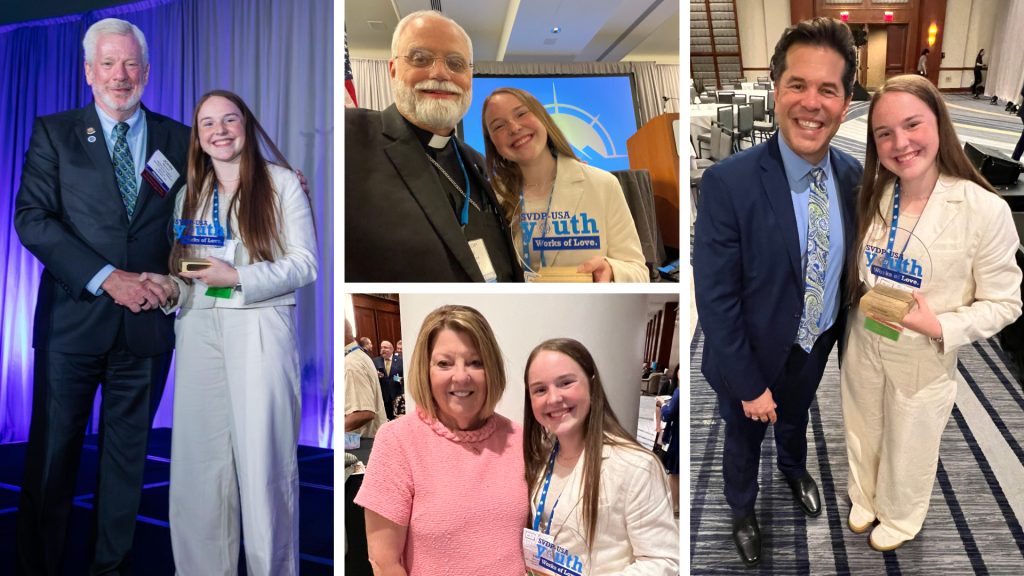
Last year’s award winner Zoie Roghair of the Sioux Falls St. Michael Conference had this to say:

“I am grateful for what this award represents—opportunity, future growth, and community,” said Zoie Roghair of the Sioux Falls St. Michael Conference. “The award and Society have opened many doors for servant leadership, advocacy for the voiceless, friendships, and increasing the involvement of Youth and Young Adults. It is something I will cherish forever.”

Do you know a young person who serves the Society in their community, embodies servant leadership, and has a passion towards the Vincentian Charism? Please submit a completed form and any supplemental material to YYAEL@svdpusa.org by May 15, 2025.


Feature: Annual Reporting is an Essential Membership Requirement

Feature: Annual Reporting is an Essential Membership Requirement 800 800 admin

SVdP Annual Reporting is an Essential Membership Requirement

By Pam Hudson Johnson, National Director of Membership Services

Annual reporting is an essential requirement for all Councils and Conferences.
On May 1st at 11:59pm, the final deadline for online Annual Reports data entry closes (that is midnight tonight!). All Councils and Conferences must submit an annual report.

Why Annual Reporting is So Important:

Accountability and Compliance: The annual reports help maintain proper record-keeping and compliance with the requirements of our tax-exempt status.

Solidarity and Income Calculation: The current formula is based on income shown in the annual reports.  If a Council or Conference does not submit an annual report, it causes significant delays in the solidarity process.

Budgeting and Operations: Delays in reports cause delays in the budgeting process and affect the operations of the National Council.

Conference Annual Reports are due by November 30; District Council Reports by December 31; and (Arch)Diocesan Council Reports by January 31. Any reports not entered before midnight must be submitted in paper form.

Each year our national consolidated annual report publication is shared with our members nationally and internationally, U.S. Bishops, donors and contributors, elected officials and many more of the great works the Society is doing in the U.S. to serve our neighbors in need. This is our way of telling our story, and the good work we are doing to serve our neighbors in need to alleviate poverty in our communities. Find a copy of the 2022-2023 National annual report here.

To better understand the reporting structure, based on our formal structure, please see details below:

  1. For those dioceses which have an Archdiocesan or Diocesan Council: This is based on the formal structure of the Society – not on your legal name. Some Councils have improperly called themselves a Diocesan Council even though they are really a District Council. An Archdiocesan Council or a Diocesan Council has District Councils reporting to it. An Archdiocesan Council or a Diocesan Council has NO Conferences reporting directly to it.

An Archdiocesan Council or a Diocesan Council will provide multiple reports as appropriate. At a minimum, it will provide the (Arch)Diocesan Council Data, the Consolidated Districts Report and the Consolidated Conferences Report. In addition, if the (Arch)Diocesan Council operates any stores, it will provide a single store report for each store. If the (Arch)Diocesan Council operates any Special Works, it will provide a single Special Work Report for each separate Special Work.

  1. For all District Councils: This applies to every District Council regardless of whether they belong to an Archdiocesan Council or a Diocesan Council or are simply a standalone District Council. A District Council has Conferences reporting directly to it.

A District Council will provide multiple reports as appropriate. At a minimum, it will provide the District Council Data and the Consolidated Conferences Report. In addition, if the District Council operates any stores, it will provide a single store report for each store. If the District Council operates any Special Works, it will provide a single Special Work Report for each separate Special Work.

  1. For all Conferences: At a minimum, a Conference will provide the Annual Conference Report. In addition, if the Conference operates any stores, it will provide a single store report for each store. If the Conference operates any Special Works, it will provide a single Special Work Report for each separate Special Work.

Things to Know and Common Misconceptions:

-Some regions have believed new Councils and Conferences do not need to submit reports in their first year, but this is incorrect. All Councils and Conferences must submit an annual report each year.

-All Vincentians are accountable for the work they do and they are required, at all levels, to do proper record keeping. Remember that the key to good reporting is keeping good records throughout the reporting year [i.e., monthly and quarterly reporting].

-The National Council does not require quarterly report filings. Conference quarterly reports are provided by the national office as a courtesy for completion by Conferences at the request of their District Councils.

If you have any questions regarding annual reporting, contact Pam Hudson Johnson, National Director of Membership Services at phudson@svdpusa.org  or (314) 576-3993 extension 214. We are One Society!

Feature: Weaving Bonds and Building Community

Feature: Weaving Bonds and Building Community 1906 1071 admin

Weaving Bonds and Building Community

By Pam Matambanadzo, SVdP Chicago area

We “make no distinctions in those we serve because, in them, Vincentians see the face of Christ.”

We follow in the footsteps set by Blessed Frédéric so many years ago, journeying towards holiness and building on generations before us. Now that we have accepted the baton, we need to pass it on to others so that we can reinforce the strength of the baton. Our challenge is that the world has changed and evolved but our ways have lagged. Our parish communities no longer look like they did 20 or 40 years ago. We hold on to the ways we have been operating even when our efforts are not bearing fruit.

Change is hard. How do we make sure that as we journey together our legacy, like Blessed Frédéric , will inspire diverse Vincentians for generations to come?

Striving for diversity within the Society of St. Vincent de Paul is not just a reflection of societal values, but also a strategic approach to better fulfill our mission. By mirroring the diversity of both Catholic parishioners and the communities they serve, SVdP ensures a more inclusive, culturally competent, and effective response to the challenges of poverty.

Our efforts need to reflect the diversity of both those in the pews, as well as those attending Mass at different time slots to ours. Our awareness should also be inclusive of the broader communities we serve, extending beyond ethnicity and encompassing age and economic diversity. We need to ask ourselves this: Are we “enabling each person to participate actively in the Church’s mission according to his or her own charism and vocation”? Here are four areas that we should contemplate:

Inclusivity and Representation

  • Fellow Parishioners: The global Church is a community that spans a rich tapestry of cultural, linguistic, and ethnic backgrounds. Mirroring this diversity ensures that we, as an organization, are inclusive and representative of the broader Catholic community, fostering a sense of belonging among parishioners.
  • Communities Served: Those who seek assistance from us come from various backgrounds, reflecting the diversity of the broader society. By embracing diversity within our own ranks, the Society ensures that our members can better relate to and understand the unique needs of those we serve, fostering trust and creating a more empathetic and effective support system.

Cultural Competence

  • Understanding Different Perspectives: A diverse membership brings a range of perspectives, experiences, and cultural competencies. This diversity allows us to approach issues with a more nuanced understanding, ensuring that our services are culturally sensitive and relevant to the diverse needs of the communities we serve. Encountering them where they are. When stocking our pantries, are we providing food for the communities we are serving, or are we guided by our own lived experience? Culturally, we each have different comfort foods.
  • Communication and Outreach: We have always prided ourselves on our ability to tailor services based on the needs of the person in front of us. Different communities will have unique challenges and require tailored approaches. Having a diverse membership allows us to communicate effectively and engage with a wider audience, breaking down potential cultural and linguistic barriers that might hinder outreach efforts. Have we explored growth potential locally — even if we may need to accommodate other languages?

Young and Economic Diversity

  • Attracting a New Generation of Vincentians: Embracing young members ensures the longevity and sustainability of the Society’s mission. By involving younger members, the organization can benefit from fresh perspectives, technological savvy, and a passion for social justice, helping to adapt and evolve its services to meet changing community needs. Are we open to changing our meeting times to accommodate younger members with work and family commitments?
  • Economic Diversity: Economic challenges affect individuals and families across various demographics. A diverse member base, including individuals from different economic backgrounds, can bring a more comprehensive understanding of the issues related to poverty and inequality. This can lead to more effective strategies for addressing these challenges at both the individual and systemic levels.

Building a Stronger Community 

  • Collaboration and Unity: A diverse group of members fosters collaboration and unity within the organization. When individuals from diverse backgrounds work together towards a common goal, it strengthens the sense of community within community and society as a whole.
  • Inspiring Others: Seeing a diverse group of members actively engaged in service to the People of God can inspire others to join our chosen vocation. This can lead to a snowball effect, encouraging more people from various backgrounds to participate, broadening the organization’s impact and reach.

The Multicultural Diversity Committee is committed to “End Poverty Through Systemic Change” with a laser focus on removing all barriers associated with discrimination of any kind through education, awareness, and compassion. The committee holds a monthly Zoom call to encourage Vincentians to advocate for justice in their local community. Learn more information at https://members.ssvpusa.org/diversity

Feature: Formation & The Vincentian Digital Pathway

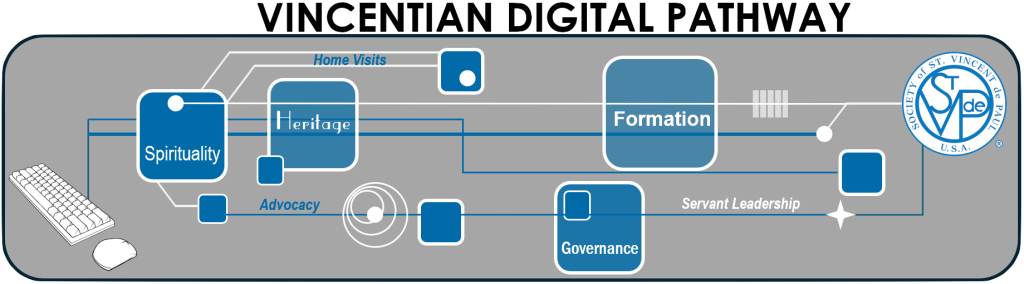
Feature: Formation & The Vincentian Digital Pathway 1839 510 admin

A Lifelong Journey of Becoming

By Tim Williams, Senior Director of Formation & Leadership Development

When I am formed,” a frustrated young Frédéric Ozanam asked, “When will that be?” Many of us may share his confusion. We attend the Ozanam Orientation, which we know is formation, and then, satisfied that we have checked off our “formation” box we find ourselves instead constantly invited to more and more “formation”! So, what is formation, exactly?

The primary purpose of the Society of St. Vincent de Paul is our own growth in holiness, our seeking to become, as Christ calls us to be, “perfect, just as your heavenly Father is perfect.” Attaining holiness, or perfection, is not the work of one seminar or workshop – it is a lifelong journey of becoming.

The Society of St. Vincent de Paul is a true lay vocation, a special way of being Catholic, a special pathway for us to follow on our journey: the Vincentian Pathway. On this pathway, we are formed in four different dimensions.

  • Our Human Formation is focused on our behavior, beginning with our virtues. We study and try to practice our Vincentian Virtues of simplicity, humility, gentleness, selflessness, and zeal, knowing that we may become by doing. Just as one becomes a builder by building, we may become humble by practicing humility. And all of these virtues in service of the greatest virtue of love, are practiced in our person-to-person service of the poor.
  • Our Spiritual Formation, most importantly, is shared. No one is saved alone, as we are taught, and in turn, you cannot be a Vincentian without other Vincentians. We are created to live in communion, and to help lead each other to holiness. As our Rule puts it, we grow in holiness together. This growth is fed, informed, and enriched by our regular spiritual reflections at Conference meetings, by attending Mass together, and by our life of prayer, individual and shared.
  • Our Intellectual Formation connects our minds and our hearts. It includes reading to help us learn more about our heritage and our traditions, and training to help us better understand the changing face of poverty and systemic change, and to be better servant leaders.
  • Finally, our Ministerial Formation draws us to truly live this vocation, to make our service to the poor and to each other not merely a thing that we do, but a thing that we are. In our ministerial formation, we are open to all opportunities to serve, including servant leadership.

If you are perfect, your formation is complete! For the rest of us, the National Formation Committee, chaired by Marge McGinley, tries to provide a wide variety of resources to help each Council, each Conference, and each member to follow the path in a way that best suits their own calling, interests, and charisms.

A good starting point for all is the Vincentian Digital Pathway, introduced last year. Here, you can begin wherever you wish, and explore the documents, videos, pictures, and books collected there. You will find that the links will take you into other subject areas, sometimes areas you did not realize were so closely connected. In the Digital Pathway, you do not have to know what you are looking for – just jump in and find what speaks to you, without trying to “check every box”!

If you are brand new to the Society, or you haven’t been to an Ozanam Orientation in a while, you might want to start with the “Introduction to the Society” video. View it alone, or better yet, with other members so you can pause and discuss it.

Are you looking for an even deeper dive? For Servant Leaders, the Society offers a unique and very special retreat twice a year called Invitation for Renewal. For all members, you can take online course through the Ozanam Institute.

Each Region also has a formation team, and in turn each Council has one, too. In the Conference, it is the Spiritual Advisor who is primarily responsible for guiding (and sharing in) the formation of members. These teams of Formators and Spiritual Advisors put together workshops, training, retreats, formation plans, and more not acting as professors or priests, but as fellow Vincentians, walking the pathway alongside us, all of us growing in holiness together.

Feature: Membership Services & Aggregation

Feature: Membership Services & Aggregation 2560 1920 admin

Aggregation: Your Official Enrollment into the Vincentian Family

By Pam Hudson Johnson, National Director of Membership Services

SVdP’s Rule and practices require that Conferences and Councils take the necessary steps to become membered into the International Confederation of the Society of St. Vincent de Paul. This process of becoming membered as a Conference is known as aggregation. The process of membership as a Council is known as institution.

The National Council strongly urges Conferences and Councils to review your official status. If you find that you have not been formally accepted into the Society internationally, please take immediate steps to rectify that oversight.

Photo: SVdP Georgia’s Wall of Aggregation

How do I know that my Conference has been Aggregated?

When you are formally recognized as an official SVdP entity in solidarity and adherence to the Rule, your Conference will receive a Letter of Aggregation, or your Council will receive a Letter of Institution.

New Conferences are eligible to apply for aggregation after one year operation, filing an annual report and contributing to solidarity. Councils do not have a waiting period and can apply for institution immediately after formation.

The National Council office is pleased to announce the recent arrival of 26 Letters of Aggregation and 6 Letters of Institution all dated December 15, 2024 from the International Council. Applications from around the world are processed and there is a 6-9 month delay in receiving the certificates.

History of Aggregation

From the very beginning, Society members wanted to retain the closeness of brotherhood, and as such, they were hesitant about subdividing and forming numerous Conferences. When they realized the need for additional Conferences, they wanted to preserve a sense of common unity and solidarity with one another. To preserve this unity and solidarity, official enrollment in the Vincentian family has always remained a function of the Council General itself. The Council General established the application process and announces new affiliations.

In the Manual page 27 and throughout the Rule (Sec 1.3.8; Sec 2.6 & Sec 3 Statute 6) you will find an official definition and explanation of the process of aggregation for Conferences and institution for (Arch) Diocesan Councils and Districts.

Benefits of Aggregation

Once your Conference is aggregated or your Council is instituted, you will be eligible for participation in national programs such as Friends of the Poor® and Systemic Change grants and Certificates of Appreciation.

Is your Conference aggregated, and Council instituted? To learn more, contact Membership Services at membership@svdpusa.org.

See the Face of Christ. Be the Face of Christ.

See the Face of Christ. Be the Face of Christ. 439 244 admin

Dear Fellow Vincentians,

We’ve been teasing this idea for awhile, and are proud to announce that today is the day!

Titled “See the Face of Christ. Be the face of Christ”, the National Council is kicking off a membership marketing campaign aimed at adding 10,000 new members to the Society of St. Vincent de Paul nationwide. Ten thousand may sound like an ambitious, even audacious, goal, but it really breaks down to about 2.5 new members per Conference. That sounds pretty achievable, doesn’t it? (Maybe not the .5 part, but you get the idea.)

To help make it as easy as possible for you to attract and welcome new members into the Society, we’ve created a wealth of resources aimed at making it easy for you to invite your family, friends, and fellow parishioners to join us in spirituality, service, and friendship.

Here’s a quick overview of your toolkit:

  • Digital Advertising on Facebook and Instagram from now through October. When you see the ads, like and share them to help our audience grow!
  • Organic posts, including videos and static posts, on Facebook, Instagram, and LinkedIn. We’ll have content highlighting both our campaign theme and all the everyday ways Vincentians serve others to See the Face of Christ, and Be the Face of Christ. Don’t forget to Like and Share!
  • Online campaign merch store. Been looking for just the right shirt or hat to show your SVdP spirit? Check out our new campaign store! A variety of sizes, styles, and colors are available, allowing you to put your personal spin on SVdP and become a walking billboard for who we are and what we do.
  • Digital downloads. Need yard signs, banners, posters? How about flyers and prayer cards to share at your next parish ministry fair? We’ve got you covered! Visit our online merch store and download the items you want for free, then take them to your local printer. You get only the items you need, saving you time and shipping costs.
  • An updated Invitation to Serve. Now known as Creating a Culture of Welcome, this updated resource includes valuable ideas for how to invite new members into your Conference, including updated Pulpit Talk examples!
  • New videos are coming! A few short videos are already available on our campaign landing page, and you’re welcome to share these on your local social media or parish events. At National Assembly this year, we will also premiere a new brand video that can be shown locally and nationally to inspire new members.

While our aim for you is to run this campaign nationally through October 2024, remember that you can use many of these resources any time of year! We should think of welcoming new members to the Society year round, not just during parish fair season or when the workload gets too heavy. Every day is a good day to invite someone to join us!

Yours in Christ,
Dave Barringer
National CEO

Sign Up for Our Newsletter

Privacy Preferences

When you visit our website, it may store information through your browser from specific services, usually in the form of cookies. Here you can change your Privacy preferences. It is worth noting that blocking some types of cookies may impact your experience on our website and the services we are able to offer.

Click to enable/disable Google Analytics tracking code.
Click to enable/disable Google Fonts.
Click to enable/disable Google Maps.
Click to enable/disable video embeds.
Our website uses cookies, mainly from 3rd party services. Define your Privacy Preferences and/or agree to our use of cookies.
Skip to content