
• Search the Site

Upcoming Events

05-09-2024 Questions & Answers

05-09-2024 Questions & Answers 1200 628 admin

Q: One of our Conferences organizes a group of volunteers, some Vincentians and some not, to cook an evening meal once a month. Another Conference undertakes a “Christmas Giving Program” at its church, whereby parishioners take a tag to donate a gift. The gifts are returned and the Conference delivers the gifts to a community agency, who will distribute them to the needy. There is no Vincentian visit with the ultimate recipients. How are these reported on the Conference annual reports?

A: These can be considered Vincentian activities, but only the hours of the members should be recorded. If funds of the Conference are used to buy food or gifts, then the expenditures can be recorded also.

Q: Under the “Total Hours of Service: Members,” would you please clarify the instructions for including the time members spend attending meetings?

A: All meetings attended by members in their capacity as Vincentians should be counted as service hours, with no distinction of the type of meeting attended.


En Español

P: Una de nuestras Conferencias organiza un grupo de voluntarios, algunos Vicentinos y otros no, para preparar una cena una vez al mes. Otra Conferencia lleva a cabo un “Programa de Donaciones de Navidad” en su iglesia, en el que los feligreses se llevan una tarjeta para donar un regalo. Los regalos se recogen y la Conferencia entrega los regalos a una agencia comunitaria que los distribuirá a las personas en necesidad. No hay una visita Vicentina con los destinatarios finales. ¿Cómo se incluyen estos informes en los informes anuales de la Conferencia?

R: Estas pueden considerarse actividades Vicentinas, pero solo se deben registrar las horas trabajadas por los miembros. Si fondos de la Conferencia se utilizan para comprar alimentos o regalos, también se pueden registrar en los gastos.

P: En la sección “Total de horas de servicio: miembros”, ¿podría aclarar las instrucciones en las que se indica que se debe incluir el tiempo que los miembros dedican al asistir a las reuniones?

R: Todas las reuniones a las que asistan los miembros en su calidad de Vicentinos deben contarse como horas de servicio sin distinción del tipo de reunión a la que asistan.
Wage Justice

Wage Justice 1500 1125 admin

By Lori A. Malcom, Director of Retail Operations
Northeast Region – Council of Boston

Employee wages are one of the store’s largest budgeted expenses. How do you know if you are paying a just wage?

Overpaying for a position is just that, overpaying, the cost for which is quantifiable. If you know what the wage should be.

Underpaying a position can be even more costly. High turnover rates have a negative effect on the bottom line, as well as employee morale. So, what should you do?

First you need to understand that for most of our non-exempt positions, minimum wage is not meant to be a living wage for our employees. Minimum wage fluctuates throughout the USA. States adjust the federal minimum wage ($7.25 per hour) for cost-of-living considerations within the states however, many states use the federal minimum wage for their state. This can make determining where you stand with your wages very daunting.

Thankfully, there are resources if you are open to the objective data they provide.

Recently the Council of Boston subcontracted a comprehensive wage survey of all positions and targeted the mid-range for all positions.

Job descriptions including job duties, responsibilities and accountability were produced, and submitted to the contractor. The contractor used a very comprehensive and detailed approach, including national, regional, and local employment databases.

The result was a compensation report for each job description. In our case, we were a little more than 10% under the midrange, overall.

Some positions were close to the midrange, where others were under.

This was quite a revelation. We used this tool to make recommended changes to our wage scale, and budgeted increases beginning October 1, 2023.

Our employees have been very gracious, and the atmosphere is incredibly positive. We have reduced our unfilled positions by 75% and our employee turnover has almost disappeared.

The cost for this wage survey was $6,000 for sixty-six employees, which may seem like a lot to spend, but it has been an extremely helpful tool for us.

Although some best practices can be regional, this one applies to all regions regardless of the demographics surveyed.

—–

We hope you are planning to attend the National Assembly in August in Phoenix, AZ.  The National Stores Committee is actively planning for a great program for you.

In addition to our daylong program on Wednesday, we will have opportunities to visit a store and have workshops planned for Thursday.

Topics may include small and large store issues like merchandising, budgeting, POS, advertising, training, store layouts, budgeting, staffing, volunteers, productivity, vehicle tracking, E-Comm, loyalty cards and voucher processing, vehicle tracking.

We encourage you to talk to your store managers and leadership about attending the National Assembly. It is a wonderful opportunity to network with and meet others around the country to share best practices.

05-02-2024 Questions & Answers

05-02-2024 Questions & Answers 1200 628 admin

Q: What are the guidelines for an internal Conference audit?

A: The Rule and Bylaws emphasize the need for an annual Conference audit. An SVdP audit should cover more than just the Treasurer’s financial portion of Conference operations. It should include a basic review of the overall operations of the Conference. Audit guidelines and forms are on the national website under the Growth and Revitalization officers training page. Click here to learn more.

Q: Our Conference reached out to the Council for financial assistance to help someone in need and the Council advised they could not help because the person in need contacted the Conference for assistance and NOT the Council. What is the purpose for having a Council?

A: A Council primarily exists to support its member Conferences. This consists of many resources which may or may not include financial help. If the Council has available funds, financial assistance to Conferences in need may be considered.

En Español

P: ¿Cuáles son las directrices para una auditoría interna de la Conferencia?

R: La Regla y los Estatutos enfatizan la necesidad de una auditoría anual de la Conferencia. Una auditoría de SVdP debe cubrir más que solo la parte financiera del Tesorero sobre las operaciones de la Conferencia. Debería incluir un análisis básico del funcionamiento general de la Conferencia. Directrices y formularios de auditoría en el sitio de la red nacional en la página de Capacitación de Oficiales, Crecimiento – Revitalización, aquí está el enlace: https://members.ssvpusa.org/growth-revitalization/conference-officer-training/.

 P: Nuestra Conferencia se dirigió al Consejo en busca de asistencia financiera para servir a alguien en necesidad y el Consejo informó que no podían ayudar porque la persona en necesidad se comunicó con la Conferencia para obtener asistencia y NO con el Consejo. ¿Cuál es el propósito de tener un Consejo?

R: El propósito principal de la existencia de un Consejo es apoyar a las Conferencias que lo componen. Esto consiste en muchos recursos que pueden o no incluir ayuda financiera. Si el Consejo dispone de fondos, se podría considerar la posibilidad de prestar asistencia financiera a las Conferencias que lo necesiten.

A Council’s Job One: Serve The Conferences

A Council’s Job One: Serve The Conferences 1198 1198 admin

(Excerpted From Vincentian Life: Council)

VOICE/VOTE IN THE COUNCIL

Conferences should have a voice in every major decision.  No Voice, no Vote, no Vincentian will be at the meeting or activity.  It is important that every Conference is represented at the District Council and that the Conference President (or his/her designated representative) is there to speak for them.

Most Council bylaws have a clause that will remove a Conference President from Council membership/voice/vote if the President misses a certain number of meetings.  This removal is a tragedy for the Council, the Conference and the people we serve.

UP-TO-DATE

Conferences should be aware of all conditions and circumstances both local and global that will impact them or the Council.  Conferences should be especially aware of any major situation that threatens the well-being of the Council.  Therefore, it is an obligation of the Council to keep the Conferences well-informed and in a timely manner.

The Council should strive to develop a fabric of communication.  One that goes up and down the normal channels but also goes sideways from Conference to Conference and from Vincentian to Vincentian.  A strong fabric of communication will strengthen the Council and avoid the problems of it relying on a few people to make it run.  If those few leave the Council for any reason it can take weeks or months to learn all that needs to be known on how the Council operates.  A fabric of communications creates an informal communications network that helps keep the members informed.

HELP IN COUNCIL EFFORTS

Conferences should be involved on a regular and frequent basis in the operation of the Council.  This can be accomplished by involving them as Council Members, as volunteers, as committee members, on special projects, on fundraising, in special works, in general membership meetings and in every other way that may be appropriate.

FORMATION/TRAINING

The Council should provide formation and training to all members of the Council especially new Vincentians.  The National Formation and Spirituality Committee has developed formation/training programs that are available across the country.  The National website (https://members.ssvpusa.org/)  has many documents, presentations, etc. available that should be used to form and train Vincentians.

By a resolution of the National Council, all new members of the Society have to attend an Ozanam Orientation within their first year as a member.  Also, any member, who is elected to or appointed to be an officer at any level in the Society, must have attended an Ozanam Orientation or must attend one within the first year as an officer. It is highly recommended that all members of the Society attend the Ozanam Orientation at least once.  Attending the Ozanam Orientation every three to four years as a refresher is recommended for all members.

This places a burden on the Council.  The Council must provide the Ozanam Orientation formation program within the Council area as often as is necessary to fulfill the requirements for training prescribed by the National Council.  If the District Council lacks the resources to provide the Ozanam Orientation on an as needed basis, it should seek assistance from the next higher Council to provide this training.

CONFERENCE/COUNCIL VISITATION

Conference visitation by a District Council (District Council visitation by a Diocesan Council) is an extremely important responsibility of the Council.  The Officers and Chief Executive Officer/Executive Director should each attend one Conference (Council in case of Diocesan Council) meeting each month to facilitate communications and solidarity with them.  That means that five meetings a month could be attended if the President, Vice President, Secretary, Treasurer and Chief Executive Officer/Executive Director each participate.  In many District Councils, this would mean that each Conference is visited at least twice a year.  For Diocesan Councils, coverage depends on the frequency of District meetings.  A staff person should come along on some of the visits to explain what that department or special work does and how they can assist the Conference/Council.

YOUTH INVOLVEMENT

A planned program for youth involvement is very important.  Many aids are available for recruitment, involvement and understanding how we can utilize one of our greatest assets.  There are so many aids now available, such as brochures, outlines of how to start a youth conference, Power Point recruitment and many more.   There are Regional Youth chairs you can contact that are eager to offer ideas and assistance.  With no intent to overuse an old cliché, “youth are our future.”

DIVERSITY

The United States is a melting pot of race, creed, language, and culture.  It is important that our Conferences reflect the diversity of our local community within its membership.  Councils should emphasize awareness of community demographics and assist Conferences to build their membership based on who comprises their community.  Councils should also strive to develop diverse leadership both within the Conferences and Councils themselves.

The Eucharist and Social Mission: May 30th Webinar

The Eucharist and Social Mission: May 30th Webinar 1600 651 admin
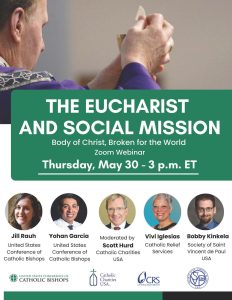
The Eucharist and Social Mission

Join us on May 30 at 3:00 p.m. Eastern Time to reflect on The Eucharist and Social Mission: Body of Christ, Broken for the World during the Solemnity of Corpus Christi. Together, we will break open the Theology of the Eucharist and consider how our liturgical practice calls us to be missionary disciples, going forth from the Eucharistic meal to accompany those who are poor and vulnerable. This webinar will also provide practical examples, resources, and tools to help our Eucharistic communities live the call to transform all that degrades human life and dignity and create systemic change. This virtual event is co-sponsored by the Department of Justice, Peace and Human Development of the United States Conference of Catholic Bishops, Catholic Charities USA, Catholic Relief Services, and the Society of St. Vincent de Paul. Register here. 


En Español

Acompáñennos el 30 de mayo de 2024 a las 7:00 p.m., hora del este, para reflexionar sobre La Eucaristía y la Misión Social: El Cuerpo de Cristo, Partido y Entregado por el Mundo durante la Solemnidad del Corpus Christi. Juntos, profundizaremos sobre la Teología de la Eucaristía y consideraremos cómo nuestra práctica litúrgica nos llama a ser discípulos misioneros, saliendo del alimento eucarístico para acompañar a los más pobres y vulnerables. Este seminario web también proporcionará ejemplos prácticos, recursos y herramientas para ayudar a nuestras comunidades a transformar todo lo que degrada la vida y la dignidad humana y crear cambios sistémicos. Este evento virtual es copatrocinado por el Departamento de Justicia, Paz y Desarrollo Humano de la Conferencia de Obispos Católicos de los Estados Unidos, la Asociación Nacional Católica de Directores Diocesanos para el Ministerio Hispano, el Consejo Nacional Católico para el Ministerio Hispano, Caridades Católicas de los Estados Unidos, Catholic Relief Services y la Sociedad de San Vicente de Paúl. Regístrense aquí.


Governance Update: Councils And Their Conferences

Governance Update: Councils And Their Conferences 1198 1198 admin

Councils And Their Conferences

(Excerpted From Vincentian Life: Council)

This document is about Councils; yet, the starting point of this document is Conferences. Why is that? As you will see below, Councils don’t exist without Conferences and the Council’s primary role is to support the Conferences.

CONFERENCE PARTICIPATION IN THE COUNCIL

This is an important principle to keep in mind: Conferences that do not want to participate with the Council have not been convinced they receive anything of value from the Council and its activities. Councils should never be formed simply for the sake of forming a Council. Councils have a particular purpose and the Conferences must understand what that is.

In the Rule that was in effect prior to 2003, there was a statement that was a clear definition of the purpose of any Council. This statement was in Part II of the Rule, Article 15:

• Councils are responsible for animating and coordinating the work of SVdP units within their respective jurisdictions.

• They serve the Conferences. All Councils are first and foremost at the service of the Conferences with a view to furthering charitable activities. Because every Council gathers information about human needs and services from a variety of sources – the community at large, as well as the Conferences – it keeps Conferences in touch with changing social problems and new programs for helping people.

• … each year, each Council obtains and compiles a consolidated annual report of all the Conferences and Councils attached to it. The Council’s report is then forwarded with any comments to the next higher Council for the preparation of the annual report of the (National) Council of the United States.

• Councils encourage initiatives and strive to bring about the establishment of Conferences, Councils and new works, and the revival of dormant or defunct Conferences.

• A Council reviews and evaluates applications for aggregation and institution that are submitted by its affiliated SVdP groups. If approved at District and Diocesan Council levels, the application is forwarded to the National Council for transmittal to the Council General (International).

• Councils organize, to the fullest possible extent, training and formation sessions for members and potential members on spiritual themes, the Vincentian vocation, and problems of social action and justice.

• To coordinate Vincentian work, Councils keep in regular contact with their Conferences and Councils and inform them of the activities of the Society.

• The Council represents its constituent units in contacts with religious and public authorities.
• Each Council determines the expected contribution (solidarity) from attached Conferences and Councils in order to meet its necessary expenses and assist needy Conference and Council groupings attached to it.

• Special works of the Society conducted by the Councils must rely on the Conferences for support, personnel and funds.

In the current Rule, these responsibilities have not changed. They are also spelled out but not in so compact a form.

The fact of the matter is that all Conferences should be aware of what the Council is doing for them. Conferences should be receiving benefits from the Council that clearly provide value to them. It is the responsibility of the Council to ensure that Conferences understand this clearly. Ultimately, it is the Conference members themselves who make up the Councils and who make the decisions in support of the Conferences.

STRONG CONFERENCES

Strong Conferences make a strong Council! It is the Council’s responsibility to assist and guide Conferences in fulfilling the mission of the Society. The best way to do this is to ensure that Conference leadership and members understand what the Society is all about, what the role of the Conference is and what is expected of members.

When Conferences get into trouble (begin to decline or get into some other difficulty), it is far better to be proactive rather than reactive. It is recommended that each Council form a Conference Resources and Concerns Committee to:

1. Promote understanding and compliance with the Rule, Bylaws and Manual;

2. Develop resources that will help Conferences to understand and fulfill their roles in the Society;

3. Provide training materials for Conference leadership;

4. Monitor Conference activity and act to assist Conferences who are in trouble;

5. Promote and assist in establishing new Conferences;

6. Assist in revitalizing existing Conferences, where needed; and

7. Mediate Conference concerns where needed.

A well-formed Conference Resources and Concerns Committee can monitor Conference activities and offer many aids to make a Conference more effective.

MONITOR SPECIAL CONDITIONS

The following special conditions should be monitored regularly and addressed as necessary:

1. Conference President’s term of office is limited to two consecutive three-year terms. After the two terms, the President must be out of office for at least three years before being elected once again. Technically, as soon as the six years expires, the President is no longer in office and the Conference operates under the leadership of the first Vice President until the election of a new President. In the case of violation of this rule, the Council must ensure that an election is held to replace the outgoing President as soon as possible.

2. Each Conference is to have at least four officers: President, Vice President, Secretary and Treasurer. Each office must be held by a separate person. No one person may hold multiple officer positions. In addition, Statute 12 of Part III of the Rule indicates that a President must not appoint his/her spouse or other closely related individual to an officer position.

3. Service area comes into conflict often within the Society. The District Council should ensure that Conferences provide service only to those people living within the boundaries established for the Conference. These boundaries should be established as a formal agreement between the Conferences in the Council. In some cases, the boundaries will simply be the parish boundaries. In other cases the boundaries may be more extensive, as long as they are agreed upon by the Council. This way, people seeking service cannot simply go from Conference to Conference seeking help. The Conference covering the area where that person or family lives is the one that makes the decision as to help or not help.

A second excerpt from the “Conferences” section of Vincentian Life: Council will appear next week.

April Advocacy Update: Child Tax Credit, Affordable Connectivity Program, and a Supreme Court Case

April Advocacy Update: Child Tax Credit, Affordable Connectivity Program, and a Supreme Court Case 1600 615 admin
Please read the April Adovocacy Update below by Voice for the Poor Chair, Bobby Kinkela:


Fellow Vincentians,

I wanted to share what we are working on and what we are watching.

First, as a member of the Circle of Protection, a broad faith-based coalition, President John Berry signed a letter to members of the U.S. Senate urging them to pass the Child Tax Credit.  The House passed their bill with an overwhelming majority. The Senate is bogged down over politics and not on the merit of the issue.  Thank you to the 2,700+ Vincentians that have sent emails to Congress on this issue.  If you have not weighed in, you can still send your message!  Because the legislative calendar is compressed due to the November election, if the Senate does not act soon, the bill will die.

We are monitoring the Affordable Connectivity Program.  The Affordable Connectivity Program provides a $30 discount on internet bills to income qualified households.  This is one of many programs that helps to reduce the internet costs for individuals. While funding for this program is in jeopardy, several similar programs remain including programs that provide cell phones to people who meet certain requirements.

The Supreme Court is hearing a case this week regarding criminalizing homelessness – Grants Pass v. Johnson.  The city argued that the ordinances merely bar camping on public property by everyone, while the challengers contended that the laws effectively make it a crime to be homeless in the city and therefore violate the Constitution’s ban on cruel and unusual punishment. Monday’s arguments mainly focused on a 1962 Supreme Court ruling Robinson v. California which held that the 8th amendment forbids states from making laws punishing those addicted to drugs. The current challengers to the Oregon case likewise contend that the city’s ordinances, like the state law in Robinson, punish people who are involuntarily homeless.  We anticipate a decision will be made in late June.

Thank you for your advocacy and prayers.

In Christ,
Bobby Kinkela
Chair, Voice for the Poor Committee

04-25-2024 Questions & Answers

04-25-2024 Questions & Answers 1200 628 admin

Q: Does the IRS care if a Conference violates the SVdP Rule and gives to another non-SVdP charity that agrees to spend the money wisely?

A: The IRS indeed cares if a nonprofit violates its own mission, organizational documents, and rules. The Society cares if an SVdP entity violates its Rule. The IRS is not aware of all of SVdP’s prohibitions, but you are. As a holder of an IRS tax-exemption and a member of the Society of St. Vincent de Paul, you must honor both. We have tax exempt status to use funds to fulfill our mission which is stated in our letter of exemption. We are not a pass-through organization. If our donors want to support another organization, they would have given the funds to that organization.

Q: Should the minutes of a conference meeting include specific details of a home visit or is it enough to note what action was decided upon to help a person/family?

A: Conference minutes are the written record of decisions made by the Conference. The details of the home visit are not necessary in the minutes; they may be in a separate case record. However, if there is something about the visit that results in a Conference decision, some details might be noted in the minutes.

En Español

P: ¿Le importa al IRS si una Conferencia viola la Regla de SVdP y dona a otra organización benéfica que no es parte de SVdP y que acepta gastar el dinero sabiamente? 

R: Al IRS le importa si una organización sin fines de lucro viola su propia misión, documentos organizacionales y reglas. A la Sociedad le importa si una entidad SVdP viola su Regla. El IRS no está al tanto de todas las prohibiciones de SVdP, pero usted sí. Como titular de una exención de impuestos del IRS y miembro de la Sociedad de San Vicente de Paúl, debe honrar a ambos. Tenemos un estado de exención de impuestos para usar fondos para cumplir con nuestra misión, que se indica en nuestra carta de exención. No somos una organización de paso. Si nuestros donantes quisieran apoyar a otra organización, le habrían dado los fondos a esa organización.

P: ¿Las actas de las minutas de una reunión de Conferencia deben incluir detalles específicos de una visita domiciliaria o es suficiente anotar qué acción se decidió para servir a una persona/familia?

R: Las actas de las minutas de la Conferencia son el registro escrito de las decisiones tomadas por la Conferencia. Los detalles de la visita domiciliaria no son necesarios en el acta; Pueden estar en un expediente de caso separado. Sin embargo, si hay algo en la visita que dé lugar a una decisión de la Conferencia, se pueden anotar algunos detalles en las minutas.

04-18-2024 Questions & Answers

04-18-2024 Questions & Answers 1200 628 admin

Q: Our Elder Care team makes visits to the elderly in our parish. They have been asked by some families to spend some extra time with the homebound individuals (and sometimes provide a respite for the family caregivers). The question has come up as to what would be our liability or exposure if something (i.e., a medical emergency) occurred while we are there? I suppose something like this could happen even during a home visit with the poor, so I’m not sure if we would treat these cases differently. However, do you think we should be concerned about getting into a situation like this, or would our status and/or insurance coverage protect us?

A: There is a difference between what we do as members of the Society and caregivers. When they are giving respite to the family caregivers, they are effectively acting as the caregivers and need to be qualified to do so (whatever minimal training that is required). Any liability insurance the Society has is based on what we normally do as Vincentians and doing so in a Vincentian manner. If we do something not in compliance with what we promote and do normally, liability coverage may not be provided.

En Español

P: Nuestro equipo de Cuidado para Ancianos hace visitas a los ancianos de nuestra parroquia. Algunas familias les han pedido a nuestros Vicentinos que pasen más tiempo con las personas confinadas en sus casas (y a veces proporcionan una ayuda personal a los familiares para que descansen). Ha surgido la pregunta de cuál sería nuestra responsabilidad o compromiso si algo (es decir, una emergencia médica) ocurriera mientras estamos allí. Supongo que algo así podría suceder incluso durante una visita domiciliaria a los pobres, así que no estoy seguro de si trataríamos estos casos de manera diferente. Sin embargo, ¿cree usted que deberíamos preocuparnos por encontrarnos en una situación como esta, o nuestro estatus y/o cobertura de seguro nos protegería?

R: Hay una diferencia entre lo que hacemos como miembros de la Sociedad y los que cuidan a personas. Cuando están dando un respiro a los que cuidan a sus familiares, están actuando efectivamente como cuidadores y deben estar capacitados para hacerlo (cualquier capacitación mínima que se requiera). Cualquier seguro de responsabilidad civil que tenga la Sociedad se basa en lo que normalmente hacemos como Vicentinos y lo hacemos de la manera Vicentina. Si hacemos algo que no cumple con lo que promovemos y hacemos normalmente, es posible que no se proporcione cobertura de responsabilidad civil.

04-11-2024 Questions & Answers

04-11-2024 Questions & Answers 1200 628 admin

Q: I am bothered by something that happens at our Conference meetings fairly regularly. We have a lot of parishioners who have shown interest in the Society, and it is pretty common to find one or two new faces at most of our meetings. During the meeting, they are allowed to vote on issues just like everyone else. Our President says he wants them to feel welcome and part of the group. Is this a good practice?

A: The answer is “no.” We welcome new people to be part of the Society, but there is a process to follow. In the current version of the Rule/Manual of the Society, there is a promoted procedure for bringing new members into the Society. This procedure includes introduction, training, active participation in works, discernment by the candidate and ultimate approval by the Conference. This process works and should not be short cut in order to bring more people into the Society. The decisions of Conferences are to be made by Active (Full) Members only, usually by consensus.

Q: Our Conference has just approved a set of bylaws. Now that they are approved, what is the next step?

A: The bylaws you approved must (should) correspond to the newly revised bylaws for Conferences approved by the National Council. Be sure that you have a record of the approval and copy of the bylaws in your Conference minutes. Next, send a copy of the bylaws through the organization chart to District and Diocesan Councils for their approval, recording and filing. The District and Diocesan Councils should also record their approvals in their minutes.

Español

P: Me molesta algo que sucede en nuestras reuniones de la Conferencia con bastante regularidad. Tenemos muchos feligreses que han mostrado interés en la Sociedad, y es bastante común encontrar una o dos caras nuevas en la mayoría de nuestras reuniones. Durante la reunión, se les permite votar sobre temas como todos los demás. Nuestro Presidente dice que quiere que se sientan bienvenidos y parte del grupo. ¿Es esto una buena práctica?

R: La respuesta es “no”. Damos la bienvenida a nuevas personas para que formen parte de la Sociedad, pero hay un proceso a seguir. En la versión actual de la Regla/Manual de la Sociedad, existe un procedimiento que se utiliza para invitar a nuevos miembros a la Sociedad. Este procedimiento incluye la presentación, la formación, la participación en los trabajos, el discernimiento por parte del candidato y la aprobación final por parte de la Conferencia. Este proceso funciona y no debe de haber un atajo para atraer a más personas a la Sociedad. Las decisiones de las Conferencias deben ser hechas únicamente por los Miembros Activos (en Pleno Derecho), generalmente por consenso.

P: Nuestra Conferencia acaba de aprobar un conjunto de Estatutos. Ahora que están aprobados, ¿cuál es el siguiente paso?

R: Los Estatutos que ustedes aprobaron deben corresponder a los Estatutos para Conferencias recientemente revisados y aprobados por el Consejo Nacional. Asegúrese de tener un registro de la aprobación y una copia de los Estatutos en las actas de la Conferencia. A continuación, envíe una copia de los Estatutos a través del organigrama a los Consejos Distritales y Diocesanos para su aprobación, registro y archivo. Los Consejos de Distrito y Diocesanos también deben registrar la aprobación de sus Estatutos en sus actas.


Sign Up for Our Newsletter

Privacy Preferences

When you visit our website, it may store information through your browser from specific services, usually in the form of cookies. Here you can change your Privacy preferences. It is worth noting that blocking some types of cookies may impact your experience on our website and the services we are able to offer.

Click to enable/disable Google Analytics tracking code.
Click to enable/disable Google Fonts.
Click to enable/disable Google Maps.
Click to enable/disable video embeds.
Our website uses cookies, mainly from 3rd party services. Define your Privacy Preferences and/or agree to our use of cookies.
Skip to content