
• Search the Site

Posts By :

admin

Feature: Weaving Bonds and Building Community

Feature: Weaving Bonds and Building Community 1906 1071 admin

Weaving Bonds and Building Community

By Pam Matambanadzo, SVdP Chicago area

We “make no distinctions in those we serve because, in them, Vincentians see the face of Christ.”

We follow in the footsteps set by Blessed Frédéric so many years ago, journeying towards holiness and building on generations before us. Now that we have accepted the baton, we need to pass it on to others so that we can reinforce the strength of the baton. Our challenge is that the world has changed and evolved but our ways have lagged. Our parish communities no longer look like they did 20 or 40 years ago. We hold on to the ways we have been operating even when our efforts are not bearing fruit.

Change is hard. How do we make sure that as we journey together our legacy, like Blessed Frédéric , will inspire diverse Vincentians for generations to come?

Striving for diversity within the Society of St. Vincent de Paul is not just a reflection of societal values, but also a strategic approach to better fulfill our mission. By mirroring the diversity of both Catholic parishioners and the communities they serve, SVdP ensures a more inclusive, culturally competent, and effective response to the challenges of poverty.

Our efforts need to reflect the diversity of both those in the pews, as well as those attending Mass at different time slots to ours. Our awareness should also be inclusive of the broader communities we serve, extending beyond ethnicity and encompassing age and economic diversity. We need to ask ourselves this: Are we “enabling each person to participate actively in the Church’s mission according to his or her own charism and vocation”? Here are four areas that we should contemplate:

Inclusivity and Representation

  • Fellow Parishioners: The global Church is a community that spans a rich tapestry of cultural, linguistic, and ethnic backgrounds. Mirroring this diversity ensures that we, as an organization, are inclusive and representative of the broader Catholic community, fostering a sense of belonging among parishioners.
  • Communities Served: Those who seek assistance from us come from various backgrounds, reflecting the diversity of the broader society. By embracing diversity within our own ranks, the Society ensures that our members can better relate to and understand the unique needs of those we serve, fostering trust and creating a more empathetic and effective support system.

Cultural Competence

  • Understanding Different Perspectives: A diverse membership brings a range of perspectives, experiences, and cultural competencies. This diversity allows us to approach issues with a more nuanced understanding, ensuring that our services are culturally sensitive and relevant to the diverse needs of the communities we serve. Encountering them where they are. When stocking our pantries, are we providing food for the communities we are serving, or are we guided by our own lived experience? Culturally, we each have different comfort foods.
  • Communication and Outreach: We have always prided ourselves on our ability to tailor services based on the needs of the person in front of us. Different communities will have unique challenges and require tailored approaches. Having a diverse membership allows us to communicate effectively and engage with a wider audience, breaking down potential cultural and linguistic barriers that might hinder outreach efforts. Have we explored growth potential locally — even if we may need to accommodate other languages?

Young and Economic Diversity

  • Attracting a New Generation of Vincentians: Embracing young members ensures the longevity and sustainability of the Society’s mission. By involving younger members, the organization can benefit from fresh perspectives, technological savvy, and a passion for social justice, helping to adapt and evolve its services to meet changing community needs. Are we open to changing our meeting times to accommodate younger members with work and family commitments?
  • Economic Diversity: Economic challenges affect individuals and families across various demographics. A diverse member base, including individuals from different economic backgrounds, can bring a more comprehensive understanding of the issues related to poverty and inequality. This can lead to more effective strategies for addressing these challenges at both the individual and systemic levels.

Building a Stronger Community 

  • Collaboration and Unity: A diverse group of members fosters collaboration and unity within the organization. When individuals from diverse backgrounds work together towards a common goal, it strengthens the sense of community within community and society as a whole.
  • Inspiring Others: Seeing a diverse group of members actively engaged in service to the People of God can inspire others to join our chosen vocation. This can lead to a snowball effect, encouraging more people from various backgrounds to participate, broadening the organization’s impact and reach.

The Multicultural Diversity Committee is committed to “End Poverty Through Systemic Change” with a laser focus on removing all barriers associated with discrimination of any kind through education, awareness, and compassion. The committee holds a monthly Zoom call to encourage Vincentians to advocate for justice in their local community. Learn more information at https://members.ssvpusa.org/diversity

3-20-25 Weekly Questions & Answers

3-20-25 Weekly Questions & Answers 1200 628 admin

March 20, 2025

Q: A SVdP active member has asked that our Conference help a seminarian in need. I know we should not send him money, but can we pay for books or help pay for some of his tuition? We have sufficient funds to help.

A: Assistance to a seminarian would have to be treated as any other case – home visit, then help in the same way we would help others. There are no other guidelines to provide.

Q: If a small group of members gather before or after their work for a spiritual reflection and a short time to visit, does that count as a Conference meeting? Do any of the officers have to be present? What about the spiritual advisor?

A: The objectives of the Society are growth in holiness, community, and service. The Conference meeting is one of the only times when all three come into play. That is why the meeting is so important. If a Conference meets before a service, etc., then it can still be considered a meeting if at least half of the active members are present, including officers. Three or four members of a larger Conference getting together does not make it a Conference meeting.


20 de Marzo

P: Un miembro activo de la SVdP ha pedido que nuestra Conferencia ayude a un seminarista necesitado. Sé que no debemos enviarle dinero, pero ¿podemos pagar los libros o ayudar a pagar parte de su matrícula? Tenemos fondos suficientes para ayudar.

R: La asistencia a un seminarista tendría que ser tratada como cualquier otro caso: Visita Domiciliaria, entonces se ayuda de la misma manera que ayudaríamos a los demás. No hay otras pautas que proporcionar.

P: Si un pequeño grupo de miembros se reúne antes o después de su trabajo Vicentino para una reflexión espiritual y un corto tiempo para compartir, ¿eso cuenta como una reunión de la Conferencia? ¿Alguno de los Oficiales tiene que estar presente? ¿Y que hay acerca del Consejero Espiritual?

R: Los objetivos de la Sociedad son el crecimiento en santidad, amistad y servicio. La reunión de la Conferencia es uno de los pocos momentos en los que los tres entran en juego. Por eso es tan importante la reunión. Si una Conferencia se reúne antes de hacer un trabajo, etc., entonces aún puede considerarse una reunión si al menos la mitad de los miembros activos están presentes, incluidos los Oficiales. El hecho de que tres o cuatro miembros de una Conferencia más grande se reúnan no lo convierte en una reunión de la Conferencia.

3-13-25 Weekly Questions & Answers

3-13-25 Weekly Questions & Answers 1200 628 admin

March 13, 2025

Q:  We have a Conference President approaching the end of her second term and trying to plan her succession. No current member of this active Conference seems willing to step up to succeed her. If that does not change, what should happen with the Conference?

A:  There are two choices, either elect someone from within or close the Conference. It is up to the Conference members to step forward and provide leadership for their Conference. A District Council president can temporarily appoint someone to be Conference President if no president is nominated before the current president term ends, but an election has to take place as soon as possible and within a reasonable time. The current president should NOT stay in office after their term has officially ended.

Q:  Can you cite how often District Councils are to meet? I can’t seem to locate this information in “The Rule.”

A:  Refer to your adopted bylaws. In each District Council bylaws is an article titled Meeting Frequency and Notice Requirements that reads, “The Board shall decide upon a schedule of regular Board meetings and present said schedule to the Corporation members annually.”


13 de Marzo

P: Tenemos a una Presidenta de Conferencia que se acerca al final de su segundo mandato y está tratando de planificar su sucesión. Ningún miembro actual de esta Conferencia activa parece estar dispuesto a dar un paso al frente para sucederla. Si eso no cambia, ¿qué debería suceder con la Conferencia?

R: Hay dos opciones, elegir a alguien dentro o cerrar la Conferencia. Corresponde a los miembros de la Conferencia dar un paso al frente y dirigir su Conferencia. Un Presidente de Consejo de Distrito puede nombrar temporalmente a alguien para que sea Presidente de la Conferencia si no se nombra a ningún Presidente antes de que termine el mandato del Presidente actual; Sin embargo, las elecciones deben celebrarse lo antes posible y dentro de un plazo razonable. El actual Presidente NO debe permanecer en el cargo después de que su mandato haya terminado oficialmente.

P: ¿Puede citar la frecuencia con la que se reúnen los Consejos de Distrito? Parece que no puedo localizar esta información en “La Regla”.

R: Refiérase a los Estatutos que se adoptaron. En los Estatutos de cada Consejo de Distrito hay un artículo titulado Frecuencia de Reuniones y Requisitos de Notificación que dice: “La Mesa Directiva decidirá sobre un calendario de reuniones regulares de la Mesa Directiva y presentará dicho calendario a los miembros de la Corporación anualmente”.

Contemplation: Between Doing and Being

Contemplation: Between Doing and Being 1080 1080 admin

By Timothy Williams, Senior Director of Formation and Leadership Development 

It has been said that God only asks us to devote one day a week to him, and on that day he asks us not to work, but to rest. On Sunday, then, you are simply a human being. The other six days, you are a human doing. For Vincentians, though, rest from our works of charity often seems unthinkable.

We seek to share generously of our time, our talents, our possessions and ourselves. [Rule, Part I, 2.5.1] By acting upon this virtue of selflessness, we seek to become truly selfless, emptied of self, so that we can be filled with God. Vincentians are people of action; of contemplation, also, but not at the expense of loving God with the strength of our arms and the sweat of our brows!” [CCD XI:32]

We follow the example of St. Louise de Marillac, whose commitment to serving the poor, the foundlings, the sick, the victims of war, and her own Daughters of Charity led her often to drag herself out of her own sickbed to go about her work. For all of his own lifelong whirlwind of work and activity for the poor of seventeenth century France, it was St. Vincent who often reminded her – implored her – to stop and to rest. “Increase your strength,” he advised. “You need it, or, in any case, the public does.” [CCD I:392]

We are called not to hoard our resources; everything given to us is meant to be used to relieve the needs of today. As a result, there may come days when we have no more money to give; both we and the neighbor understand this. In a similar way, we don’t hold back our love, our presence, or our efforts when they are needed – and we are able. But just as the money sometimes runs out, so, too, can our personal reserve of strength and stamina.

Aristotle said that if you want to become a builder, you build something. If you want to become virtuous, you do virtuous things. [Nichomachean Ethics] We become by doing; what begins as an exterior practice, becomes interior. We no longer simply act generously, we become generous.

So, what do we become if we do too much, especially if we do so much that we can do no more without suffering burnout, or compassion fatigue, or physical exhaustion; if our very actions of virtue lead to our inability to continue them? We are people of contemplation and action, and we need to pause our actions in order to replenish and refresh ourselves with prayer and rest.

The Catechism teaches that the cardinal virtue of temperance moderates our desires for worldly goods. In a sense, learning to control our drive to always “do more” can be an exercise in temperance, allowing our love of God and neighbor to be undisturbed by a body or mind crying out for rest. Only each of us can know our personal limits, and not everything that makes us tired is too much, but there is a time for everything, even rest.

Contemplate

Do I pause to refresh myself with prayer and reflection, rather than focusing only on “the work”?

Recommended Reading

15 Days of Prayer with Blessed Frédéric Ozanam


Contemplación : ENTRE EL HACER Y EL SER

Traducción de Sandra Joya

Se ha dicho que Dios sólo  nos pide que le dediquemos un día  a la semana y que en ese día  no mos pude qye travahemos, sino que descabsemos. El domingo, pues. eres simplemente un ser humano. Los otros seis días eres  un ser humano que hace.  Sin embargo, para los Vicentinos, el descanso de nuestras obras de caridad a menudo parece impensable.

Buscamos compartir generosamente nuestro tiempo, nuestros talentos, nuestras posesiones y a nosotros mismos.  (Regla, Parte 1, 2. 5 1) Al actuar según  ésta  virtud del altruismo, buscamos volvernos verdaderamente altruistas, vaciamos de nosotros mismos, para poder llenarnos de Dios. Los Vicentinos somos gente de acción; de Contemplacion,  también , pero no a expensas de amar a Dios con la fuerza de nuestros brazos, y el sudor de nuestra frente. (SV XI.32)

Seguimos el ejemplo de Santa Luisa de Marillac, cuyo compromiso al servicio de los pobres, los expositos. los enfermos, las víctimas de la guerra y sus propias Hijas de la Caridad la llevaron a menudo a salir de su propio lecho de enferma para dedicarse a su travajo. A pesar de todo el torbellino de trabajo y actividades que vivió  durante toda su vida en favor de los pobres de la Francia del siglo XVII,  fue San Vicente quién  a menudo le recordó-que se detubiera y descansara “Aumenta tus fuerzas, le aconsejó. Tú  las necesitas, o en todo caso, el público  las necesita” (SV I, 392)

Estamos llamados a no acumular nuestros recursos; todo lo que se nos da está  destinado a ser utilizado para aliviar las necesidades de hoy. Como resultado, puede haber días en que no tengamos más  dinero para dar; tanto nosotros como el prójimo  lo entendemos. De manera similar no retenemos nuestro amor, nuestra presencia o nuestros esfuerzos cuando son necesarios somos capaces de hacerlo. Pero así  como el dinero, a veces se acaba, también  puede agotarse nuestra reserva personal de fuerza y resistencia.

Aristóteles decía, que si quieres ser constructor, construyes algo, si quieres ser virtuoso,  haces cosas virtuosas (Ética de Nicomaco)  Llegamos a ser haciendo; lo que comienza como una práctica  exterior, se vuelve interior. Ya no actuamos simplemente con generosidad, nos volvemos generosos.

Entonces ¿ en qué  nos convertimos si hacemos demasiado, especialmente si hacemos tanto que no podemos hacer más, sin sufrir agotamiento, fatiga por compasión  o agotamiento físico; si nuestras mismas acciones de virtud nos llevan a ser incapaces de continuar con ellas? Somos personas de Contemplacion  y acción  y necesitamos hacer una pausa en nuestras acciones para reponernos y refrescarnos con la oración  y el descanso.

El Catecismo nos enseña que la virtud cardinal de la templanza modera nuestros deseos de bienes mundanos. En cierto sentido, aprender a controlar nuestro lmpulso de “hacer siempre más” puede ser un ejercicio de templanza, permitiendo que nuestro amor a Dios y al prójimo  no se vea perturbado por un cuerpo o una mente que claman por descansar; sólo  cada uno de nosotros puede conocer sus límites  personales, y no todo lo que nos causa es demasiado ,pero hay un tiempo para todo,incluso para el descanso”

Contemplar 

¿Me detengo para refrescarme con la Oración  y la Reflexión, en lugar de centrarme sólo  en el trabajo?

Contemplation: Only the Father Knows Best

Contemplation: Only the Father Knows Best 1080 1080 admin

By Timothy Williams, Senior Director of Formation and Leadership Development 

Have you ever thought, “Who are these people who keep calling us for help? If they had made better decisions, they never would have needed help!” It’s only natural to judge things only from our own perspective, and to assume that our way is the right way. Maybe it would be if everybody had faced the same choices and had the same opportunities as we did, but of course, we know they haven’t.

We can also be tempted, when we think this way, to condition our future assistance, even if only subconsciously, on whether the neighbor takes our advice. Yet we are taught that we should “not be quick to advise,” instead remaining humble enough to recognize that ours may not be the best advice, and that respecting the neighbor’s dignity also means that we “must never force our will onto those we help. Be sure that you don’t make your assistance dependent upon them actually taking your advice.” [Pres. Handbook, 35]

We are called to “establish relationships based on trust and friendship” with the neighbor – mutual relationships between equals, not agent-client, or parent-child relationships. We seek to see Christ in those we serve and to “understand them as we would a brother or sister.” [Rule, Part I, 1.9] After all, only the Father knows best.

Christ shared meals, the sort of intimate gathering one reserves for friends, with sinners, not because they were deserving, but because they were the ones most in need. In a similar way, we must always remember that we “are dealing with individuals and families who may be desperate, who often have dysfunctional histories, and who are at a point in their lives when a multitude of problems weigh them down. These are precisely the people whom the Society is called on to serve by bringing them support and hope.” [Manual, 23] We carry this friendship, understanding, and compassion for the neighbor in our hearts, in our actions, and in our words.

God forbid that we should slander the poor whom the Gospel blesses, or render the suffering classes responsible for their misery,” Bl. Frédéric reminds us, adding that this only serves to make us feel “exonerated from helping the poor man when they have proved his wrongdoing.” [O’Meara, 248] The neighbor, the poor one, is our brother, our sister, our friend, not our client, NIN, or FIN. When sharing our Home Visit reports at meetings, we should always imagine the neighbor sitting right in our midst, listening to the words we say, and, through us, participating in the discussion.

Because we can never really know the neighbor’s whole story, we also cannot know if in fact we would have made different choices ourselves in their situation. We can only know that right now, they are suffering, and that they are for us the sacred images of that God whom we do not see and not knowing how to love Him otherwise, we love Him in their persons. [cf. 137, to Janmot, 1836]

Contemplate

How can I better keep my mind and heart open to love the neighbor without judgment?

Recommended Reading

Apostle in a Top Hat


Contemplación : SÓLO EL PADRE SABE MÁS

Traducción de Sandra Joya

Alguna vez has pensado: “¿Quiénes  son estas personas que nos siguen pidiendo ayuda? Si hubieran tomado mejores decisiones, nunca habrían  necesitado ayuda.” Es natural juzgar las cosas sólo  desde nuestra propia perspectiva y suponer que nuestra manera de actuar es la correcta. Tal vez lo sería  si todos se hubieran enfrentado a las mismas opciones y hubieran tenido las mismas oportunidades que nosotros pero, por supuesto, sabemos que no es así.

También  podemos sentirnos tentados, cuando pensamos de ésta  manera, a condicionar nuestra futura ayuda, aunque sea de manera inconsciente, a que el prójimo  siga nuestro consejo. Sin emvargo, se nos enseña que no debemos  “apresurarnos a dar consejos” sino que debemos ser lo suficientemente humildes para que al reconocer que nuestro consejo puede no ser el mejor, y que respetar  la dignidad del prójimo  también  significa que ” nunca debemos imponer nuestra voluntad a quienes ayudamos. Asegurate de no hacer que tu ayuda dependa de que realmente sigan tú  consejo. (Pres. Manual 35)

Estamos llamados a “establecer relaciones basadas en la confianza, y la amistad” con el prójimo: relaciones mutuas entre iguales, no relaciones de agente- cliente  o de padre – hijo. Buscamos ver a Cristo en aquellos a quienes servimos y “comprenderlos, como entenderíamos  a un hermano o a una hermana” (Regla, Parte 1, 1.9) Después de todo, sólo el Padre sabe más.

Cristo compartió las comidas, el tipo de reunión  íntima  que uno reserva para los amigos, con los pecadores, no porque lo merecieran, sino porque eran los más  necesitados. De manera similar, siempre debemos recordar que ” estamos tratando con individuos y familias  que pueden estar desesperados, que a menudo, tienen historias disfuncionales y que están  en un punto de sus vidas en que una multitud de problemas los agobian. Estas son precisamente las personas a quienes la Sociedad está  llamada a servir llevandoles apoyo  y esperanza” (Manual, 23) Llevamos ésta  amistad, comprensión  y compasión  por el prójimo en nuestros corazones, en nuestras acciones y en nuestras palabras.

Dios no permita que calumniemos a los pobres a quienes El Evangelio bendice, o que hagamos responsable de su miseria a las clases que sufren” nos recuerda el beato Federico, añadiendo que esto sólo sirve para hacernos sentir “exonerados de ayudar al pobre cuando se ha demostrado su mal proceder.” (O’Meara, 248) El vecino, el pobre, es nuestro hermano, nuestra hermana, nuestro amigo, no nuestro cliente, NIN, o FIN. Cuando compartimos nuestros informes de visitas domiciliarias en las reuniones, siempre debemos imaginar al vecino sentado en medio de nosotros escuchando las palabras que decimos, y, a través de nosotros participando en la discusión.

Cómo  nunca podemos conocer realmente la historia completa del vecino, tampoco podemos saber si de hecho nosotros mismos hubiéramos  tomado decisiones diferentes en su situación. Sólo podemos saber que ahora mismo, ellos están sufriendo y que son para nosotros las imagenes sagradas de ese Dios a quién no vemos y, al no saber cómo  amarlo de otra manera, lo amamos en sus personas. (cf. 137, a Janmot, 1836)

Contemplar 

¿Cómo puedo nantener mejor mi mente y mi corazón para amar al prójimo sin juzgar?

Feature: Formation & The Vincentian Digital Pathway

Feature: Formation & The Vincentian Digital Pathway 1839 510 admin

A Lifelong Journey of Becoming

By Tim Williams, Senior Director of Formation & Leadership Development

When I am formed,” a frustrated young Frédéric Ozanam asked, “When will that be?” Many of us may share his confusion. We attend the Ozanam Orientation, which we know is formation, and then, satisfied that we have checked off our “formation” box we find ourselves instead constantly invited to more and more “formation”! So, what is formation, exactly?

The primary purpose of the Society of St. Vincent de Paul is our own growth in holiness, our seeking to become, as Christ calls us to be, “perfect, just as your heavenly Father is perfect.” Attaining holiness, or perfection, is not the work of one seminar or workshop – it is a lifelong journey of becoming.

The Society of St. Vincent de Paul is a true lay vocation, a special way of being Catholic, a special pathway for us to follow on our journey: the Vincentian Pathway. On this pathway, we are formed in four different dimensions.

  • Our Human Formation is focused on our behavior, beginning with our virtues. We study and try to practice our Vincentian Virtues of simplicity, humility, gentleness, selflessness, and zeal, knowing that we may become by doing. Just as one becomes a builder by building, we may become humble by practicing humility. And all of these virtues in service of the greatest virtue of love, are practiced in our person-to-person service of the poor.
  • Our Spiritual Formation, most importantly, is shared. No one is saved alone, as we are taught, and in turn, you cannot be a Vincentian without other Vincentians. We are created to live in communion, and to help lead each other to holiness. As our Rule puts it, we grow in holiness together. This growth is fed, informed, and enriched by our regular spiritual reflections at Conference meetings, by attending Mass together, and by our life of prayer, individual and shared.
  • Our Intellectual Formation connects our minds and our hearts. It includes reading to help us learn more about our heritage and our traditions, and training to help us better understand the changing face of poverty and systemic change, and to be better servant leaders.
  • Finally, our Ministerial Formation draws us to truly live this vocation, to make our service to the poor and to each other not merely a thing that we do, but a thing that we are. In our ministerial formation, we are open to all opportunities to serve, including servant leadership.

If you are perfect, your formation is complete! For the rest of us, the National Formation Committee, chaired by Marge McGinley, tries to provide a wide variety of resources to help each Council, each Conference, and each member to follow the path in a way that best suits their own calling, interests, and charisms.

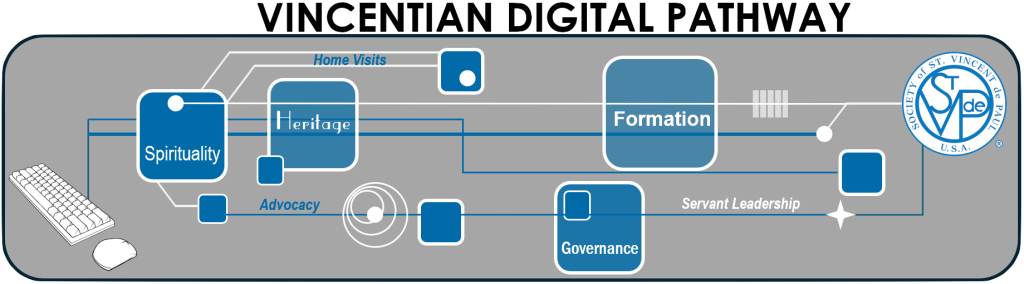
A good starting point for all is the Vincentian Digital Pathway, introduced last year. Here, you can begin wherever you wish, and explore the documents, videos, pictures, and books collected there. You will find that the links will take you into other subject areas, sometimes areas you did not realize were so closely connected. In the Digital Pathway, you do not have to know what you are looking for – just jump in and find what speaks to you, without trying to “check every box”!

If you are brand new to the Society, or you haven’t been to an Ozanam Orientation in a while, you might want to start with the “Introduction to the Society” video. View it alone, or better yet, with other members so you can pause and discuss it.

Are you looking for an even deeper dive? For Servant Leaders, the Society offers a unique and very special retreat twice a year called Invitation for Renewal. For all members, you can take online course through the Ozanam Institute.

Each Region also has a formation team, and in turn each Council has one, too. In the Conference, it is the Spiritual Advisor who is primarily responsible for guiding (and sharing in) the formation of members. These teams of Formators and Spiritual Advisors put together workshops, training, retreats, formation plans, and more not acting as professors or priests, but as fellow Vincentians, walking the pathway alongside us, all of us growing in holiness together.

2-27-25 Weekly Questions & Answers

2-27-25 Weekly Questions & Answers 1200 628 admin

February 27, 2025

Q:  Our Conference has not been doing many Home Visits and we would like to promote this and get our members comfortable with it. What is available in the way of training for doing Home Visits? 

A:  The Ozanam Orientation is an excellent training tool. Part of the Ozanam Orientation is a segment devoted to home visitation. This segment includes a PowerPoint presentation as well as training videos which present both the right and the wrong of Home Visits. Many Councils throughout the country have separated Home Visits from the Ozanam Orientation and offer it as a separate workshop. There are a lot of materials available related to this. For more details contact our Senior Formation Director, Tim William, twilliams@svdpusa.org.

Q:  Does the Society have a policy related to investments that is based on moral objectives?

A: The National Council Resolution 140 identifies the criteria/process to be used in accepting donations and developing relationships. This also applies to making investments. Click here to view National Resolutions: https://members.ssvpusa.org/governance/resolutions/


27 de Febrero

P: Nuestra Conferencia no ha estado haciendo muchas Visitas Domiciliarias y nos gustaría promover esto y hacer que nuestros miembros se sientan cómodos con ello. ¿Qué hay disponible en forma de capacitación para hacer las Visitas Domiciliarias?

R: La Orientación Ozanam es una excelente herramienta de formación. En una parte de la Orientación Ozanam existe un segmento dedicado a las Visitas Domiciliarias. Este segmento incluye una presentación de PowerPoint, así como videos de capacitación que presentan lo correcto y lo incorrecto de las Visitas Domiciliarias. Muchos Consejos en todo el país han separado las Visitas Domiciliarias de la Orientación Ozanam y la ofrecen como un taller separado. Hay una gran cantidad de materiales disponibles relacionados con esto. Para obtener más detalles, póngase en contacto con nuestro Director de Formación, Tim William, twilliams@svdpusa.org.

P: ¿Tiene la Sociedad una política relacionada con las inversiones que se basa en objetivos morales?

R: La Resolución 140 del Consejo Nacional identifica los criterios/procesos que se utilizarán para aceptar donaciones y desarrollar relaciones. Esto también se aplica a la realización de inversiones. Haga clic aquí para ver las Resoluciones Nacionales: https://members.ssvpusa.org/governance/resolutions/

Contemplation: The Strength of Our Arms

Contemplation: The Strength of Our Arms 1080 1080 admin

By Timothy Williams, Senior Director of Formation and Leadership Development 

We are commanded to love God with our whole heart, our whole being, and our whole strength. This command speaks to our unitary nature, spirit and body together, calling on us to love completely: with our whole being. Jesus repeats this commandment, calling it the greatest one, and adding to it a second part, to “love your neighbor as yourself,” which He says is like the first. If we love God, then, with all our strength, can we love the neighbor in any other way?

St. Vincent taught that “love is divided into affective and effective love” and that affective love is “a pleasure and tender feeling one has for the thing loved, as a father has for his child.” [CCD XI:35] This is the love of our hearts, a love which comes naturally and easily, a love that is expressed in our gentleness, our patience, and our words. Effective love, though, demands more from us; it demands our action and our work. It is, Vincent explains, “doing the things the loved person commands or desires.” [Ibid] Love, then, becomes not simply an emotion, but an act of will, and not our own will, but the will of the God who gave us this greatest commandment.

Our neighbors, our loved ones, often command or desire much from us, with needs that can be met not only with our possessions, but with our time, our talents, and ourselves of which we promise to give generously. [Rule, Part I, 2.5.1] “Who is my neighbor?” the young man asks Christ. In reply, Jesus shows him that there is always more than one neighbor: the one in need of help, and the one who helps. As neighbors ourselves, the love that we owe is not only gentle words of reassurance, but the work of binding the wounds and the time to set aside our own plans in order to share the burdens of our wounded neighbor. We love our neighbor as ourselves.

Love, agape, charity, is our motive. As Blessed Frédéric once explained, charity “is a fire that dies without being fed, and good works are the food of charity.” [82, to Curnier, 1834] This work, this love we offer, is our labor of love, not a mere task that can be hired out. “If you hire someone to do it,” St. Vincent explained, not only will it be costly, but this practice will grow, our gift of time and self will be reduced to material gift only, “and in this way your Charity will be reduced to failure.” [CCD I:70]

All this work, expending the “strength of our arms and the sweat of our brow” may leave us feeling depleted at times, just as our Conference treasuries may at times run low. Just as our financial assistance may pause until those treasuries are replenished, so our bodies must sometimes be refreshed in order to continue the work, for “even though God commands us to love Him with all our heart and with all our strength. His Goodness doesn’t, however, want us to go so far as to damage and ruin our health by these acts; no, no! God doesn’t ask us to kill ourselves for that.” [CCD XI:204]

We rest not in order to escape the work, but in order to continue it, because if they are to know we are Christians by our love, they must know our love by our work.

Contemplate

Am I fully committed to doing the work of love?

Recommended Reading

Faces of Holiness


Contemplación : La fuerza de nuestros brazos

Traducción de Sandra Joya

Se nos manda amar a Dios con todo nuestro corazón, con todo nuestro ser y con todas nuestras fuerzas. Este mandamiento habla de nuestra naturaleza unitaria, espíritu  y cuerpo juntos. y nos llama a amar completamente; con todo nuestro ser. Jesús  repite este mandamiento,llamándolo  el mayor, y añadiendole una segunda parte, “amar al prójimo  como a ti mismo”, que dice que es como el primero. Si amamos a Dios entonces, con todas nuestras fuerzas, ¿ podemos amar al prójimo  de otra manera?

San Vicente enseñaba que “el amor se divide en amor afectivo y amor efectivo” y que el amor afectivo es “un placer y un sentimiento tierno que uno tiene por la cosa amada, como un padre tiene por su hijo” ( SV XI: 35) Este es el amor de nuestros corazones, un amor que surge natural y fácilmente, un amor que se expresa en nuestra dulzura, nuestra paciencia y nuestras palabras. El amor efectivo, sin embargo, exige más  de nosotros, exige nuestra acción  y nuestro trabajo. Se trata, explica Vicente, de ” hacer lo que la persona amada manda o desea” (lbid.) El amor, entonces, no se convierte simplemente en una emoción,  sino en un acto de voluntad, y no nuestra propia voluntad, sino la voluntad de Dios que nos dio este gran mandamiento.

Nuestros vecinos, nuestros seres queridos, a menudo nos mandan o desean mucho, con necesidades que pueden ser satisfechas, no solo con nuestras posesiones, sino con nuestro tiempo, nuestros talentos y con nosotros mismos, de los que nos comprometemos a dar generosamente (Regla 1, 2.5.1) ¿Quién  es mi prójimo? Pregunta el joven a Cristo. En respuesta, Jesús  le muestra que siempre hay más  de un prójimo; el que necesita ayuda y el que ayuda. Como prójimos  nosotros mismos, el amor que debemos no solo son palabras suaves de consuelo, sino el trabajo de curar las heridas y el tiempo para dejar de lado nuestros propios planes para compartir las cargas de nuestro prójimo herido. Amamos a nuestro prójimo  como a nosotros mismos.

El amor, el ágape, la caridad, es nuestro motivo, y la caridad, como explica una vez el veato Federico, “es un fuego que se apaga sin ser alimentado, y las buenas obras son el alimento de la caridad” (82, a Curnier 1834), Este trabajo, este amor que ofrecemos, es nuestro trabajo de amor, no una simple tarea que se puede contratar, “Si contratais a alguien para que lo haga”, explicaba San Vicente, no sólo será  costoso, sino que esta práctica crecerá , nuestro don de tiempo y de nosotros mismos se reducirá  a un don material,” y de esta manera vuestra caridad se verá reducida al fracaso (SV I:70)

Todo este trabajo, que gasta ” la fuerza de nuestros brazos y el sudor de nuestra frente”, puede hacernos sentir agotados a veces, así  como a veces pueden escasear los fondos de nuestra Confetencia. Así  como nuestra ayuda economica, puede detenerse hasta que esos tesoros se repongan, así  también  nuestro cuerpo debe ser renovado a veces para continuar la obra, porque ” si bien Dios nos manda amarlo con todo nuestro corazón  y con todas nuestras fuerzas, su bondad no quiere, sin embargo, que lleguemos hasta el punto de dañar y arruinar nuestra salud con estos actos; ¡ no, no! Dios no nos pide que nos matemos por eso”. (SV XI, 204)

No descansamos para escapar de la obra. sino para continuarla, porque para que conozcan que somos cristianos por nuestro amor, deben conocer nuestro amor por nuestro trabajo.

Contemplar 

¿Estoy plenamente comprometido con la obra del amor?

Feature: Membership Services & Aggregation

Feature: Membership Services & Aggregation 2560 1920 admin

Aggregation: Your Official Enrollment into the Vincentian Family

By Pam Hudson Johnson, National Director of Membership Services

SVdP’s Rule and practices require that Conferences and Councils take the necessary steps to become membered into the International Confederation of the Society of St. Vincent de Paul. This process of becoming membered as a Conference is known as aggregation. The process of membership as a Council is known as institution.

The National Council strongly urges Conferences and Councils to review your official status. If you find that you have not been formally accepted into the Society internationally, please take immediate steps to rectify that oversight.

Photo: SVdP Georgia’s Wall of Aggregation

How do I know that my Conference has been Aggregated?

When you are formally recognized as an official SVdP entity in solidarity and adherence to the Rule, your Conference will receive a Letter of Aggregation, or your Council will receive a Letter of Institution.

New Conferences are eligible to apply for aggregation after one year operation, filing an annual report and contributing to solidarity. Councils do not have a waiting period and can apply for institution immediately after formation.

The National Council office is pleased to announce the recent arrival of 26 Letters of Aggregation and 6 Letters of Institution all dated December 15, 2024 from the International Council. Applications from around the world are processed and there is a 6-9 month delay in receiving the certificates.

History of Aggregation

From the very beginning, Society members wanted to retain the closeness of brotherhood, and as such, they were hesitant about subdividing and forming numerous Conferences. When they realized the need for additional Conferences, they wanted to preserve a sense of common unity and solidarity with one another. To preserve this unity and solidarity, official enrollment in the Vincentian family has always remained a function of the Council General itself. The Council General established the application process and announces new affiliations.

In the Manual page 27 and throughout the Rule (Sec 1.3.8; Sec 2.6 & Sec 3 Statute 6) you will find an official definition and explanation of the process of aggregation for Conferences and institution for (Arch) Diocesan Councils and Districts.

Benefits of Aggregation

Once your Conference is aggregated or your Council is instituted, you will be eligible for participation in national programs such as Friends of the Poor® and Systemic Change grants and Certificates of Appreciation.

Is your Conference aggregated, and Council instituted? To learn more, contact Membership Services at membership@svdpusa.org.

2-20-25 Weekly Questions & Answers

2-20-25 Weekly Questions & Answers 1200 628 admin

February 20, 2025

Q: We are about to have an election for District Council President.  Our existing Council President is not running for a second term. As Council President, he will not vote unless there is a tie. If the election results in a tie, is he allowed to cast the tie breaking ballot?

A: You are correct. That will work in your case since your Council president is not running for office. However, keep in mind that in the future, it would be best to set a specific tie breaking process that would not include the existing president’s vote. That process needs to be approved by the Council before the election takes place.

Q: I have a comment in my notes that all officers of the Board [and I assume officers of Councils and Conferences as well] must be Vincentians [I read this to mean Catholic]. I can’t find any reference to this in the Rule or the bylaws. Can you lead me to where this distinction is made?

A: The Rule, Part III, Statute 3: An active (full) member accepts the Rule and Statutes of the Society, belongs to the Catholic Church, and is received as a Vincentian brother or sister into the Society’s Conference or Council with which he or she is affiliated. Normally, membership implies Conference affiliation. Less commonly is membership obtained through direct Council affiliation. Only active (full) members hold office in the organization.


20 de Febrero

P: Estamos a punto de tener una elección para elegir al Presidente del Consejo de Distrito.  Nuestro actual Presidente del Consejo no se postula para un segundo mandato. Como Presidente del Consejo, no votará a menos que haya un empate. Si la elección resulta en empate, se le permite emitir el voto de desempate. ¿Es esto correcto?

R: Usted está en lo correcto. Eso funcionará en su caso, ya que el Presidente de su Consejo no se postula para el cargo. Sin embargo, tenga en cuenta que en el futuro, sería mejor establecer un proceso de desempate específico que no incluya el voto del Presidente actual. Ese proceso debe ser aprobado por el Consejo antes de que se lleven a cabo las elecciones.

P: Tengo un comentario en mis notas de que todos los funcionarios de la Mesa Directiva [y supongo que también los funcionarios de los Consejos y Conferencias] deben ser Vicentinos [leí esto en términos católicos]. No puedo encontrar ninguna referencia a esto en el Reglamento o en los Estatutos. ¿Puede indicarme dónde se hace esta distinción?

R: La Regla, Parte III, Estatuto 3: Un miembro activo (en pleno derecho) acepta la Regla y los Estatutos de la Sociedad, pertenece a la Iglesia Católica y es recibido como hermano o hermana Vicentina en la Conferencia o Consejo de la Sociedad a la que está afiliado. Normalmente, la membresía implica la afiliación a la Conferencia. Con menos frecuencia se obtiene la membresía a través de la afiliación directa al Consejo. Solo los miembros activos (en pleno derecho) ocupan cargos en la organización.

Sign Up for Our Newsletter

Privacy Preferences

When you visit our website, it may store information through your browser from specific services, usually in the form of cookies. Here you can change your Privacy preferences. It is worth noting that blocking some types of cookies may impact your experience on our website and the services we are able to offer.

Click to enable/disable Google Analytics tracking code.
Click to enable/disable Google Fonts.
Click to enable/disable Google Maps.
Click to enable/disable video embeds.
Our website uses cookies, mainly from 3rd party services. Define your Privacy Preferences and/or agree to our use of cookies.
Skip to content