By Timothy P. Williams, Senior Director of Formation and Leadership Development
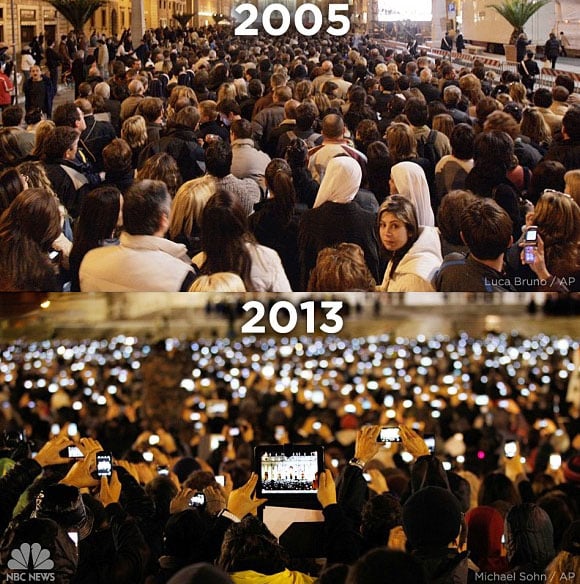
Shortly after the election of Pope Francis in 2013, photos of the crowd awaiting his first appearance were published alongside photos of an earlier crowd awaiting the appearance of Pope Benedict XVI. In 2005, the massive crowd simply stood waiting. Eight years later, they held thousands of phones aloft in order to record what was to come. It seems that, as cameras have become ubiquitous, we seek to chronicle as much as we can, often at the expense of truly experiencing it in the first place. We risk ending up with more photos on our phones than memories in our minds.
In a similar way, on our home visits, we sometimes seek to learn, and write down, everything that can be known, like the gentile in the famous Talmudic story, who demanded to be taught the entire law while standing on one foot. We bring along clipboards holding forms with a hundred boxes that we feel bound and committed to fill, and sometimes begin to focus more on that clipboard than on the person before us, just as so many in that 2013 crowd stared at their cameras instead of Pope Francis. What do they – and we – truly remember from our encounters? What greater understanding do we gain from a page of notes or a picture than what is revealed through an encounter in which we are fully present?
Our Manual reminds us, in the context of confidentiality, that “Because people tend to share personal information more freely with their Vincentian visitors in the relaxed atmosphere of their own homes, Society members should be careful to record only what is essential to serve them.” [Manual, 21] It’s okay to take notes, of course, but the more we record, the more we ensure that very little on our pages of notes will be at all necessary, much less essential, to serve them. As the Manual suggests, the more we record, the less we demonstrate our commitment to confidentiality. In turn, the less we truly respect the dignity of the neighbor
It is possible, in our day and age, to record everything. It is not possible, in any day and age, to experience everything twice. Our home visits are not an occasion to record, but to experience, to listen, and to try to understand. We are not there to inventory lives, or to audit the books, we are there to listen to our neighbors “with [our] hearts, beyond all words and appearances.” [Rule, Part I, 1.11] We “seek to understand them as [we] would a brother or sister.” [Rule, Part I, 1.9]
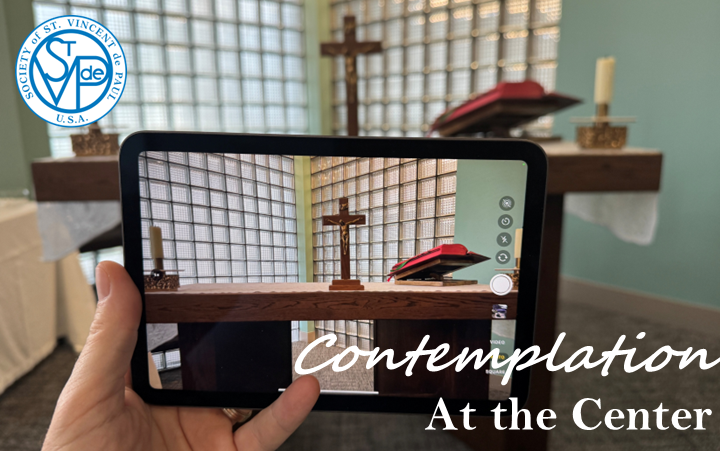
All we really need in order to pay an electric bill is a copy of the bill, but paying a bill is not the most important reason we are there. We are there to form relationships. We are there to share God’s love and Christ’s hope through our loving and humble presence. We do that best not by seeking all the knowledge in the room, but by remembering that God is at its center. This should be easy to remember on a home visit. After all, He is sitting right in front of us.
Contemplate
Do I allow myself to be distracted from the encounter by a desire to “write it all down”?
Recommended Reading
Contemplación: En el centro
Traducción de Sandra Joya
Poco después de la elección del Papa Francisco en 2013, se publicaron fotos de la multitud que esperaba su primera aparición, junto con fotos de una multitud anterior que esperaba la aparición del Papa Benedicto XVI. En 2005, la multitud simplemente esperaba de pie. Ocho años después, sostenían miles de teléfonos en alto para grabar lo que iba a suceder. Parece que, a medida que las cámaras se han vuelto omnipresentes, buscamos documentar todo lo que podemos, a menudo a expensas de experimentarlo realmente en primer lugar. Corremos el riesgo de terminar con más fotos en nuestros teléfonos que recuerdos en nuestra mente.
De manera similar, en nuestras visitas a domicilio, a veces buscamos aprender y anotar todo lo que se puede saber, como el gentil de la famosa historia talmúdica, que exigió que le enseñaran toda la ley mientras estaba parado sobre un solo pie. Llevamos consigo portapapeles con formularios con cien casillas que nos sentimos obligados a llenar, y a veces comenzamos a concentrarnos más en el portapapeles que en la persona que tenemos delante, al igual que muchos en esa multitud de 2013 miraban sus cámaras en lugar del Papa Francisco. ¿Qué recuerdan realmente ellos, y nosotros, de nuestros encuentros? ¿Qué mayor comprensión obtenemos de una página de notas o una fotografía que la que se revela a través de un encuentro en el que estamos plenamente presentes?
Nuestro Manual nos recuerda, en el contexto de la confidencialidad, que “Dado que las personas tienden a compartir información personal con mayor libertad con sus visitantes vicentinos en la atmósfera relajada de sus propios hogares, los miembros de la Sociedad deben tener cuidado de registrar solo lo que es esencial para servirles”. [Manual, 21] Está bien tomar notas, por supuesto, pero cuanto más registramos, más nos aseguramos de que muy poco de lo que anotamos será necesario, y mucho menos esencial, para servirles. Como sugiere el Manual, cuanto más registramos, menos demostramos nuestro compromiso con la confidencialidad. A su vez, menos respetamos verdaderamente la dignidad del prójimo.
Es posible, en nuestra época, grabar todo. No es posible, en ninguna época, experimentar todo dos veces. Nuestras visitas a domicilio no son una ocasión para grabar, sino para experimentar, escuchar e intentar comprender. No estamos allí para hacer un inventario de vidas ni para auditar las cuentas; estamos allí para escuchar a nuestros vecinos «con el corazón, más allá de las palabras y las apariencias». [Regla, Parte I, 1.11] Buscamos comprenderlos «como a un hermano o una hermana». [Regla, Parte I, 1.9]
Para pagar una factura de electricidad, solo necesitamos una copia de la factura, pero pagar una factura no es la razón más importante por la que estamos allí. Estamos allí para forjar relaciones. Estamos allí para compartir el amor de Dios y la esperanza de Cristo a través de nuestra presencia amorosa y humilde. Lo logramos mejor no buscando obtener todo el conocimiento posible, sino recordando que Dios está en el centro de todo. Esto debería ser fácil de recordar durante una visita a domicilio. Después de todo, Él está sentado justo frente a nosotros.
Contemplar
¿Me dejo distraer del encuentro por el deseo de «anotarlo todo»?


 hed people’s hearts. I truly believe that nearly everybody who attended one of his talks left the room feeling…loved.