By Timothy P. Williams, Senior Director of Formation and Leadership Development
It seems to be the central irony of this Vincentian vocation that our Society’s primary purpose is our own growth in holiness. Most, if not all of us join the Society in order to serve others, only to learn later that we are primarily serving ourselves. Blessed Frédéric himself commented on this apparent contradiction. Having explained that our home visits are as much for ourselves as for the neighbor, he suggested that “this motive of personal interest, this egoism at the bottom of our work, might cause it to lose something of your esteem.” [82, to Curnier, 1834]
It does seem backwards if you view it this way. We are called to works of true charity, to give of ourselves “for love alone”, yet we also believe, as Frédéric said, that “visiting the poor should be the means and not the end of our association.” [182, to Lallier, 1838] Read in isolation, this sounds like an instrumentalist view of charitable works, reducing the neighbors to mere objects. Yet nothing could be further from the truth of our calling.
Recall that when asked which is the Greatest Commandment, Christ gave us two: first to love God, and second to love the neighbor just as we love ourselves. These words are echoed in our Catechism’s definition of the virtue of charity. [CCC:1822] Frédéric points out that this call to love of God and neighbor mentions, but “does not prescribe self-love, because it is so innate that it needs to be enlightened, moderated, and not ordained.” [29, to Materne, 1831] In other words, love of self, properly understood, is love for the gift of self that we have received from God, which, like all of His gifts, is meant to be shared.
While a disordered self-love can lead us to pride or vanity, it can also lead us to a false humility, in which “love grows weak, and self-interest hides beneath the false austerity of our disappointment. We are only so unhappy because we love ourselves too much.” [160, to Lallier, 1837] To live our virtue of charity, to answer our Vincentian calling, requires us to love ourselves not as idols, but as creatures made in God’s image, living vessels of God’s love. The Greatest Commandment, Frédéric explained, “is a magnificent law that identifies three principles for human actions: the infinite, immense, boundless love of God; love for one’s neighbor, related to the love of God; and lastly the love of oneself, subordinate to the other two.” [29, to Materne, 1831]
And so, this “central irony” is not ironic at all. Our love of the neighbor is only an expression of our love for God Himself, Who first loved us into being, and wants us to come to Him. We can’t truly love the neighbor without recognizing God’s love in and for ourselves. With this understanding, we can say with Frédéric, “Self-love shall be the basis of my private life, love of my fellow man shall be the basis of my social life, love of God shall soar up above them both, as the first and final principle behind all of my works, the A and Ω.” [Ibid]
Contemplate
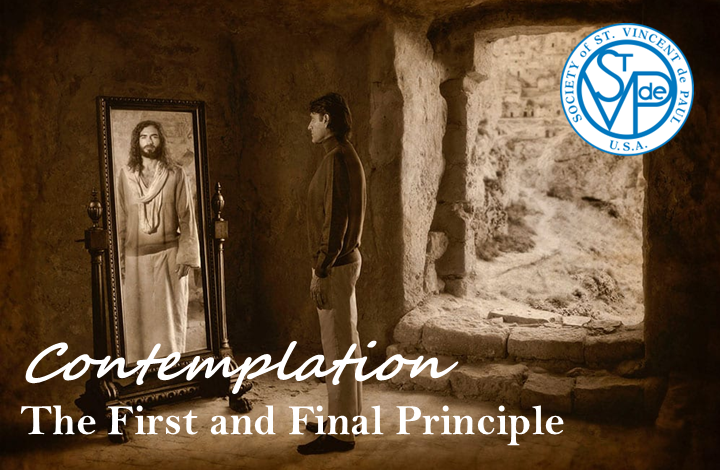
When I look in the mirror, just as when I look at the neighbor, do I see and love the image of God?
Recommended Reading
Letters of Frédéric Ozanam: Earliest Letters
Contemplación: El Primer y Último Principio
Traducción de Sandra Joya
Parece ser la ironía central de esta vocación vicentina que el propósito principal de nuestra Sociedad sea nuestro propio crecimiento en santidad. La mayoría, si no todos, nos unimos a la Sociedad para servir a los demás, solo para descubrir más tarde que, en primer lugar, nos servimos a nosotros mismos. El Beato Frédéric mismo comentó sobre esta aparente contradicción. Después de explicar que nuestras visitas a domicilio son tanto para nosotros como para el prójimo, sugirió que “este motivo de interés personal, este egoísmo en el fondo de nuestra obra, podría hacer que pierda algo de su estima”. [82, a Curnier, 1834]
Parece contradictorio si se ve de esta manera. Estamos llamados a obras de verdadera caridad, a entregarnos “solo por amor”, sin embargo, también creemos, como dijo Frédéric, que “visitar a los pobres debe ser el medio y no el fin de nuestra asociación”. [182, a Lallier, 1838] Leído de forma aislada, esto suena a una visión instrumentalista de las obras de caridad, reduciendo a los prójimos a meros objetos. Sin embargo, nada podría estar más lejos de la verdad de nuestro llamado.
Recordemos que, al preguntarle cuál es el Mandamiento más grande, Cristo nos dio dos: primero, amar a Dios, y segundo, amar al prójimo como a nosotros mismos. Estas palabras se reflejan en la definición de la virtud de la caridad en nuestro Catecismo. [CIC:1822] Frédéric señala que este llamado al amor de Dios y del prójimo menciona, pero “no prescribe el amor propio, porque es tan innato que necesita ser iluminado, moderado y no ordenado”. [29, a Materne, 1831] En otras palabras, el amor propio, bien entendido, es amor por el don de nosotros mismos que hemos recibido de Dios, el cual, como todos sus dones, está destinado a ser compartido.
Si bien un amor propio desordenado puede llevarnos al orgullo o la vanidad, también puede llevarnos a una falsa humildad, en la que “el amor se debilita y el interés propio se esconde bajo la falsa austeridad de nuestra decepción. Solo somos tan infelices porque nos amamos demasiado a nosotros mismos”. [160, a Lallier, 1837] Vivir nuestra virtud de la caridad, responder a nuestra vocación vicentina, nos exige amarnos a nosotros mismos no como ídolos, sino como criaturas hechas a imagen de Dios, recipientes vivos del amor divino. El Mandamiento principal, explicó Frédéric, “es una ley magnífica que identifica tres principios para las acciones humanas: el amor infinito, inmenso e ilimitado de Dios; el amor al prójimo, relacionado con el amor de Dios; y, por último, el amor a uno mismo, subordinado a los dos anteriores”. [29, a Materne, 1831]
Y así, esta “ironía central” no es irónica en absoluto. Nuestro amor al prójimo es solo una expresión de nuestro amor a Dios mismo, quien nos amó primero y nos creó, y desea que volvamos a Él. No podemos amar verdaderamente al prójimo sin reconocer el amor de Dios en nosotros y para nosotros. Con esta comprensión, podemos decir con Frédéric: “El amor propio será la base de mi vida privada, el amor al prójimo será la base de mi vida social, el amor de Dios se elevará por encima de ambos, como el primer y último principio de todas mis obras, el Alfa y la Omega”. [Ibid]
Contemplar
¿Cuando me miro al espejo, al igual que cuando miro al prójimo, ¿veo y amo la imagen de Dios?