
• Search the Site

Posts By :

SVdPUSA

The Saints Who Find and Form Us

The Saints Who Find and Form Us 2195 2195 SVdPUSA

By Tim Williams, Senior Director, Formation & Leadership Development

“We don’t find the saints,” my dear friend Fr. Ronald Ramson likes to say. “They find us.”

St. Vincent, St. Louise, Bl. Frédéric, Bl. Rosalie – all of them, or at least one of them – has found you and led you to this vocation, perhaps in ways you did not even recognize at the time. For me, the call to this vocation came via my wife, who had attended an Invitation to Serve at our parish while I was away on business travel. She signed me up in absentia.

Some years later, I sought to discern what seemed like a much greater commitment: to leave the corporate world and move to a new state to serve full-time as National Formation Director. Amidst my own prayer and reflection, I found God, through the saints, kept nudging me, tapping me on the shoulder, letting me know that this was not only the path I should follow, but was the path I already was on.

Visiting my mother around that time, we went to my father’s grave, where Mom had often expressed comfort in a statue of St. Joseph, patron saint of fathers, who she said stood on a small rise overlooking Dad. When we arrived, I took a closer look and found it was not St. Joseph who had been watching over my father for fifteen years – it was St. Vincent de Paul. I didn’t find him; he always was there.

When I’d joined the Society full-time, my Uncle Denny, my godfather, called me very excitedly to congratulate me, and asked, “Did I ever tell you my confirmation name was Vincent de Paul?” All my life, though I had not known it, my godfather was Vincent de Paul. I didn’t find him; he always was there.

Just last year, as my wife and I celebrated our 40th anniversary, we traveled to an outdoor museum containing historical buildings from around the state. The last time we had visited Old World Wisconsin we were just teenagers, and in the little white church there we made promises we would later keep through our engagement and marriage. We had both forgotten, or perhaps never noticed, that this old wooden church was Catholic, and were pleasantly surprised to notice and that it was named St. Peter – the same name as our current parish. It wasn’t until weeks later, though, reading an old history book in the office, that I turned the page and froze, seeing a 100-year-old photo of a little white church, the church in which the first Conference in Milwaukee (the town where I grew up) had been founded. It was St. Peter Cathedral, the very same little white church that would later mean so much to me and my wife – the very wife who would one day sign me up for the Society of St. Vincent de Paul. I didn’t find him; he always was there.

This vocation, our Rule reminds us, is not just for Conference Meetings and home visits, but for “every moment of our lives.” Let us seek the saints who already have found us, looking both ahead and behind us, in all the events and people in our lives, so that we may better follow their path towards holiness.
2-26-2026 A Letter from Our Servant Leaders

2-26-2026 A Letter from Our Servant Leaders 1200 1200 SVdPUSA

Our Vocation Is Unique

What is it that makes the Society of St. Vincent de Paul unique? What is our purpose? Or, to borrow from Simon Sinek – what is our “WHY?” Is it our focus on good works? There are many organizations, both faith-based and secular, that do good works. Is it our focus on friendship? There are many fraternal organizations that offer the chance for friends to gather together. Is it spirituality? There are many groups that provide a spiritual focus for their members.

So, what is it? Our focus on growing in holiness in fellowship with our brother and sister Vincentians all pointing to serving our neighbors in need gets us closer to the answer. You might even call these the “Essential Elements” of being a Vincentian! Blessed Frédéric and the other founders could have just focused on being very efficient in delivering wood to the homes of the poor. Good work for sure; but if that was their only focus, their “WHY,” then none of us would be Vincentians because the Society of St. Vincent de Paul would not exist and millions of the faithful around the world would not have had this opportunity for spiritual growth. Tens of millions of our neighbors in need likely would not have witnessed Christ’s presence in their lives. It is the emphasis on growing in holiness, to empty ourselves so that we are able to see Christ in our neighbors in need (and our fellow Vincentians), added to the fellowship we have with one another, all leading to our corporal and spiritual works of mercy that makes us unique. We are called by Christ to be His disciples in this Vincentian vocation. Isn’t that wonderful!

Pope Saint John Paul II alludes to this in his Apostolic Exhortation, Christifideles Laici (“Christ’s Faithful Laity”), where he says, “We come to a full sense of the dignity of the lay faithful if we consider the prime and fundamental vocation that the Father assigns to each of them in Jesus Christ through the Holy Spirit: the vocation to holiness, that is, the perfection of charity.” This combination of our vocation to holiness leading to “the perfection of charity” is what sets us apart as an organization. It is my belief that the uniqueness of our vocation is that the Society offers us a means to capture a tangible, authentic, “real world” experience of this call to holiness and perfection of charity (our “WHY”).

Formation

But this vocation isn’t something we experience once and forget about. This is something we will spend the rest of our lives figuring out – being changed in ways we do not yet understand. This is God’s plan!

It is, therefore, critical to not only continue to open ourselves to this call through our prayer life, fellowship and service, but also to continually work on our formation. In fact, the Rule tells us that “It is essential that the Society continually promote the formation and training of its members and Officers, in order to deepen their knowledge of the Society and their spirituality, improve the sensitivity, quality and efficiency of their service to the poor and help them be aware of the benefits, resources and opportunities that are available for the poor. The Society also offers members higher training in order to better help to raise the cultural and social level of those who request this support. [3.12]”

But we need to always help each other understand this vocation we have and, frankly, the challenges involved. We can reassure one another that we are together and that staying with formation prepares us for our mission – to meet Christ in those in need.

I recently had the pleasure of being one of the presenters of an Ozanam Orientation for a brand new conference in South Carolina. Not only is this a new conference but it is also a relatively new church parish that was looking for a way to do outreach – and they decided to form a St. Vincent de Paul conference! What a blessing to see new Vincentians on fire as they begin their vocation!  It is up to us as “experienced” Vincentians to help them and all newcomers grow in holiness; to grow in our perfection of charity, to grow in our Vocation.

Your National Council, through the leadership of Aldo Barletta (National Vice President of Vincentian Spiritual Growth and Enrichment) and others, want to help you in this process by broadening and expanding available formation and training material, programs, and tools for our Vincentian Pathways. This includes exploring revising the Ozanam Orientation and its delivery, Invitation for Renewal, highlighting a Formation Day at the National Assembly, emphasizing training of Spiritual Advisors (English and Spanish speaking) across the country, utilizing Fred Talks and the Ozanam Institute (https://www.ozanaminstitute.org/), and more. Your Technology Committee is also working to implement modern technologies to facilitate delivery of formation materials to you when you need them. I hope to have more to come on that later this year.

Pope Francis, in his Apostolic Exhortation, Evangelii Gaudium (“The Joy of the Gospel”), wrote, “We need to help others to realize that the only way is to learn how to encounter others with the right attitude, which is to accept and esteem them as companions along the way, without interior resistance. Better yet, it means learning to find Jesus in the faces of others, in their voices, in their pleas.” And so it is, my Vincentian brothers and sisters, that the essence, the uniqueness – the “WHY” – of the Society of St. Vincent de Paul is that it provides you and me a way to personally encounter Jesus in a real, tangible manner.

May we help one another remain formed in this message!

Yours in Blessed Frédéric,

Brian

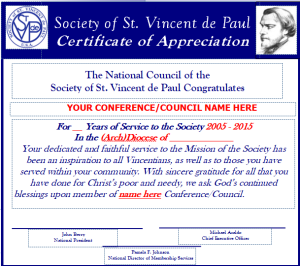
Apply for a National Council Certificate of Appreciation

Apply for a National Council Certificate of Appreciation 1000 667 SVdPUSA

By Pamela Hudson Johnson, National Senior Director of Membership Services, SVdP USA

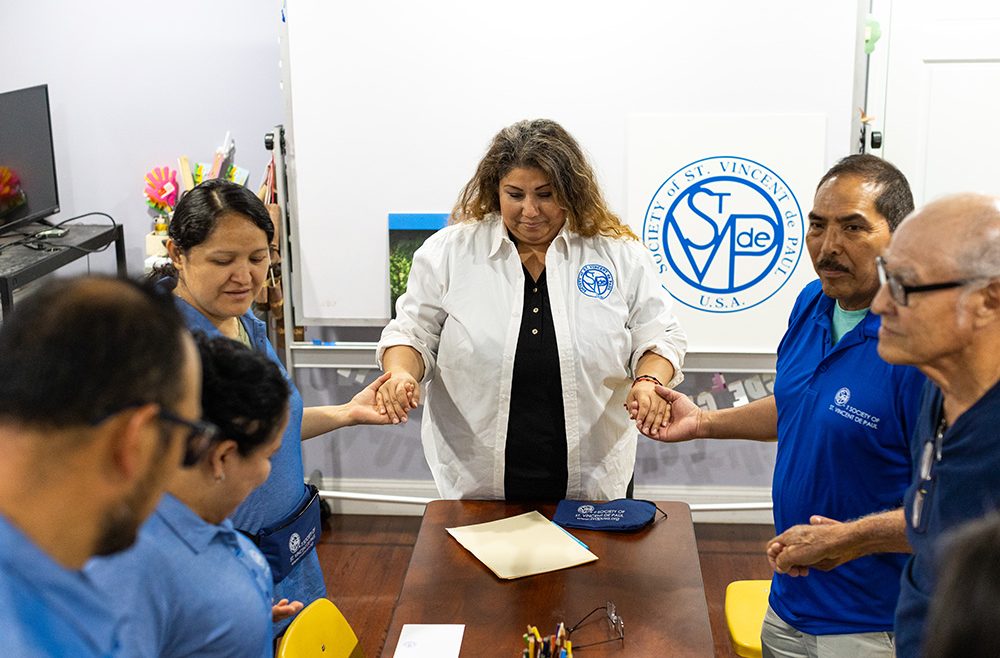
For generations, Vincentians of the Society of St. Vincent de Paul have faithfully served neighbors in need – quietly, consistently, and with deep love for Christ. The National Council Certificate of Appreciation is a program that commemorates Conferences and Councils whose years of service have been acknowledged by the Council General International (CGI). It offers a meaningful way to mark important milestones and to celebrate the enduring Vincentian presence in local communities across the country.

The impact of this recognition goes beyond a framed certificate. Whether your Conference or Council has served for a decade, 100 years, or more, the Certificate of Appreciation affirms a legacy of charity since the founding of SVdP in 1833. It highlights the countless Home Visits, food boxes, prayers, and acts of compassion that have strengthened communities and brought hope to vulnerable neighbors. For many members, receiving a certificate also sparks renewed appreciation for their Conference’s history and its longstanding commitment to serving Christ in the poor.

Past recipients include:

  • SVdP St. Joseph Conference (Arlington, Texas) – 20 Years of Service
  • SVdP Denver Metro Council (Denver, Colo.) – 135 Years of Service
  • SVdP St. Margaret Mary Catholic Church (Cedar Park, Texas) – 20 Years of Service
  • SVdP St. Peter Catholic Church (Mt. Clemens, Mo.) – 100 Years of Service
  • SVdP Council of Fond du Lac County (Fond du Lac, Wisc.) – 75 Years of Service
  • SVdP St. Francis of Assisi Conference (St. Michael, Minn.) – 10 Years of Service

Sometimes, the simple act of being seen strengthens faith and deepens commitment. This certificate program serves as a visible sign of gratitude – and a reminder that every act of charity contributes to a much larger Vincentian legacy.

How to Apply

The criteria for receiving these certificates are as follows:

  • Conferences must be Aggregated / Councils must be Instituted
  • Current year Annual Report must be filed
  • Solidarity Contributions must be current

If your Conference or Council is celebrating a milestone in years of service and would like to receive a National Council Certificate of Appreciation, please contact the Membership Services Department at membership@svdpusa.org.

Let us celebrate your years of faithful service and the countless lives touched through your Vincentian vocation.

2-19-26 Monthly Questions & Answers

2-19-26 Monthly Questions & Answers 1200 628 SVdPUSA

February 19, 2026

Q: When soliciting funds from various sources, who in the SVdP chain of command is authorized to sign contracts? Should a copy of this contract be filed with the District Council or Archdiocesan Council?

A: It is the holder of the EIN (District or (Arch)Diocesan Council) that should authorize contracts.  The owner of the EIN can authorize a specific person(s) such as the president and/or executive director to sign on behalf of the Council. A copy of the contract should be filed with the EIN Council owner. Your bylaws should also reflect signatory authority by person and amount limits.

P: Al solicitar fondos de diversas fuentes, ?qui?n en la cadena de mando de SVdP est? autorizado a firmar contratos? ?Se debe presentar una copia de este contrato ante el Consejo de Distrito o el Consejo Arquidiocesano?

R: Es el titular del EIN (Consejo Distrital o Diocesano) el que debe autorizar los contratos.  El propietario del EIN puede autorizar a una persona o personas espec?ficas, como el Presidente y/o el Director Ejecutivo, para firmar en nombre del Consejo. Se debe presentar una copia del contrato ante el del Consejo propietario del EIN. Sus estatutos tambi?n deben reflejar la autoridad del firmante y los l?mites de cantidad.

Q: The definition of memberships is somewhat vague in the Manual. Does National have any additional guidelines on what constitutes a full voting member of a Conference, especially on how many meetings members need to attend to maintain active status?

A: The Rule, Part III, Statute 3 identifies clearly the membership types. There is nothing in the Rule that specifies who is eligible to vote. However, in the Nationally Approved Bylaws for Conferences, it states that each Active Member is entitled to one vote, and that vote must be cast in person. The Rule does say an Active Member must be Catholic, attend meetings on a regular basis, and provide person-to-person service to those in need. A true Active Member will make an effort to attend all meetings, will want to be with fellow Vincentians as often as possible, and will attend the far majority of all meetings.

P: La definici?n de membres?as es algo vaga en el Manual. ?La Oficina Nacional tiene alguna pauta adicional sobre lo que constituye un miembro con derecho a voto de una Conferencia, especialmente sobre cu?ntas reuniones deben asistir los miembros para mantener el estado activo?

R: La Regla, Parte III, Estatuto 3 identifica claramente los tipos de miembros. No hay nada en la Regla que especifique qui?n es elegible para votar. Sin embargo, en los Estatutos Aprobados a Nivel Nacional para las Conferencias, se establece que cada Miembro Activo tiene derecho a un voto, y ese voto debe ser emitido en persona. La Regla dice que un Miembro Activo debe ser cat?lico, asistir a las reuniones de manera regular y brindar servicio personal a las personas en necesidad. Un verdadero Miembro Activo se esforzar? por asistir a todas las reuniones, querr? estar con otros Vicentinos tan a menudo como sea posible y asistir? a la gran mayor?a de todas las reuniones.

2-19-2026 A Letter from Our Servant Leaders

2-19-2026 A Letter from Our Servant Leaders 1200 1200 SVdPUSA

A Reminder This Lent: Be Friends in Christ

Dear Vincentian Friends:

As we begin this season of Lent, I am drawn to one of the most important, yet often least discussed, essential elements of our Vincentian vocation: friendship. The Rule of the Society names it alongside service and spirituality as one of the three pillars of our identity. Friendship is not simply a coincidental byproduct of our work; it is a sacred method of evangelization, a sign that God is present among us in the simple acts of human connection.

Last Sunday, we heard in the Gospel (Matthew 5:17–37) Jesus’ teaching about the law and true righteousness. He tells His listeners that He has not come to abolish the law but to fulfill it, to reveal its deepest meaning. Every commandment, He explains, points beyond external obedience to interior conversion. It is not enough to avoid murder; one must also renounce anger. Not enough to refrain from adultery; one must also purify the heart. Jesus calls His followers to reconciliation before offering their gifts at the altar, urging them to settle differences quickly and speak truthfully. His words remind us that holiness is rooted in relationship; that friendship, forgiveness, and integrity are themselves forms of worship.

For Vincentians, this is our model for the essential element of friendship. Like Christ, we are invited not to stand apart but to reach out in friendship, even, especially, when doing so might expose us to discomfort. True friendship, after all, is not developed only in pleasant moments but also in shared suffering, honesty, and compassion.

Pope Leo tells us in his February 13, 2026 message on Lenten abstinence that the season is not merely about refraining from physical indulgence, but about freeing the heart to love. “Let us begin by disarming our language, avoiding harsh words and rash judgement, refraining from slander and speaking ill of those who are not present and cannot defend themselves,” he said. “Instead, let us strive to measure our words and cultivate kindness and respect in our families, among our friends, at work, on social media, in political debates, in the media and in Christian communities.” “Abstinence,” he writes, “is the schooling of charity.” By tempering our appetites and pausing from excess, we learn again to hunger for the good of others.

In that light, Lent is an ideal time to renew our practice of friendship; within our Conferences, among fellow Vincentians, and with those we serve. We might abstain not just from food but from speaking ill of one another. We might give up impatience, sarcasm, or the urge to win every disagreement. These fasts are more difficult than skipping a meal, but they heal the soul in precisely the same way.

And heaven knows, our modern world sorely needs such healing.

We live in a moment when public discourse has become alarmingly dysfunctional. Our national conversations, be they political, social, even ecclesial, are all too often dominated by noise, anger, suspicion, and contempt. Digital connections abound, yet genuine friendship is rare. Loneliness is rampant, especially among the young. Many have forgotten what it means to listen, to disagree charitably, or to love someone whose opinions differ from our own.

This culture of division has crept into every aspect of life, and the Church is not immune. Vincentians, too, can feel its strain: differing philosophies about advocacy and charity, tensions between new ideas and tradition, or simple fatigue that dulls our charity, creates judgmental thinking and fosters burnout. But the Society of St. Vincent de Paul was born in a turbulent century, and its founders faced similar storms. Blessed Frédéric Ozanam understood that Christian friendship – real, face-to-face, humble, and attentive – is the antidote to the bitterness of public life.

If we wish to make the love of Christ visible in our world, we must begin by modeling a better way of relating to one another. Because friendship must be where charity begins.

Friendship within the Society has a distinctive shape. It is not based on mere sentiment or shared hobbies, but on shared mission and faith. When we meet as members, we begin and end in prayer, not as a formality but as a sign that Christ is the third person in our conversation. In Him, ordinary human friendship becomes something divine, a participation in God’s own love, offered freely and without condition.

So how might we deepen that friendship this Lent?  Here are four ideas for you.

  • By revisiting our Conference meetings with a renewed spirit of patience and hospitality. Let every voice be heard; let disagreements be guided by gentleness.
  • By reaching out personally to a Vincentian who has drifted away. A private phone call, a handwritten note, or an invitation to share a simple Lenten meal.
  • By encountering our neighbors in need not as caseworkers but as companions. By listening to their stories. Remembering their names. Letting them see, in our eyes, the face of Christ.
  • By praying together intentionally, not only before and after meetings, and not by rushing through the Spiritual Reflection so we can get to the ‘business’ and keep the meeting to an hour, but in genuine intercession for each other’s burdens and joys.

Such acts of friendship may seem small, but in a secular society that prizes debate over dialogue, and competition over compassion, Vincentian friendship is a quiet revolution. It is evidence that the Kingdom of God is already breaking through the noise.

When Vincentians cultivate friendship, authentic Christ-centered friendship, it becomes the most credible witness to the Gospel we can offer. Our neighbors do not need political arguments or theological lectures; they need love and mercy made tangible through human kindness. To touch another person’s suffering, without judgment and without fear, is to act as Christ would act.

Lent challenges us to humility, which is friendship’s greatest ally. It takes humility to admit we need others, to ask forgiveness, to listen without defending our pride. But humility is not weakness; it is strength disciplined by love. Pope Leo’s reminder about abstinence points us again to this truth: the self-denial of Lent is meant to make room for the abundance of grace.

So perhaps this Lent we might each take up one simple practice: to be a reconciling presence in our corner of the world. When faced with tension in our community, we can choose calm over outrage, understanding over accusation, conversation over condemnation. Each time we do, we bear witness to divine friendship, and in doing so, we restore both relationship and peace.

This is the heart of Vincentian life. To be friends in Christ is our identity, our method, and our mission. As we encounter and accompany one another through Lent toward Easter, let us remember that when friendship and charity meet, Christ is present.

Peace and God’s blessings,

John

Michael Acaldo

2-12-2026 A Letter from Our Servant Leaders

2-12-2026 A Letter from Our Servant Leaders 1200 1200 SVdPUSA

The Power of Vincentian Prayer and Action

It’s hard to believe that a month and a half of 2026 has already passed. Time goes by so quickly in today’s world, and we all   must be on our spiritual toes to keep our focus on our mission.

Our Conferences and Councils are making our Vincentian mission come to life by growing together in friendship and holiness while we serve an ever-growing number of our neighbors in need.  Rent, utilities and costs continue to increase at historic levels, which puts additional strain on those we are blessed to serve.

I am so blessed to be in my 38th year of being a part of our mission. The ability to visit around the country has been a great blessing for me to witness Vincentians that are generous with their time, possessions, and most importantly, the gift of themselves in our mission of charity. Thank you for being so generous!!!

As you all know, we are a grassroots organization, so for us, everything starts at the Conference level. At the National Council, our Board of Directors is working so hard for you! Witnessing their dedication to our mission has also been such a blessing to me!

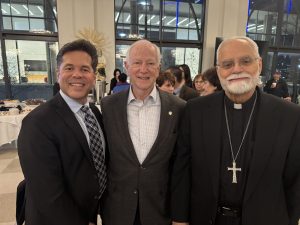
We just had our most recent Board meeting in Dallas which coincided with the 70th Anniversary of the Society in that wonderful Diocese. Our Board was able to meet Council President Harry Storey, Chief Executive Officer Luis Gonzalez, and other Vincentians from around North Texas.

It was great to be there to celebrate with these fine Vincentians. I was blessed to be reunited with a Vincentian that I had not seen in many years – Hank Hermann.

Archbishop Andrew E. Bellisario, C.M. with Hank Hermann and Michael Acaldo

I met Hank over 25 years ago, when he reached out to the Society in Baton Rouge about our Community Pharmacy. Like you, Hank has a Vincentian heart that can’t just make a home visit and be alright with seeing a need and ignoring it. He saw families and the elderly struggling with the question: do I pay my rent or for my prescription medicine?

Because of Hank’s commitment to his “Christian calling to seek and find the forgotten the suffering or the deprived,” he got his brother and sister Vincentians to pray for and support this new special work opportunity!

It was not easy. Hank spent years working with state legislators to establish the legal framework for a freestanding charitable pharmacy that could serve any patient, regardless of their healthcare provider.

Hank was a Voice for the Poor – his efforts enlightened state leaders. He helped change laws so the Society could bring Christ’s love to those in need. Since opening in 2018, the Society’s pharmacy has distributed over $139 million in free prescriptions to needy patients throughout the state of Texas.

Our Board Meeting in Dallas was focused on our future. How can we position every Conference and Council to be even more successful in bringing our Vincentian mission to life? Whether through special works – like charitable pharmacies, motel to home programs, or thrift stores – better use of technology, or success in fund development, the Board’s focus was on the future of our Society.

At the end of our Board meeting, Archbishop Andrew Bellisario, C.M., our National Episcopal Advisor, shared that our relationship with God is so important, and prayer is how we constantly grow closer to Him. He observed the Board’s passion for our mission, and reminded us to always focus on growing in holiness.

After a great meeting in Dallas, I flew down to Houston for a meeting of over fifty SVdP Executives from around the country. These leaders gathered to grow in their spiritual journeys to better serve our Society. It was a wonderful meeting that also focused on the importance of prayer.

Jill Lynch-Sosa, Executive Director of SVdP Omaha, and Ralph May, Executive Director of SVdP Southwest Idaho, (both members of our National Board) did a great job leading this meeting. The meeting kicked off with a spiritual presentation by Bill Gosse, Executive Director of SVdP Green Bay, Wisc. He shared the power of growing closer to Christ each day through an active prayer life.

God has blessed each Vincentian with so many gifts and talents. Thank you all for your work to make our Vincentian mission come to life in your communities!

Inspired by Archbishop Bellisario and our Vincentian leaders, and most of all, by the Holy Spirit, I ask you to pray for our Society and for those we serve. St. Vincent de Paul cautioned that without prayer we “will do little or nothing useful.” Let’s unite our prayers to ask that God would renew our Society and our world in simplicity, humility, gentleness, selflessness, and zeal.

Best wishes in Christ,

Michael

2-5-2026 A Letter from Our Servant Leaders

2-5-2026 A Letter from Our Servant Leaders 1200 1200 SVdPUSA

Love That Listens, Loves That Endures

My Dear Vincentian Sisters and Brothers,

In case your calendar hasn’t told you yet, Valentine’s Day is next week. (You’re welcome if I just kept you from being in BIG trouble with your significant other!) That means the stores will be filled with red hearts, chocolates, and cards with sweet messages, and there will be maybe a bit of pressure to “prove” our love with the right gesture at the right time. But beyond all the dinners, roses and romance, this day has a much deeper story, one that, I believe, speaks directly to who we are as Vincentians and to the way we love Christ in those who are poor.

Historically, Valentine’s Day is linked to Saint Valentine, a Christian martyr remembered not for candy, but for courageous love. Over time, the Church’s memory of a faithful disciple’s love for Christ became intertwined with the human desire to love and be loved, to belong to someone and to know that our life matters to another. At its best, Valentine’s Day asks a very spiritual question: “Who has your heart, and how do they know?”

The Gospel answers that question in a way that challenges us. Jesus tells us that our love for God is proven not only in prayer and worship, but in how we love our neighbor: “The second is this, ‘You shall love your neighbor as yourself.’ There is no commandment greater than these” (Mark 12:31). Saint John goes even further: “Little children, let us love, not in word or speech, but in truth and action” (1 John 3:18).

On Valentine’s Day, when the whole world is talking about love, we have a chance to remember that Christian love is more than a feeling. It is a decision, a way of life, a concrete choice to seek the good of another; even when there is no ‘thank you,’ no bouquet of roses, no card in return.

That kind of love is exactly how we live through our vocation as Vincentians. Saint Vincent de Paul was clear that it is not enough to say we love God and the poor; our love must move our feet, our hands, and our hearts. “It is not sufficient for me to love God if I do not love my neighbor. I belong to God and the poor.”

Vincent knew that charity was not simply about giving things, but about giving ourselves. One famous line attributed to him captures this beautifully: “It is only for your love alone that the poor will forgive you the bread you give to them.” In other words, people in need can find food, clothing, or help in many places, but what they are most hungry for is the love, respect, and dignity that you bring with you.

Scripture reinforces this. In Proverbs we read, “Whoever is kind to the poor lends to the Lord, and he will reward them for what they have done” (Proverbs 19:17). Matthew teaches us that Jesus himself made it clear that in serving the least, we serve him: “Whatever you did for one of the least of these brothers and sisters of mine, you did for me” (Matthew 25:40). That is the deepest “Valentine” of all: the Lord identifies himself with the poor and says, ‘If you love me, you will love them.’

Blessed Frédéric Ozanam understood that love was never meant to stay locked in our hearts; it must overflow into friendship, community, and service. Writing about the early days of the Society, he explained that God placed in our souls not only a need for family, but also a need for friends and relationships built on shared faith and purpose. The strongest bond, he said, is charity itself, and “charity cannot exist in the hearts of several without gushing over; it is a fire which is extinguished without nourishment, and the nourishment of charity is good works.”

For Frédéric, love was never just inward or private. The group of young students who gathered in Paris and formed the Society did not simply want to reassure each other that they believed; they wanted to prove their love of Christ by loving the poor. Out of that desire came what Ozanam called “a universal network of charity,” a vision he carried in his heart; to unite the world in a single network of love and justice.

That same fire burns in you when you leave your home to make a visit, when you listen patiently to someone’s story, when you defend the dignity of a neighbor who has been dismissed or ignored. You are the modern answer to Frédéric’s youthful dream.

So, what does all this have to do with Valentine’s Day next week? The world measures love in gifts and grand gestures; but Vincentian love is measured in presence, patience, and perseverance. Think for

  • You give the gift of time, often the most precious thing you have to offer. In a culture that is always rushing, you slow down enough to sit, listen, and really see the person in front of you.
  • You give the gift of dignity, making sure that your neighbor is treated as a guest, not a case number, because, as Saint Vincent said, “Charity is the cement which binds communities to God and persons to one another.”
  • You give the gift of hope, reminding people who are discouraged that God has not forgotten them, that the Church stands with them, and that there is a community ready to walk beside them.

Sometimes, love feels like a glow in the heart. Other times, as Vincent admitted, “Charity is a heavy burden to carry, heavier than the kettle of soup and the full basket.” Yet he encouraged his followers to keep their gentleness and their smile, because our neighbors are “terribly sensitive and exacting masters,” and the more difficult the encounter, “the more love you must give them.”

On the Valentine holiday next week, when love will often be portrayed as effortless and glamorous, you will embody the kind of love that rolls up its sleeves, accepts the weight of another’s suffering, and keeps going.

An Invitation for this Valentine’s Day

So, as Valentine’s Day approaches, I invite you to see it as more than a date on the calendar. Let it be a small examen of the heart for each of us as Vincentians.

  • Is there a neighbor in need whom I have grown impatient with or discouraged about, maybe someone Christ is asking me to love again, more patiently, more tenderly?
  • Is there a fellow Vincentian I need to encourage, thank, or reconcile with, so that our friendship in Christ shines more brightly?
  • Is there a family member or friend who needs to hear, in simple words, “I love you, and I’m grateful for you,” so that the charity we show outside the home is also alive within it?

Saint Paul reminds us of what Christian love looks like in real life: “Love is patient; love is kind; love is not envious or boastful or arrogant or rude… It bears all things, believes all things, hopes all things, endures all things” (1 Corinthians 13:4, 7). You bring that passage to life every time you knock on a door, answer a phone, pack a food box, or sit with someone who is lonely.

My prayer for you this Valentine’s Day is simple: that you will know how deeply you are loved by God; that you will feel the gratitude of the Church and of the Society; and that you will find renewed joy in the quiet, often hidden ways you live the Gospel of love. As one modern reflection found on Hallow about Saint Vincent puts it, to love generously is to “serve without expecting some reward… to be solely concerned about giving; to give our whole self.”

Thank you for the countless “Valentines” you have already given in Christ’s name, acts of love that will never be printed on a card or posted on social media, but which are, instead, written forever in the heart of God.

With gratitude and affection in Christ,

John


1-29-2026 A Letter from Our Servant Leaders

1-29-2026 A Letter from Our Servant Leaders 1200 1200 SVdPUSA

Winners, Losers, and the Wisdom of God

We’re back in the National Football League playoffs, that short championship season that ends this Sunday in Santa Clara, California. Unlike the Fourth of July or Thanksgiving, Super Bowl Sunday is truly America’s civic high holy day – the one moment each year when we all come together in a vast liturgical celebration of what we most long to be: winners. I spend the two weeks preceding the game listening to sports talk radio or perusing online analyses of the contest. And on the day itself, I tune in to watch nearly the whole broadcast, including the extensive pre-game coverage. The entire spectacle is on view every year: the Via Sacra of Super Bowl Boulevard, the handsome celebrities and preening politicians, the ersatz patriotism, the heart-tugging commercials, and the procession of larger-than-life players into the stadium. There is always the grandiose halftime show, the arrival of the mystical Lombardi Trophy, the euphoric coronation of the victors, and the ritual banishment of the losers. And then, suddenly, the gauzy morning after, the awful truth sets in that the football season is over, leaving nothing but baseball and boredom until late summer.

A few years ago, Super Bowl Sunday fell on the Feast of the Presentation of the Lord. At my parish, we welcomed a guest celebrant: Fr. Michael Marigliano, OFM Cap, a Franciscan friar. Fr. Michael pointed out that in stark contrast to the Super Bowl, all the figures in the Presentation narrative would have been considered losers in their historical context: Simeon, an odd old man obsessed by a private revelation; Anna, an elderly widow who spent her nights huddled in dark corners of the temple; Joseph and Mary, making their way across the temple courtyard with their pitiful two pigeons for sacrifice; and the forty day-old Jesus, the speechless Word of God, soon to be a refugee hunted by Herod’s death squads. Taken together, the five of them didn’t amount to much – losers in the world’s calculus of success and failure, without power, wealth, fame, or nobility.

In 1990, during an address to the American Humanist Association, media magnate Ted Turner famously called Christianity “a religion for losers.” Turner later apologized, but his declaration has been echoed by worldly wisdom since our Lord walked among us. The temple leadership in first century Jerusalem deplored the motley collection of hicks and sinners who followed Jesus and shared his weird solicitude for women, outsiders, the unclean, and the ritually impure. The Romans at first ridiculed and later feared Christianity as a religion of slaves and the poor – a loser’s faith. To the 19th Century philosopher Nietzsche, “Christianity was from the beginning, essentially and fundamentally, life’s nausea and disgust with life, merely concealed behind, masked by, dressed up as, faith in ‘another’ or ‘better’ life.” Paradoxically, that view was shared by both Karl Marx, who saw Christianity as “the sigh of the oppressed creature,” and Ayn Rand, who scorned it as an immoral weapon wielded by takers against makers.

But, you know, Ted Turner was right! Christianity is a religion for losers and therein lays the divine wisdom that confounds the wisdom of this world. As St. Paul reminded the ragtag collection of slaves, women, and the poor who constituted the early Church: “Consider your own calling, brothers. Not many of you were wise by human standards; not many were powerful; not many were of noble birth. Rather, God chose the foolish of the world to shame the wise, and God chose the weak of the world to shame the strong, and God chose the lowly and despised of the world, those who count for nothing, to reduce to nothing those who are something, so that no human being might boast before God. It is due to him that you are in Christ Jesus, who became for us wisdom from God, as well as righteousness, sanctification, and redemption, so that, as it is written, ‘Whoever boasts, should boast in the Lord’” (I Corinthians 1:26-31).

The truth is that God doesn’t care who wins or loses a football game (though a majority of Americans apparently think he’s got something to do with it). God doesn’t care who’s rich and who’s poor, or who wields power and who doesn’t. What God wants us to know is that apart from grace we are all powerless, that we have all suffered losses only He can restore. Regardless of our station or net worth, we’re all called to appropriate the beautiful words of the old hymn, written by Isaac Watts: “When I survey the wondrous cross / On which the prince of glory died / My richest gain I count as loss / And pour contempt on all my pride.”

This, at bottom, is the source of the Church’s “preferential option for the poor,” which could (and perhaps should) be amended to read, “preferential option for losers.” As Vincentians, we recognize ourselves in the need and powerlessness of those we serve. In identifying with those the world considers losers, we acknowledge the truth of who we are in relation to God. And in serving others, we imitate what God did for us in Christ. But the wisdom of God goes even deeper than that – in embracing our loss, in identifying with the poor, “we are more than conquerors through him who loved us” (Romans 8:37). God turns the wisdom of the world on its head, so that “many who are first will be last and the last will be first” (Matthew 19:30).

In the Presentation narrative, Simeon thanks God for revealing Jesus, whom he calls “a light to the nations.” A couple of millennia later, the poet Leonard Cohen wrote, “Ring the bells that still can ring / Forget your perfect offering / There is a crack, a crack in everything / That’s how the light gets in.” God doesn’t want or expect a perfect offering from us; we couldn’t give it anyway. He takes us as we are, with our cracks and broken pieces, ready to receive His light. On Sunday, I’ll be sitting in my favorite place with friends watching this year’s Super Bowl. We’ll eat some wings and join in the festival of competition and winning. But thanks to Fr. Michael Marigliano, O.F.M. Cap., I’ll also remember that at bottom, all of us – me, you, my friends, those we serve, even the players on the winning team, are losers, and thanks be to God for it. Or as we hear at the Easter Vigil, “O happy fault, O necessary sin of Adam, that gained for us so great, so glorious a Redeemer!”

Blessings,

Mark Gordon

1-22-2026 A Letter from Our Servant Leaders

1-22-2026 A Letter from Our Servant Leaders 1200 1200 SVdPUSA

From Transactions to Relationships: A Vincentian Examination of Heart

There is a quiet shift happening in many places that the Society of St. Vincent de Paul cannot ignore. Some forms of our charitable work, even when generous, are drifting from relational to transactional – from presence to process, from shared life to “service delivery.” The Society was never founded to be a distribution system of help, but a living network of faith, friendship, and transformation among and with those who are poor. When our works become an exchange instead of a relationship, we risk losing something essential in our Vincentian identity.

Blessed Frédéric Ozanam and his friends began not with programs, but with people they knew by name. Their response to the cry, “What is the Church doing for the poor?” was not a new project alone, but a new friendship; face-to-face, heart-to-heart. In that spirit, Ozanam echoed St. Vincent in insisting that the poor are our “lords and masters,” not objects of our generosity but partners who reveal Christ to us. The Society exists so that members “may grow in holiness” through personal service and encounter with those in need, not simply through successful events or programs.

This is why both advocacy for the poor and deep personal relationship with them belong at the center of our Society, not at the edges. Church teaching makes clear that poverty is not simply bad luck or personal failure but is often the result of structures and systems that wound human dignity. To love our friends fully, Vincentians must be willing to address not only the emergency they face today, but also the policies, practices, and economic realities that keep them on the margins. At the same time, those realities must never become abstractions that replace actual people. Advocacy must rise from the ground of friendship, from stories we know, hands we have held, and homes we have entered.

Pope Leo’s encyclical ‘Dilexi Te’ speaks with striking clarity to this Vincentian tension between private faith and public witness, between quiet charity and courageous advocacy. He rejects the idea that religion can be confined to the private sphere, insisting that Christian faith has a rightful place in shaping social, economic, and political life. For Pope Leo, love for the poor is not an optional extra or a private hobby of a few generous souls; it is a decisive test of whether a person, a community, or a movement within the Church is authentically living the Gospel.

At the same time, ‘Dilexi Te’ strongly rejects and condemns any narrative that blames the poor for their own poverty. The encyclical insists that the poor “are not there by chance or blind and cruel fate,” nor simply because they failed to work hard enough. Any attitude that treats the poor as undeserving or as a burden is unmasked as “blindness and cruelty.” In this light, Vincentian advocacy is not a political add-on but a moral duty: if systems, laws, or economic arrangements trap our friends in poverty, then charity alone is not enough. Love for them must include the willingness to question and challenge whatever crushes their dignity.

Perhaps most beautifully, ‘Dilexi Te’ reminds the Church that the poor are not a “problem” to be solved but members of our own family. Pope Leo points to a vision of the Church where the poor are welcomed, listened to, and honored; not only because they need us, but because we need them. Their faith, their endurance, and their perspective help the whole Church see reality more truthfully. This matches the deep heart of the Vincentian Charism: when we draw close to those who are poor, we do not simply bring Christ to them; we also receive Christ from them.

Pope Francis warned that the Gospel is not an idea or ideology but a living word that touches and changes hearts. Speaking to grassroots leaders, he praised those who feed, house, and employ the poor, reminding them that “we are not serving an ideology but truly living the Gospel,” and that in the faces and wounds of the poor “is hidden” the face of Christ. Mother Teresa expressed the same truth in her own way: “Our poor people are great people, very lovable people… they don’t need our pity and sympathy, they need our understanding love… our respect; they need that we treat them with dignity.” That is not a service model; that is a relationship.

For Vincentians, the parable of the Good Samaritan offers a wonderful kind of “examination of heart.” The Samaritan does not simply offer quick aid and move on; he stops, draws near, listens, binds wounds, and stays involved. Yet he also forces us to ask: Why is the road itself so dangerous? Who profits from a world where so many are left bleeding by the wayside? Authentic Vincentian holiness holds both dimensions together: the tenderness that kneels beside a neighbor and the truth-telling that questions and challenges unjust structures.

This leads to two simple questions that every conference, council, and Vincentian must prayerfully ask:

  1. Who among the poor do I truly know by name? As more than a “case,” more than a number? We may try to make ourselves feel better by calling them ‘Neighbors in Need’ instead of ‘Clients,’ but that is not truth, it is make-up.
  2. Whose voice do I help raise up when decisions are made that affect housing, work, health, and future for the people we serve? Or do I hide behind the excuse that ‘politics’ is not my thing?

If our answer to the first is thin, our charity may be drifting toward transaction. If our answer to the second is weak, our faith may be retreating into the private sphere. The Society’s charism calls us to strengthen both friendship and justice, closeness and courage, so that the poor are not simply “helped,” but honored, heard, and joined in the work of transforming our communities.

In the end, this is not primarily about strategies but about vision. Do we see the families we serve as “problems to manage,” or as “lords and masters” who bear Christ’s presence and wisdom? Do we design programs around what we think they need, or do we listen until our plans begin “starting from them”? As we let the poor become our friends and teachers, our Society becomes more truly itself, more deeply Vincentian, more clearly evangelical, and more fully a sign of the Kingdom where no one is a stranger and everyone is called by name.

Peace and God’s blessings,

John

1-15-26 Monthly Questions & Answers

1-15-26 Monthly Questions & Answers 1200 628 SVdPUSA

January 15, 2026

Q: Do you know of anywhere that we might find a written history of the Black Bag? Several of our Conferences have asked, but I’m not sure where to look.

A: The secret collection goes back to the beginnings of the Society. In the beginning, the funding for the Conferences came strictly from the members themselves. There was no parish funding, no special collections. The secret collection gave an opportunity for each member to contribute what they could to the works of the Conference without anyone knowing who gave how much. I don’t remember ever seeing anything written about the origins of the Black Bag itself, but it only makes sense that there had to be some type of bag used in order for the members to contribute without others seeing what they gave. Update: On page 87 of the latest printing of “Apostle in a Top Hat,” it indicates the first Conference used a top hat for the secret collection. (Thanks to Deacon Bob Lablanc.) At the first meeting, Devaux was chosen to be the treasurer, and he walked backward with his top hat behind him for the first secret collection.

P: ¿Conoce usted si existe en algún lugar en el que podamos encontrar una historia escrita de la Bolsa Negra? Varias de nuestras Conferencias han preguntado, pero no estoy seguro de dónde buscar.

R: La colecta secreta se remonta a los inicios de la Sociedad. Al principio, la financiación de las Conferencias procedía estrictamente de los propios miembros. No había fondos parroquiales, ni colectas especiales. La colecta secreta dio la oportunidad a cada miembro de contribuir con lo que pudiera a los trabajos de la Conferencia, sin que nadie supiera quién dio cuánto. No recuerdo haber visto nunca nada escrito sobre los orígenes de la Bolsa Negra en sí, pero tiene sentido que tuviera que haber algún tipo de bolsa utilizada para que los miembros contribuyeran sin que otros vieran lo que depositaron. Actualización: En la página 87 de la última impresión de “Apóstol con sombrero de copa”, indica que la primera Conferencia usó un sombrero de copa para la colecta secreta. (Gracias al diácono Bob Lablanc.) En la primera reunión, Devaux fue elegido para ser el tesorero, y caminó hacia atrás con su sombrero de copa detrás de él para la primera colecta secreta.

Q: In Part I of the Rule, it indicates that non-Catholics can serve as officers (secretary or treasurer) and in Part III, it says that only Catholics can be officers. Is there a conflict in the Rule?   

 A: There is no conflict. Part I is the International Rule. Part III of the Rule is associated with the Society in the United States. When Part I was approved internationally each nation was given an option related to non-Catholics holding the officer positions of secretary or treasurer.  The National Council of the United States voted not to allow non-Catholics as officers. Thus, there is no conflict.

P: En la Parte I de la Regla, se indica que los que no son Católicos pueden servir como Oficiales (secretario o tesorero) y en la Parte III, dice que sólo los Católicos pueden ser Oficiales. ¿Hay algún conflicto en la Regla?

R: No existe ningún conflicto. La Parte I es la Regla Internacional. La Parte III de la Regla está asociada con la Sociedad en los Estados Unidos. Cuando la Parte I fue aprobada internacionalmente, a cada nación se le dio una opción relacionada con los que no son Católicos que ocupaban los cargos de Oficiales de secretario o tesorero.  El Consejo Nacional de los Estados Unidos votó para no permitir que los que no son Católicos fueran Oficiales. Por lo tanto, no hay un conflicto.

Sign Up for Our Newsletter

Privacy Preferences

When you visit our website, it may store information through your browser from specific services, usually in the form of cookies. Here you can change your Privacy preferences. It is worth noting that blocking some types of cookies may impact your experience on our website and the services we are able to offer.

Click to enable/disable Google Analytics tracking code.
Click to enable/disable Google Fonts.
Click to enable/disable Google Maps.
Click to enable/disable video embeds.
Our website uses cookies, mainly from 3rd party services. Define your Privacy Preferences and/or agree to our use of cookies.
Skip to content